
Light Therapy Lamp for Seasonal Depression: What 10,000 Lux Really Means and How to Use One
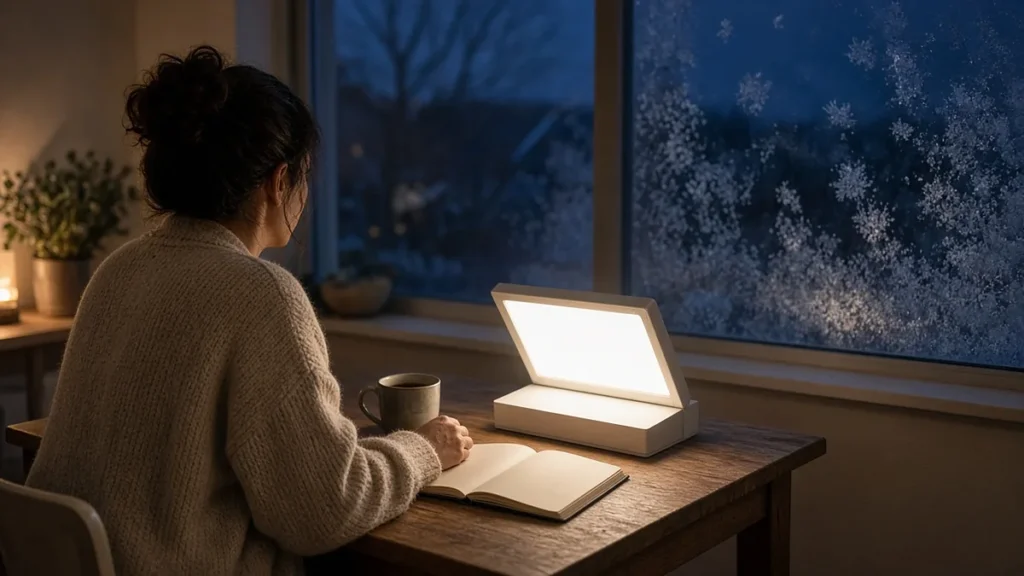
It's 7 a.m., still dark, and you've hit snooze three times. You're craving toast at 10, crashing by 3, and the things you usually love feel like chores. If that pattern shows up every fall and lifts every spring, a light therapy lamp for seasonal depression is one of the few tools with decades of research behind it. The catch is that most lamps only hit their "10,000 lux" promise at a distance nobody actually sits at. Here's how to pick one that works, and how to use it so it does.
Affiliate disclosure: As an Amazon Associate, I earn from qualifying purchases. I may also earn from some brand partner links. If you buy through a product link on this page, the price is the same for you. Read the full disclosure.
- Do light therapy lamps actually work?
- What 10,000 lux really means (and why distance matters more than the box)
- Best light therapy lamps for seasonal depression, compared honestly
- How to use a SAD lamp: a 7-step morning routine
- Who should be careful with light therapy
- Vitamin D, dawn simulators and red light: what the evidence says
- Why this hits women harder
- When to see a doctor
- Frequently asked questions
- Do light therapy lamps work for seasonal depression?
- How long should you sit in front of a SAD lamp?
- How far away should a light therapy lamp be?
- What time of day should I use a light therapy lamp?
- Can a SAD lamp give you vitamin D?
- Who should not use a light therapy lamp?
- Is a dawn simulator as good as a light box?
- Why does seasonal depression affect women more?
- Sources
Do light therapy lamps actually work?
For winter-pattern seasonal affective disorder (SAD), yes. The National Institute of Mental Health (NIMH) calls light therapy a mainstay of SAD treatment since the 1980s, and a meta-analysis in the American Journal of Psychiatry (Golden and colleagues, 2005) found that bright light therapy and dawn simulation both reduced symptom severity. When researchers compared light therapy with a SAD-specific version of cognitive behavioral therapy, the two worked about equally well, with CBT's benefits lasting longer over a second winter.
What a lamp can't do is replace care when depression is moderate or severe. Mayo Clinic notes that for some people light therapy works better combined with an antidepressant or talk therapy, and the FDA has approved extended-release bupropion to prevent seasonal depressive episodes when it's started before winter.
Winter blues, holiday stress or SAD?
The NIMH is clear that SAD follows daylight, not the calendar. A rough December because of family, money and a packed schedule is holiday stress, and it improves when January calms down (here's how to handle holiday stress without burning out). SAD comes back in the same season for at least two years in a row, lasts four to five months, and often brings oversleeping, carb cravings, weight gain and wanting to "hibernate."
| Holiday stress | Winter-pattern SAD | |
|---|---|---|
| What drives it | Calendar pressures: family, money, schedule | Shorter daylight |
| When | Around the holidays, improves after | Late fall to spring, about 4–5 months |
| Pattern | Can happen any year | Same season at least 2 years in a row |
| Typical extras | Irritability, poor sleep, overwhelm | Oversleeping, carb cravings, weight gain, withdrawal |
| What helps most | Planning, sharing the load, rest | Light therapy, CBT-SAD, sometimes medication |
What 10,000 lux really means (and why distance matters more than the box)
Lux measures how much light reaches your eyes, not how strong the lamp is. Move away and it drops fast. That's why "10,000 lux" on a box means almost nothing unless it also tells you the distance.
In 2019, Oldham and colleagues measured 24 commercial light therapy devices. Only seven larger light boxes met all three of their clinical criteria. Some devices sold as 10,000-lux lamps reached that number only at "unreasonably close distances," over a narrow field, or with uncomfortable glare. For scale, they note a typical home interior gives 50 to 200 lux and a clear day 10,000 to 30,000.
- Look for a stated distance. SAD researcher Alfred Lewy told Wirecutter that if a manufacturer doesn't say how far from your eyes you get 10,000 lux, he wouldn't use the lamp.
- Bigger light face, more freedom. Research lamps have had an illuminated surface of about one square foot, according to psychiatrist Norman Rosenthal, who first described SAD. A large panel lets you sit at a normal distance and still get the dose.
- UV-filtered, white light. Mayo Clinic says a SAD lamp should produce as little UV as possible. Lamps designed for skin conditions mainly produce UV and can hurt your eyes.
- Not FDA-regulated. Light boxes aren't regulated by the FDA for SAD, so the spec sheet is all you have. Read it.
Best light therapy lamps for seasonal depression, compared honestly
I compared the lamps that show up most when women shop for one this fall, using the 10,000-lux distance each manufacturer or Wirecutter's testing reports. Prices are what I saw on October 20, 2026 and change often, so take them as tiers.
| Lamp | 10,000 lux at | Light face | UV | Price tier | Best for | |
|---|---|---|---|---|---|---|
| Carex Day-Light Elite | 12–14 in | About 15.5 × 13 in | UV-free | $$ (about $190) | Most people; Wirecutter's top pick | Check price |
| Carex Day-Light Classic Plus | 12–14 in | 16 × 13 in | Blocks 100% UV | $$ ($145–$170) | Reading under it; height-adjustable stand | Check price |
| Northern Light Technologies Boxelite | 14 in | About 15.5 × 12.5 in | UV-free | $$$ (about $195–$240) | Warmest light (3,500 K), minimalist look | Check price |
| Verilux HappyLight Luxe | 6 in | About 9 × 6 in | UV-free | $ (about $70) | Small desks, travel, a first lamp | Check price |
| Circadian Optics Lattis | Not stated on the product page | Slim tabletop panel | UV-free | $ (about $70) | Looks; ask the seller for the distance first | Check price |
My pick for most women: if you can make the space, the large Carex lamps are the ones that let you sit at a real breakfast-table distance and still get 10,000 lux. That matters more than any feature, because the lamp only works if you use it every single morning, and nobody keeps a tablet-sized lamp six inches from her face while she eats. The Elite adds a timer and four brightness levels; the Classic Plus is a bit cheaper and taller. See the Carex Day-Light Elite.
On a budget or short on space: the HappyLight Luxe is a decent first lamp, as long as you accept that 10,000 lux only happens at about 6 inches. Wirecutter also measured its light as less powerful than its larger picks. Prop it close while you read emails, or plan on longer sessions. See the HappyLight Luxe.
Searches for Circadian Optics have jumped this fall. It's a good-looking lamp, but the product page I checked doesn't say at what distance it delivers 10,000 lux, which is exactly the number you need. If you love the design, ask the seller first.
How to use a SAD lamp: a 7-step morning routine
- Use it within an hour of waking. That's the window Mayo Clinic recommends, and it's when light helps reset a body clock that drifts later in winter.
- Set the distance from the spec sheet, not by feel. Measure it once with a tape measure and mark the spot on the table.
- Start with 20 to 30 minutes. Mayo Clinic suggests 20 to 30 minutes at 10,000 lux; the NIMH describes 30 to 45. Farther away or on a lower setting, you need longer. Carex, for example, says its 5,000-lux setting takes about an hour.
- Keep your eyes open, but don't stare. Place the lamp slightly above and to the side so light falls toward your eyes while you eat, read or answer messages.
- Glasses are fine; tinted lenses aren't. Regular glasses don't block the dose, but photochromic lenses that darken in light can.
- Be consistent from fall to spring. One session a week won't do much. The NIMH notes people with a history of SAD may benefit from starting before symptoms usually begin.
- Skip it late in the day. Bright light in the evening can push your sleep later.
Headaches and eye strain are the side effects people report most. Move the lamp a little farther away, shorten the session, and tell your doctor if they don't settle in a few days.
Who should be careful with light therapy
- Bipolar disorder: Mayo Clinic warns that increasing exposure too fast or for too long may trigger mania. Use a lamp only with your psychiatrist's plan.
- Eye conditions: glaucoma, cataracts, macular degeneration or diabetic eye damage call for an eye specialist's advice first.
- Light-sensitizing medicines: the NIMH says some medications that increase sensitivity to sunlight may mean you need supervision or another treatment. Ask your pharmacist about yours.
- Migraine or light sensitivity: start at a lower setting and build up, or talk to your doctor about other options.
Vitamin D, dawn simulators and red light: what the evidence says
Vitamin D. A SAD lamp won't raise it. Good lamps filter UV, and your skin needs UVB to make vitamin D. The NIMH lists vitamin D as a possible treatment, but studies have produced mixed results, so a blood test makes more sense than guessing.
Dawn simulators. These bedside lights brighten slowly before your alarm. The 2005 meta-analysis found they reduced SAD symptoms too, and some women find mornings much easier with one. Head-to-head trials against a light box have mixed results, so think of a dawn simulator as a helper rather than a substitute if your symptoms are more than mild.
Red light panels. "Red light for seasonal depression" is a popular search, but SAD research has been done with bright white light boxes. Red light panels are a different product and haven't been shown to treat SAD the way light boxes do.
Why this hits women harder
The NIMH says SAD occurs much more often in women than in men, usually starting in young adulthood, and it's more common the farther you live from the equator, so Alaska and New England see more of it than Florida. Many women also notice mood dips that track their cycle, pregnancy or perimenopause. If winter lows arrived together with irregular periods, night sweats or broken sleep in your 40s, read what perimenopause does to mood and how it's treated, because both can be going on at once.
When to see a doctor
- Low mood, emptiness or loss of interest most days for two weeks or more.
- You're sleeping much more, eating much more or pulling away from people, and it's affecting work or family.
- You have bipolar disorder, an eye condition or take light-sensitizing medicine and want to try a lamp.
- You've used a lamp properly every morning for a few weeks and feel no better.
- Right away: if you have thoughts of death or suicide, call or text 988 (Suicide & Crisis Lifeline) in the US, or 911 in an emergency.
Frequently asked questions
Do light therapy lamps work for seasonal depression?
Yes, for winter-pattern SAD they are a first-line treatment. The NIMH calls light therapy a mainstay since the 1980s, and a 2005 meta-analysis found bright light reduced SAD symptoms. They work best used every morning at the right distance, and some people need therapy or medication as well.
How long should you sit in front of a SAD lamp?
Mayo Clinic suggests about 20 to 30 minutes at 10,000 lux, within the first hour after waking. The NIMH describes 30 to 45 minutes. If your lamp only reaches 10,000 lux up close and you sit farther back, you get less light, so you need more time or a bigger lamp.
How far away should a light therapy lamp be?
Use the distance at which your lamp delivers 10,000 lux, which the manufacturer should state. Mayo Clinic gives 16 to 24 inches as a typical range. Large lamps like the Carex Day-Light Elite reach 10,000 lux at 12 to 14 inches; the small Verilux HappyLight Luxe only at 6 inches.
What time of day should I use a light therapy lamp?
In the morning, ideally within an hour of waking, which is when the research and Mayo Clinic recommend it. Using a bright lamp late in the afternoon or evening can push your body clock later and make it harder to fall asleep, which is the opposite of what you want in winter.
Can a SAD lamp give you vitamin D?
No. Light boxes for SAD filter out ultraviolet light, and your skin needs UVB to make vitamin D, so the lamp won't raise your levels. If you suspect low vitamin D, ask for a blood test. The NIMH notes vitamin D studies for SAD have had mixed results.
Who should not use a light therapy lamp?
Talk to a doctor first if you have bipolar disorder, because bright light can trigger mania, or eye conditions such as glaucoma, cataracts, macular degeneration or diabetic eye damage. The same goes if you take medicines that make you sensitive to light. Lamps made for skin conditions emit UV and are not for SAD.
Is a dawn simulator as good as a light box?
It can help, but it is a different tool. A 2005 meta-analysis found both bright light and dawn simulation reduced SAD symptoms, while head-to-head trials have given mixed results. A dawn simulator makes waking up easier; a 10,000-lux light box is the option with the most research behind it.
Why does seasonal depression affect women more?
The NIMH says SAD occurs much more often in women than in men, and it usually begins in young adulthood. Researchers have not pinned down a single reason. Shorter daylight affects serotonin and melatonin, and hormonal shifts across the menstrual cycle, pregnancy and perimenopause can add to mood symptoms.
This article is for informational purposes and doesn't replace advice from a healthcare professional. Reviewed by Sofía Castillo on October 20, 2026.
Sources
- Seasonal affective disorder treatment: Choosing a light box – Mayo Clinic
- Seasonal Affective Disorder – National Institute of Mental Health (NIMH)
- Oldham MA et al. Commercially available phototherapy devices for treatment of depression: physical characteristics of emitted light. Psychiatric Research and Clinical Practice, 2019
- Golden RN et al. The efficacy of light therapy in the treatment of mood disorders: a meta-analysis. American Journal of Psychiatry, 2005
- The Best Light Therapy Lamp – Wirecutter (updated Nov 18, 2025)
- Carex Day-Light Classic Plus: specifications – Carex
- HappyLight Luxe: specifications – Verilux
- Circadian Optics Lattis: product page – Circadian Optics
- 988 Suicide & Crisis Lifeline
Keep reading
- Holiday stress: a realistic plan for women who do it all
- Perimenopause symptoms and HRT: what actually helps
- Winter dry skin: what actually works
- Creatine for perimenopause: dose, gummies vs powder and the weight myth
- More women's health guides
If you want to read more articles like Light Therapy Lamp for Seasonal Depression: What 10,000 Lux Really Means and How to Use One, check out the Women's Health category.