
Wedding Budget Spreadsheet: Free Template and the Real Percentages (2026)

This free wedding budget spreadsheet splits your total into the percentages couples actually spent, then tracks every quote, deposit and payment. Type in your total and guest count, and it fills in a planned amount for 12 categories using The Knot's 2026 Real Weddings Study. It opens in Excel, and in Google Sheets in two clicks.
Below you'll find the download, how to use it, the full percentage breakdown in dollars at three budget sizes, and why those percentages stop working on a small budget. The study covers 10,474 US couples married in 2025, and every figure here is linked to its source at the bottom of the page.
- Download the free wedding budget spreadsheet
- The real wedding budget breakdown by percentage
- How can I create a wedding budget in Excel?
- How much does the average wedding cost in 2026?
- Why the percentages break on a small budget
- Is ,000 a small wedding budget?
- Is 00 a good budget for a wedding?
- What is the 50/30/20 rule for weddings?
- Costs that sit outside the percentages
- Where to cut first
- Your first money talk
- Mistakes that blow a wedding budget
- Frequently asked questions
- What percentage of a wedding budget should go to the venue?
- How much does a wedding cost per guest?
- Does this wedding budget spreadsheet work in Google Sheets?
- Is the wedding budget template really free?
- How much should I set aside for surprises and tips?
- How much does a wedding cost for 50 guests?
- Why do The Knot and Zola report different average wedding costs?
- Can I use this spreadsheet if I am having a courthouse wedding?
- Sources
Download the free wedding budget spreadsheet
Download the wedding budget spreadsheet (.xlsx, free, no sign-up)
- Start Here: your total budget, guest count and cushion go in the yellow cells. It shows what is planned, quoted, spent and left, and tells you if you are over.
- Budget: 12 categories with The Knot percentages already filled in, a "Fixed" or "Per guest" label on each, columns for estimate, actual, paid and balance due, and a red flag when a line goes over its plan.
- Guest Count: the cost of one more guest and a what-if table from 20 to 150 guests.
- Payments: a log of deposits and due dates that turns red when a payment is late.
To use it in Google Sheets, upload the file to Google Drive, open it, and choose File, then Save as Google Sheets. Everything carries over. If anything looks off, the Start Here tab has a reminder of how each tab works.
The real wedding budget breakdown by percentage
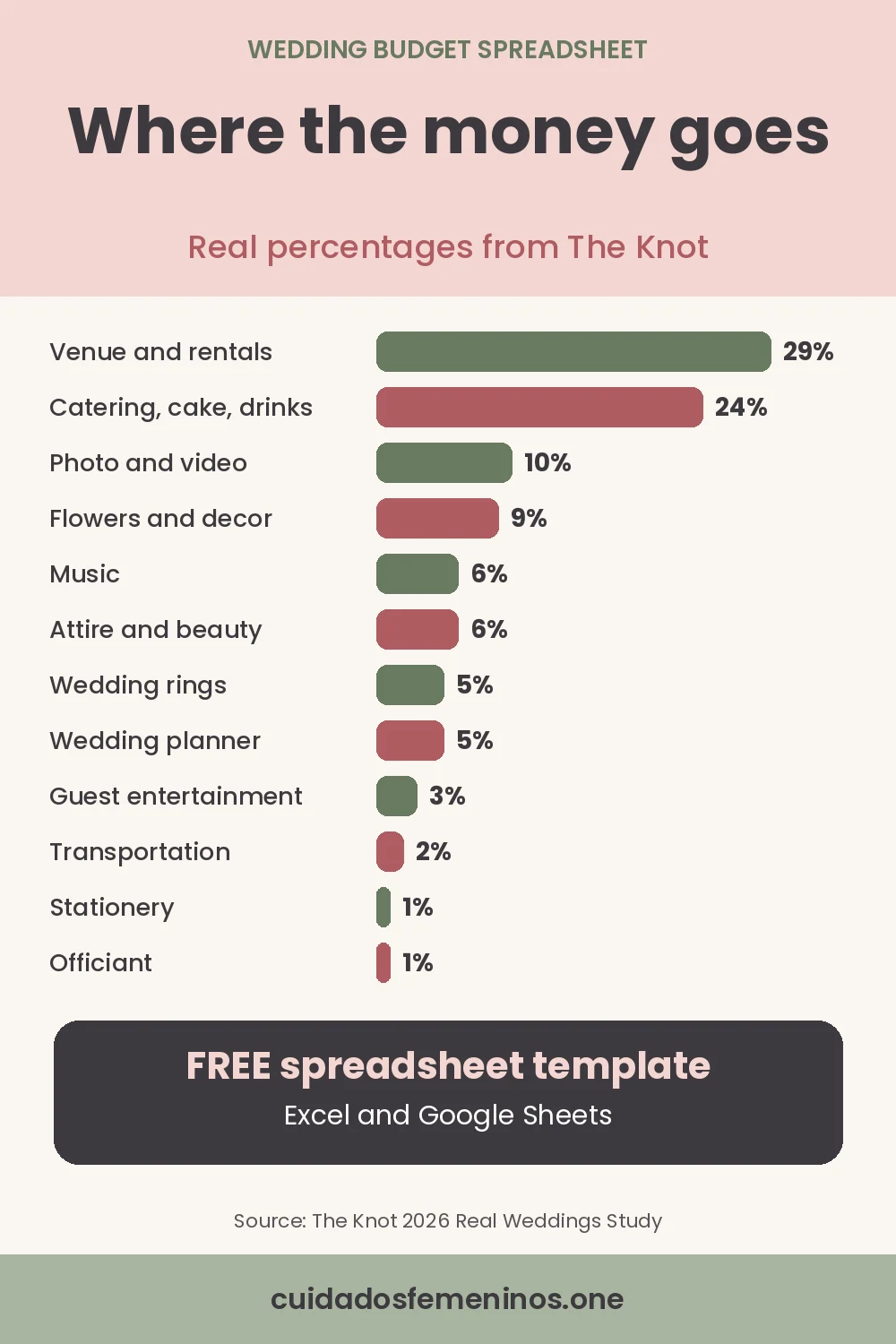
These are the shares The Knot calculated from its 2026 Real Weddings Study, which asked couples what they spent on each category for weddings held in 2025. The dollar columns are our multiplication, rounded to the nearest $100, so you can see what the percentages mean at different budgets.
| Category | Share of budget | At $10,000 | At $20,000 | At $34,200 (the average) | What it covers |
|---|---|---|---|---|---|
| Venue and rentals | 29% | $2,900 | $5,800 | $9,900 | Space, tables, chairs, linens |
| Catering, cake and drinks | 24% | $2,400 | $4,800 | $8,200 | Food, bar, dessert |
| Photographer and videographer | 10% | $1,000 | $2,000 | $3,400 | — |
| Floral design and decor | 9% | $900 | $1,800 | $3,100 | Flowers, lighting, signage |
| Music | 6% | $600 | $1,200 | $2,100 | DJ or band |
| Attire and beauty | 6% | $600 | $1,200 | $2,100 | For the couple |
| Wedding rings | 5% | $500 | $1,000 | $1,700 | — |
| Wedding planner | 5% | $500 | $1,000 | $1,700 | — |
| Guest entertainment | 3% | $300 | $600 | $1,000 | Extras beyond music |
| Transportation | 2% | $200 | $400 | $700 | — |
| Stationery | 1% | $100 | $200 | $300 | Invitations, postage |
| Officiant | 1% | $100 | $200 | $300 | — |
The 12 shares add up to 101% because The Knot rounds each one, and it lists the planner at 5% in its summary and 4% in its detail. The spreadsheet rescales them to 100% and takes out your cushion. The percentages describe the average wedding, not what you should spend. If photos matter most to you, give photography more and take it from a category you care about less.
Source: The Knot, Wedding Budget Breakdown (2026 Real Weddings Study of couples married in 2025).
How can I create a wedding budget in Excel?
You can build one yourself in under an hour, or start from the template above. Here is the order that works.
- Set one total. Add up what the two of you can save, plus any family contributions you have confirmed. Don't count money you hope to receive.
- Set a guest count. It is the biggest lever you have. Fixed costs like a photographer barely change with it, but food, drinks, rentals and stationery do.
- Pick your top three priorities. The Knot suggests choosing three and giving them a little extra, then naming the three that matter least and budgeting those tightly.
- List the categories and their percentages. Start from the table above, then change the numbers to match your priorities.
- Turn percentages into dollars. In Excel, the planned amount is your total times the percentage, such as
=B1*C5. - Get quotes and enter them as estimates. Replace them with the contract price once you sign.
- Track what you've paid. Balance due is actual minus paid,
=H5-I5. Keep deposits and due dates in one list. - Check cost per guest. Divide your actual spend by your guest count and compare it with The Knot's $292 average.
The template does all of these steps for you, including the Fixed versus Per guest label on every line.
How much does the average wedding cost in 2026?
Two big surveys give two answers. The Knot's 2026 Real Weddings Study found an average of $34,200 for weddings held in 2025, with 117 guests and $292 per guest. Zola's First Look Report, based on more than 11,500 couples marrying in 2026, puts the average at $36,000 with 145 guests. They differ because one asks what couples spent and the other what couples are planning, and because their guest counts differ.
| What The Knot measured | Average cost |
|---|---|
| All weddings (117 guests on average) | $34,200 |
| Weddings with 1 to 50 guests | $17,100 |
| Weddings with 51 to 100 guests | $27,200 |
| Weddings with more than 100 guests | $43,300 |
| Couples in the $0 to $15,000 budget band | $8,900 |
| Couples in the $15,001 to $40,000 band | $26,400 |
| Couples with budgets over $40,000 | $70,300 |
| Couple pays for all | $25,500 |
| Couple pays for the majority | $29,700 |
| Couple pays for the minority | $39,600 |
Averages hide a wide range. As one planner told The Knot, you can spend $50 on a marriage license and call it a day, or spend millions. The Knot's data also shows that couples who pay for the wedding themselves spend less, which is not the same as saying paying for it yourself makes it cheaper. Treat the table as a map, not a target.
Why the percentages break on a small budget
Percentages assume everyone buys the same things. Some costs do not shrink when your total does. The Knot also publishes average prices for single vendors, and when you put them next to a $10,000 budget the problem is clear.
| Item (The Knot average) | Average price | As a share of $10,000 |
|---|---|---|
| Reception venue | $12,900 | 129% |
| Photographer | $3,000 | 30%, not the 10% in the breakdown |
| Catering, per person | $80 | $4,000 for 50 guests, or 40% |
| Officiant | $260 | 2.6% |
| DJ | $1,800 | 18% |
| Wedding cake | $540 | 5.4% |
Those vendor averages come from couples who hired that vendor, so they will not line up exactly with the shares of the total. The takeaway still holds: on a smaller budget, a few fixed costs take a bigger slice, and the rest has to shrink around them. That is why the spreadsheet labels each line Fixed or Per guest. Cut the guest list first and the per-guest lines fall on their own. To cut a fixed line you have to change the vendor, the hours or the plan.
Is $10,000 a small wedding budget?
It is well below the average, but it sits inside The Knot's lowest budget band. The average is $34,200, and couples in the $0 to $15,000 band averaged $8,900. The Knot also reports that couples spending under $12,000 had an average of 92 guests, so a $10,000 budget is typically paired with a smaller guest list than average.
The catch is the venue. The average reception venue costs $12,900, which is more than your whole budget, so a $10,000 wedding usually means a different kind of space: a park, a family backyard, a restaurant's private room or a community hall. Here is one way a $10,000 budget for 50 guests could be split. It is our illustration, not data, and your quotes will differ.
| Category | Example amount | Share | Why |
|---|---|---|---|
| Catering, cake and drinks | $3,800 | 38% | About $76 a guest, casual menu or buffet |
| Venue and rentals | $2,000 | 20% | Low-cost or no-rental-fee space |
| Photographer | $1,000 | 10% | A few hours, not a full day |
| Attire and beauty | $800 | 8% | Off-the-rack or borrowed |
| Wedding rings | $500 | 5% | Simple bands |
| Cushion for surprises | $500 | 5% | The Knot suggests at least 5% |
| Flowers and decor | $500 | 5% | A few arrangements |
| Music | $400 | 4% | Playlist and rented speaker, or a short DJ set |
| Officiant and license | $300 | 3% | Officiant average is $260 plus your license fee |
| Stationery | $200 | 2% | Digital invitations |
| Total | $10,000 | 100% |
Is $5000 a good budget for a wedding?
It can work if the guest list is small. At The Knot's average of $292 per guest, $5,000 covers roughly 17 guests (our math), and at the $80 average catering price, 30 guests would take $2,400 for food alone. Weddings that are mostly food and a ceremony, such as a courthouse ceremony and a dinner, fit this budget best. Our courthouse wedding guide lists what the license and ceremony cost in 10 US places, from $60 to about $218 where fees are published.
In the spreadsheet, set your total to $5,000, enter your real guest count and look at the Guest Count tab. If the estimated total is above $5,000, you now know how many guests to cut or which fixed cost to change.
What is the 50/30/20 rule for weddings?
It's a popular rule of thumb, not an industry standard, and there is more than one version. The version on Nearlywed Magazine puts 50% on the venue, catering and rentals, 30% on design and style (flowers, decor, attire, beauty, stationery) and 20% on photography, entertainment, planner, officiant and extras. Citizens bank describes a different version: 50% for necessities, 30% for wants and 20% for taxes, fees, tips and the unexpected.
Here is how The Knot's real data lines up with the Nearlywed grouping (our math from the shares above). Venue plus catering is 53%, so the first group is close to 50%. But the second group, flowers, decor, attire, beauty and stationery, adds up to only 16%, not 30%. The third group, photo and video, music, planner, officiant, transportation and entertainment, comes to 27%. Rings take another 5%.
| Group | 50/30/20 rule | The Knot data (our grouping) |
|---|---|---|
| Venue, rentals, catering, cake, drinks | 50% | 53% |
| Flowers, decor, attire, beauty, stationery | 30% | 16% |
| Photo and video, music, planner, officiant, transportation, entertainment | 20% | 27% |
| Wedding rings (not in the rule) | n/a | 5% |
So the rule gets the big picture roughly right, and it overstates what couples spend on style. Use it for a quick sanity check, then use the full breakdown for planning.
Costs that sit outside the percentages
- Service charges. The Knot says a venue or caterer service charge typically runs 20% to 25% of the food and drink total. On $8,200 of catering, that is $1,640 to $2,050.
- A cushion. The Knot suggests earmarking at least 5% of the budget for surprises. The spreadsheet takes it out first.
- Tips, tax and delivery fees. Quotes do not always include them. Ask.
- Costs The Knot leaves out of the $34,200 average: the rehearsal dinner (average $2,800), the engagement ring ($4,600) and the honeymoon ($5,500). They are on the Budget tab as optional rows.
- Seasons barely move the total. The Knot's average was $33,200 for January to March and October to December weddings, $34,300 for April to June and $35,400 for July to September. Guest count matters far more than the month.
Where to cut first
- The guest list. The Knot calls guest count one of the biggest drivers of cost. Each guest costs you food, drinks, a chair, a place setting and stationery.
- One service at a time. A full-day photographer, a live band and a planner are the biggest fixed lines. Decide which one you will actually miss.
- Add-ons you didn't plan for. Favors, guest entertainment and extra events add up. In the study, the average favors cost $480 and non-musical entertainment $1,500.
- The venue. It is the biggest line at 29%, and it is the choice that changes everything else.
If the guest list is the sticking point, consider the smallest version of the wedding. A courthouse ceremony costs a fraction of a reception, and many couples add a party later: see our courthouse wedding guide for fees, waiting periods and rules in 10 US places.
Your first money talk
Before you book anything, agree on how much comes from whom, and who can sign contracts. A wedding fund is often the first shared money you two manage. If you plan to keep a shared account for it, our guide to a joint bank account for couples explains the three ways couples set money up and what protects you if you're not yet married. And if either of you has savings, a business or a home to protect, read how to get a prenup without a lawyer before you set a date, because the legal steps have a timeline too.
Mistakes that blow a wedding budget
- Setting a budget after you book the venue
- Counting money you hope to receive as money you have
- Budgeting by percentage instead of by priorities
- Forgetting service charges, tax and tips
- Skipping the 5% cushion
- Not tracking deposits and due dates
- Letting the guest list grow without updating the budget
Frequently asked questions
What percentage of a wedding budget should go to the venue?
About 29%, according to The Knot's 2026 Real Weddings Study, which counts venue and rentals together. Catering, cake and drinks add another 24%, so venue plus food is roughly half of the typical budget. If your venue includes catering, combine the two lines in your spreadsheet so you do not count them twice.
How much does a wedding cost per guest?
The Knot reports an average of $292 per guest for weddings in 2025, with 117 guests on average. That number divides the whole bill by the guest count, so it includes fixed costs like the photographer. To see what one more guest really adds, use the Guest Count tab, which starts catering at The Knot's $80 per person average.
Does this wedding budget spreadsheet work in Google Sheets?
Yes. Upload the .xlsx file to Google Drive, open it, and choose File, then Save as Google Sheets. The formulas, yellow input cells and dropdowns carry over. If you prefer Excel, just open the file directly. It also opens in LibreOffice.
Is the wedding budget template really free?
Yes, it is a free download with no sign-up. Use it for your own wedding, copy it for a friend or edit it however you like. The percentages come from The Knot's published 2026 Real Weddings Study. They are national averages, not recommendations, so change the Planned % cells to match your own priorities.
How much should I set aside for surprises and tips?
The Knot recommends earmarking at least 5% of your budget for unforeseen costs, and the template does that for you in the Start Here tab. Also check whether your venue or caterer adds a service charge. The Knot says those typically run 20% to 25% of the food and drink total.
How much does a wedding cost for 50 guests?
The Knot reports that weddings with 1 to 50 guests averaged $17,100 in 2025, compared with $27,200 for 51 to 100 guests and $43,300 for more than 100. Those are averages, and your total depends on your city and choices. Put 50 guests into the template with your own quotes to see your number.
Why do The Knot and Zola report different average wedding costs?
They survey different couples. The Knot asked 10,474 couples who married in 2025 and found an average of $34,200 with 117 guests. Zola surveyed more than 11,500 couples who are marrying in 2026 and reports $36,000 with 145 guests. One looks back at what was spent, the other at what couples plan.
Can I use this spreadsheet if I am having a courthouse wedding?
Yes. Set your total to what you plan to spend on the license, ceremony, outfits, photos and a meal, and set the guest count to your group. Your categories will look nothing like the national percentages, so type your own Planned % values. Our courthouse wedding guide lists license and ceremony fees for 10 US places.
This article is general information, was last updated on November 26, 2026, and isn't financial advice. Averages are national figures from surveys, not price quotes, and your own costs will depend on your city, season and guest list.
Sources
- The Knot: Wedding Budget Breakdown, Based on Real Couples' Data (2026 Real Weddings Study, updated June 24, 2026)
- The Knot: The Average Wedding Cost (average $34,200, vendor averages, budget bands, who pays; updated June 24, 2026)
- The Knot: The Average Wedding Size in the US (117 guests, guest count by budget; updated February 18, 2026)
- The Knot Worldwide: 2026 Real Weddings Study press release (10,474 US couples married in 2025; February 18, 2026)
- Zola: 2026 Wedding Trends, First Look Report ($36,000 average, 145 guests; last updated November 22, 2026)
- Nearlywed Magazine: What Is the 50/30/20 Rule for Weddings?
- Citizens: How to pay for a wedding (a different version of the 50/30/20 rule)
Keep reading
- Courthouse wedding · What it costs and how to plan it.
- Joint bank account for couples · Yours, mine and ours.
- Can you get a prenup without a lawyer? · Real costs and state rules.
- More wedding guides

If you want to read more articles like Wedding Budget Spreadsheet: Free Template and the Real Percentages (2026), check out the Weddings category.