
Breast Reduction Covered by Insurance: How Many Grams Each Insurer Requires (2026 Chart)
Is breast reduction covered by insurance? Usually, if you can show it is medically necessary, and that comes down to two things: documented symptoms that haven't improved with other treatment, and a surgeon's estimate of how many grams of tissue will come out of each breast compared with the minimum for your body size. That minimum is very different depending on your insurer. For the same 5'5", 180-pound woman, Cigna's threshold is about 560 grams per breast and Aetna's is about 840.
Below you'll find the charts insurers actually use, worked out for common heights and weights, a side-by-side of five major policies, the paperwork that gets approvals, how to appeal a denial and what to know if you're trying to get surgery done before your deductible resets on January 1.
- The short version
- How big for insurance to cover breast reduction?
- Is 500 grams a lot for breast reduction?
- The full Schnur sliding scale vs Aetna
- What each insurer requires (2026)
- The paperwork that gets approvals
- If your breast reduction is denied: how to appeal
- The December deadline: getting surgery before your deductible resets
- How much does breast reduction cost without insurance?
- Recovery: what to plan for
- When to see a doctor
- Frequently asked questions
- Is breast reduction covered by insurance?
- Is 500 grams a lot for breast reduction?
- Is DD big enough for breast reduction?
- How many grams are typically removed in breast reduction?
- How long does insurance approval take for breast reduction?
- What happens if my breast reduction is denied?
- Does losing weight affect breast reduction approval?
- How much does breast reduction cost without insurance?
- Sources
The short version
- Insurers don't care about cup size. They look at symptoms, photos and grams of tissue per breast compared with your body surface area (BSA).
- Most use the Schnur sliding scale. In a 2023 study of seven major insurers, 85.7% used it. Cigna and Blue Cross Blue Shield of Michigan set the bar at the 22nd percentile.
- Aetna's table is stricter for the same BSA, but anyone with symptoms and more than 1 kg (1,000 g) per breast qualifies regardless of size.
- Expect at least 3 months of documented conservative treatment at Aetna (support bra, physical therapy, anti-inflammatories) before approval.
- Denials are common: 41.6% of requests in one study were denied at first. Appeals work, and the deadlines are on your side.
- Check your plan for an exclusion. Most UnitedHealthcare commercial plans exclude breast reduction except after mastectomy.
How big for insurance to cover breast reduction?
Insurers don't measure "big" by cup size. They estimate grams of breast tissue the surgeon will remove from each side and compare it with a minimum that rises with your body surface area, a number calculated from your height and weight. Aetna and Blue Cross Blue Shield of Michigan use the Mosteller formula: the square root of (height in cm × weight in kg ÷ 3,600). Cigna's policy notes there is no consensus on which BSA formula to use, so small differences between calculators are normal.
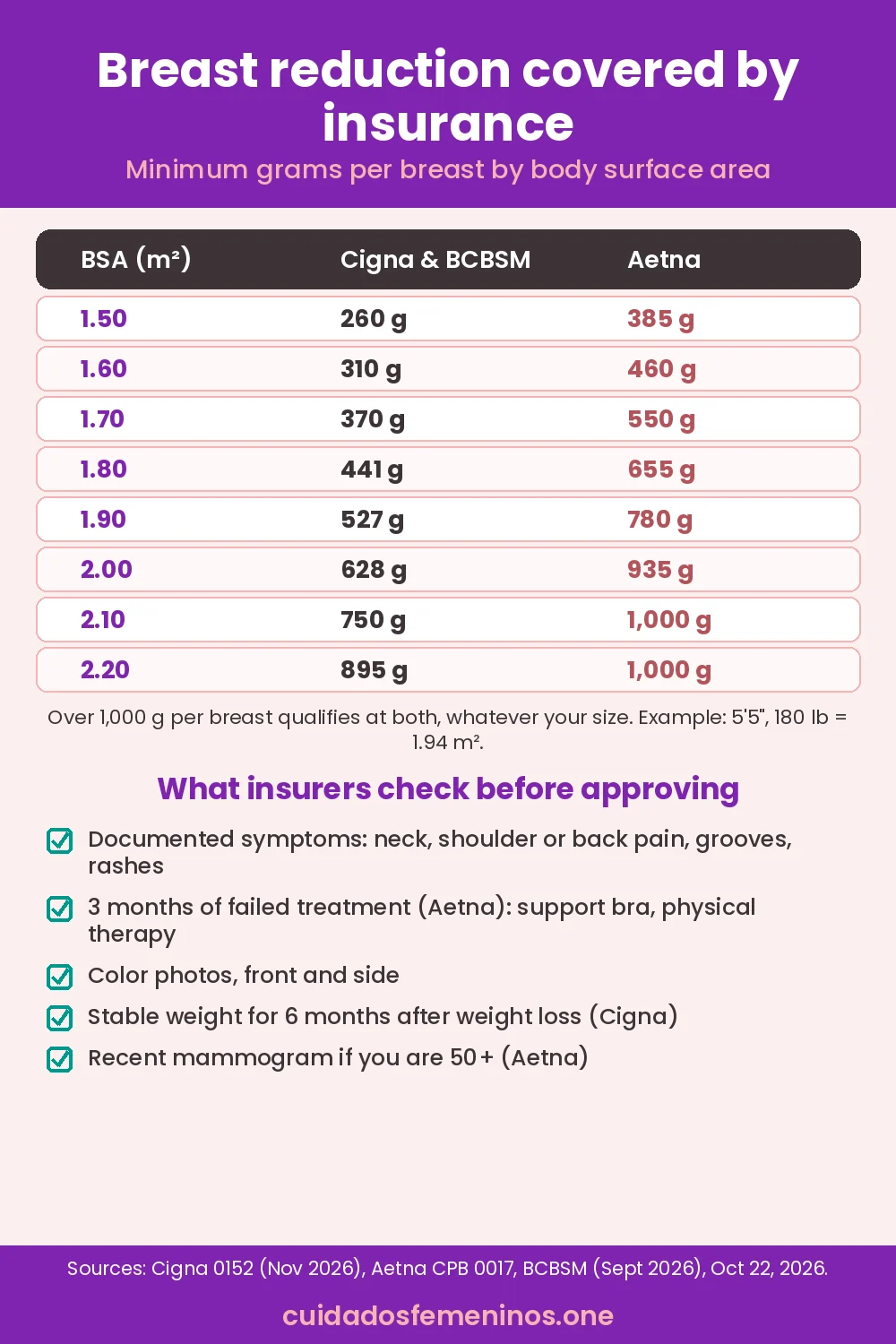
This table shows the minimum grams per breast for common body sizes. The Cigna/BCBSM column is the 22nd percentile of the Schnur scale, interpolated from Cigna's 2026 appendix and rounded to the nearest 5 grams. The Aetna column comes from Aetna's own BSA table.
| Height | Weight | BSA (m²) | Cigna and BCBSM minimum | Aetna minimum |
|---|---|---|---|---|
| 5'0" (152 cm) | 130 lb (59 kg) | 1.58 | 300 g | 445 g |
| 5'2" (157 cm) | 150 lb (68 kg) | 1.73 | 385 g | 580 g |
| 5'3" (160 cm) | 170 lb (77 kg) | 1.85 | 485 g | 715 g |
| 5'4" (163 cm) | 200 lb (91 kg) | 2.02 | 655 g | 965 g |
| 5'5" (165 cm) | 180 lb (82 kg) | 1.94 | 560 g | 840 g |
| 5'6" (168 cm) | 220 lb (100 kg) | 2.16 | 830 g | 1,000 g |
| 5'7" (170 cm) | 160 lb (73 kg) | 1.85 | 485 g | 715 g |
| 5'8" (173 cm) | 240 lb (109 kg) | 2.29 | over 1,000 g | 1,000 g |
| 5'9" (175 cm) | 200 lb (91 kg) | 2.10 | 750 g | 1,000 g |
Notice the gap: Aetna asks for roughly 1.5 times what the Schnur 22nd percentile requires at the same BSA. Your surgeon makes the estimate at your consult, and the insurer checks it against the pathology weight after surgery, so ask them directly: "How many grams do you expect to remove from each side, and is that above my insurer's minimum?"
Is 500 grams a lot for breast reduction?
For many women, yes. Cigna's 2026 policy calls 400 to 700 grams per side a moderate reduction. Whether 500 grams is enough for insurance depends on your BSA. At 1.70 or below, it clears the Cigna minimum. At 1.85, it barely does (482 grams). At 2.00, it falls short for both Cigna (628) and Aetna (935). Blue Cross Blue Shield of Michigan has a separate route: if your breasts are fully grown and more than 500 grams will be removed from each, you don't need the Schnur scale at all.
The full Schnur sliding scale vs Aetna
If your BSA isn't in the profile table above, use this one. The 5th percentile is shown because some plans and older policies use it; the 22nd percentile is what Cigna and BCBSM require today.
| BSA (m²) | Schnur 5th percentile | Schnur 22nd percentile (Cigna, BCBSM) | Aetna minimum |
|---|---|---|---|
| 1.40 | 139 g | 218 g | 324 g |
| 1.45 | 152 g | 238 g | 355 g |
| 1.50 | 166 g | 260 g | 385 g |
| 1.55 | 181 g | 284 g | 420 g |
| 1.60 | 198 g | 310 g | 460 g |
| 1.65 | 216 g | 338 g | 505 g |
| 1.70 | 236 g | 370 g | 550 g |
| 1.75 | 258 g | 404 g | 600 g |
| 1.80 | 282 g | 441 g | 655 g |
| 1.85 | 308 g | 482 g | 715 g |
| 1.90 | 336 g | 527 g | 780 g |
| 1.95 | 367 g | 575 g | 855 g |
| 2.00 | 401 g | 628 g | 935 g |
| 2.05 | 439 g | 687 g | 1,000 g |
| 2.10 | 479 g | 750 g | 1,000 g |
| 2.15 | 523 g | 819 g | 1,000 g |
| 2.20 | 572 g | 895 g | 1,000 g |
| 2.25 | 625 g | 978 g | 1,000 g |
| 2.30 | 682 g | 1,068 g (or over 1,000 g) | 1,000 g |
The Schnur scale comes from a 1991 survey of 92 plastic surgeons about 591 patients. Schnur himself later questioned using it as a strict insurance cutoff, and the American Society of Plastic Surgeons recommends basing coverage on symptoms rather than grams or cup size. Insurers still use it, so plan around it.
What each insurer requires (2026)
| Insurer | Grams per breast | Key extra requirements |
|---|---|---|
| Aetna (CPB 0017) | Aetna BSA table; over 1,000 g qualifies at any BSA | Age 18+ or growth complete; symptoms in 2+ areas for at least 1 year; color front and side photos; at least 3 months of failed conservative treatment; negative mammogram within 2 years if 50+ |
| Cigna (policy 0152, effective Nov 15, 2026) | Above Schnur 22nd percentile, or over 1 kg | Age 18+ or growth complete; at least one symptom unresponsive to treatment; photos; stable weight 6 months after major weight loss (18 months after bariatric surgery; stable on or after GLP-1 drugs) |
| Blue Cross Blue Shield of Michigan (Sept 1, 2026) | Route A: over 500 g with breasts fully grown. Route B: Schnur 22nd percentile | Route B also needs 6+ weeks of pain with failed conservative treatment, shoulder grooving or chronic rash under the breasts |
| BCBS Federal Employee Program (July 2026) | Varies by plan; commonly 500 to 600 g, some use Schnur below that | Documented symptoms; some plans require being within 20% of ideal body weight |
| UnitedHealthcare commercial and exchange (June 1, 2026) | Uses InterQual criteria when covered | Most plans have a specific exclusion except as required after mastectomy (WHCRA). Check your plan document first. |
Other Blue Cross plans, Kaiser and Medicaid programs set their own rules, and they change often. Ask your insurer for the exact medical policy number for breast reduction (CPT code 19318) and read the version in effect on your surgery date.
The paperwork that gets approvals
Most denials aren't about your breasts. They're about missing records. Before your surgeon submits, make sure the file includes:
- Notes from your primary care doctor, physical therapist or chiropractor showing neck, shoulder or upper back pain, headaches, bra-strap grooving or rashes, and how long you have had them.
- Proof of conservative treatment with dates: a professionally fitted support bra, physical therapy, anti-inflammatory medication, and skin treatment for rashes. Aetna wants at least 3 months.
- Clear color photos from the front and side, which your surgeon takes.
- Your height and weight on the day of the consult, and the surgeon's estimated grams per breast.
- A negative mammogram within the last 2 years if you are 50 or older (Aetna).
- If you lost weight recently, notes showing your weight has been stable (Cigna asks for 6 months).
Affiliate disclosure: As an Amazon Associate, I earn from qualifying purchases. I may also earn from some brand partner links. If you buy through a product link on this page, the price is the same for you. Read the full disclosure.
One practical tip: insurers often list a properly fitted support bra as part of conservative treatment. If yours no longer fits, a professional fitting is worth doing anyway. If you're shopping, you can compare wide-strap full-support bras on Amazon, and keep the receipt with your records.
If your breast reduction is denied: how to appeal
In a 2023 study of 380 requests, 41.6% were denied at first, and two-thirds of the denials happened even after prior authorization. A denial isn't the end. Under federal rules for most plans, explained by HealthCare.gov:
| Step | Deadline |
|---|---|
| Insurer answers a prior authorization request | Within 15 days (72 hours if urgent) |
| You file an internal appeal | Within 180 days of the denial |
| Insurer decides an internal appeal for surgery not yet done | Within 30 days (60 days if already done) |
| You request an independent external review | Within 4 months of the final denial |
| External reviewer decides | Within 45 days; the insurer must follow the decision |
Read the denial letter for the exact criterion you missed: grams, photos, therapy duration or a plan exclusion. Then answer that point only, with a letter from your surgeon and the missing records. If the issue is grams, ask whether a revised estimate is medically appropriate, never inflated. Your state's consumer assistance program can help you file.
The December deadline: getting surgery before your deductible resets
If you have already met your 2026 deductible or out-of-pocket maximum, having surgery before December 31 can save you thousands, since most plans reset on January 1. The catch is time: a prior authorization can take up to 15 days, operating rooms fill up in December, and recovery needs a couple of weeks off. Work backward:
- Early November: consult done, records gathered, request submitted.
- Mid to late November: approval in hand. If you're with Cigna, the updated policy takes effect November 15, 2026, so your request will likely be judged by it.
- December: surgery date, plus a confirmed authorization number that covers that date.
- Check your plan year. Some employer plans don't reset in January.
How much does breast reduction cost without insurance?
ASPS reports an average surgeon fee of $7,000 to $12,500 for cosmetic breast reductions in 2024, across 76,734 procedures by its members. That's only the surgeon's fee. Anesthesia, the hospital or surgical center, lab work and post-op garments are extra. If you're paying cash, ask for a written all-inclusive price and whether a revision is included.
Recovery: what to plan for
Most people wear a surgical support bra for several weeks and avoid heavy lifting and strenuous exercise for about 4 to 6 weeks, according to ASPS and Mayo Clinic. Plan for help at home for the first days and a sleeping setup that keeps you on your back.
Things people often buy ahead of time: a front-closure post-surgical bra (check your surgeon's instructions first), silicone scar sheets for later, once incisions have fully closed and your surgeon agrees, and a wedge pillow for sleeping propped up.
When to see a doctor
Start with your primary care doctor if you have neck, shoulder or back pain, headaches, bra-strap grooves or rashes under your breasts that keep coming back. Those visits also start your paper trail. See a doctor promptly, regardless of surgery plans, for:
- A new lump, skin dimpling, nipple changes or discharge (see how to do a breast self-exam).
- Numbness or tingling in your arms or hands.
- A rash under the breast that oozes, smells, bleeds or keeps returning despite treatment.
- After surgery: fever, spreading redness, a breast that becomes very swollen or hard on one side, or chest pain or shortness of breath. These need same-day care.
Frequently asked questions
Is breast reduction covered by insurance?
Often, yes, when it is medically necessary. Most insurers cover it if large breasts cause documented pain or skin problems that haven't improved with treatment and the surgeon plans to remove enough tissue for your body size. Some plans, including most UnitedHealthcare plans, exclude it except after mastectomy, so read your plan document first.
Is 500 grams a lot for breast reduction?
It depends on your body size. For a woman with a body surface area of 1.70, Cigna's minimum is 370 grams per breast, so 500 clears it easily. At 2.00, Cigna asks for 628 grams and Aetna for 935. Blue Cross Blue Shield of Michigan accepts more than 500 grams per breast without the Schnur scale.
Is DD big enough for breast reduction?
Cup size doesn't decide coverage. Bra sizes vary between brands, so insurers look at symptoms, photos and the estimated grams of tissue removed compared with your body surface area. The American Society of Plastic Surgeons also says coverage should be based on symptoms, not cup size. A DD can qualify; so can a smaller cup.
How many grams are typically removed in breast reduction?
Cigna's 2026 policy describes small reductions as 200 to 400 grams per side, moderate as 400 to 700, large as 700 to 1,200 and gigantomastia reductions as more than 1,200 grams. What matters for insurance is your surgeon's estimate compared with the minimum for your body surface area, not the average.
How long does insurance approval take for breast reduction?
Under federal rules, your insurer must answer a prior authorization request in writing within 15 days. Many offices take a few extra weeks to gather photos, therapy records and letters before they submit. If you are hoping to have surgery before December 31, ask your surgeon to submit by early November.
What happens if my breast reduction is denied?
You have 180 days to file an internal appeal. For surgery you haven't had yet, the insurer must decide within 30 days. If it still says no, you can ask for an independent external review within four months, and the insurer must follow that decision. Denials are common, and many are overturned with better documentation.
Does losing weight affect breast reduction approval?
It can. Cigna's policy, effective November 15, 2026, asks for a stable weight for at least six months after significant weight loss, 18 months after bariatric surgery, and a stable weight on or after GLP-1 drugs like semaglutide. Some plans also want you within a certain range of ideal body weight.
How much does breast reduction cost without insurance?
The American Society of Plastic Surgeons reports an average surgeon fee of $7,000 to $12,500 for cosmetic breast reductions in 2024. That range covers only the surgeon. Anesthesia, the operating facility, lab work and the surgical bra are billed separately, so ask for a written all-inclusive quote.
This article is for general information, was last updated on October 22, 2026, and does not replace advice from your surgeon or your insurer. Medical policies change, often once or twice a year, and your own plan documents decide what is covered. Always confirm with your insurer before surgery.
Sources
- Aetna Clinical Policy Bulletin 0017: Breast Reduction Surgery and Gynecomastia Surgery
- Cigna Medical Coverage Policy 0152: Breast Reduction (effective November 15, 2026)
- UnitedHealthcare Commercial and Individual Exchange Medical Policy: Breast Reduction Surgery (effective June 1, 2026)
- Blue Cross Blue Shield of Michigan / BCN: Reduction Mammaplasty medical policy (effective September 1, 2026)
- Blue Cross Blue Shield FEP Medical Policy 7.01.21: Reduction Mammaplasty (July 2026)
- Boyd et al. Insurance coverage of reduction mammaplasty. Plast Reconstr Surg Glob Open. 2023;11(10):e5361
- American Society of Plastic Surgeons: recommended insurance coverage criteria for reduction mammaplasty (reaffirmed 2021)
- American Society of Plastic Surgeons: breast reduction, procedure and recovery
- American Society of Plastic Surgeons: 2024 procedural statistics and average surgeon fees
- HealthCare.gov: internal appeals and decision deadlines
- HealthCare.gov: external review
- Mayo Clinic: breast reduction surgery
Keep reading
- How to do a breast self-exam And which changes to get checked.
- Winter dry skin Including rashes in skin folds.
- IPL vs laser hair removal Which works better and what it costs.
- Does at-home IPL actually work? Who it is for and how long it takes.
If you want to read more articles like Breast Reduction Covered by Insurance: How Many Grams Each Insurer Requires (2026 Chart), check out the Beauty & Aesthetics category.