
Pregnant With No Health Insurance? Your 2027 Options: Medicaid, CHIP, Open Enrollment and the New Immigrant Rules

If you're pregnant with no health insurance, you don't have to wait for open enrollment. Medicaid and CHIP take applications every month of the year, pregnancy can't be used to deny you coverage, and in many states the income limit for pregnant women is twice the poverty line or higher. What did change, a lot, is who qualifies based on immigration status: one set of rules kicked in October 1, 2026, and another arrives January 1, 2027.
This guide pulls together what most pages scatter across a dozen sites: the 2027 deadlines, a 50-state table of income limits, which states still cover lawfully residing pregnant women without the five-year wait, where prenatal care is covered regardless of status, and a checklist for this week. Every number comes from an official or nonpartisan source, linked at the end.
- The short version
- What happens if I'm pregnant and have no insurance?
- When can I apply for health insurance for 2027?
- Can you get insurance outside of open enrollment if you get pregnant?
- Can I be denied health insurance if I'm pregnant?
- How to apply for pregnancy Medicaid, step by step
- What changed in 2026 and 2027 for pregnant immigrants
- Medicaid for undocumented pregnant women: what actually exists
- Public charge: the rule that changed in September 2026
- State-by-state table: income limits and options for pregnant women
- Where to get low-cost prenatal care while you wait
- Choosing a Marketplace plan that covers delivery
- Your checklist for this week
- Taking care of the basics while coverage comes through
- When to get care right away, insurance or not
- Frequently asked questions
- Can I get Medicaid if I am already pregnant?
- Can you get insurance outside of open enrollment if you get pregnant?
- Will a Marketplace plan cover my pregnancy if I was pregnant before I enrolled?
- When does my coverage start if I sign up in December?
- Does emergency Medicaid cover labor and delivery for undocumented immigrants?
- Will my baby have health insurance if born in the US?
- Does applying for Medicaid while pregnant affect my immigration case?
- How long does pregnancy Medicaid last after the baby is born?
- Sources
The short version
- Apply for Medicaid or CHIP now, not in November. You can apply any time, and coverage can reach back to cover recent bills.
- Got medical bills from this fall? Apply before December 31, 2026. Until then, Medicaid can cover up to 3 months before the month you apply. For applications starting January 1, 2027, that drops to 2 months.
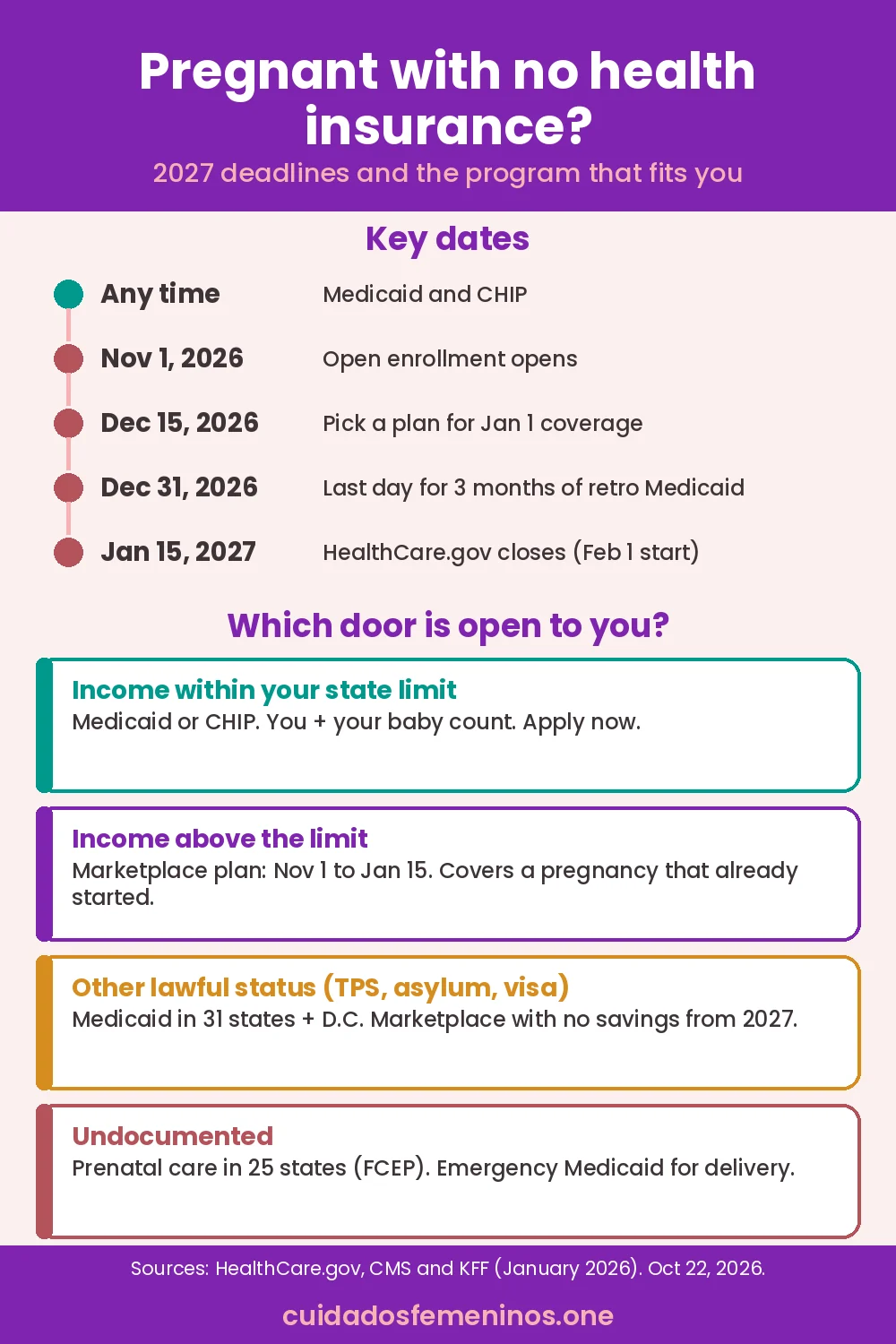
- 2027 open enrollment runs November 1, 2026 to January 15, 2027 on HealthCare.gov. Pick a plan by December 15 to be covered January 1.
- Pregnancy isn't a qualifying life event on HealthCare.gov, but it is in 10 states plus D.C. Your baby's birth qualifies everywhere.
- Immigrants: starting in 2027, only green card holders, Cuban/Haitian entrants and COFA migrants get help paying for Marketplace plans. 32 states (counting D.C.) still cover lawfully residing pregnant women through Medicaid, and 25 cover prenatal care regardless of status.
- Emergency labor and delivery is covered by emergency Medicaid if you meet income and residency rules, even without papers.
What happens if I'm pregnant and have no insurance?
Three things are true at once. First, any hospital with an emergency department has to examine and stabilize you if you show up in labor, insured or not, under the federal EMTALA law. Second, the bill still comes later, and an uninsured birth can run into the thousands, which is why the goal is coverage that can apply retroactively. Third, almost every pregnant woman with a low or moderate income has at least one door open. It just isn't the same door for everyone.
Medicaid pays for nearly half of all births in the U.S., according to CMS. It isn't only for people in deep poverty: for pregnant women, the national median income limit is 201% of the federal poverty level, and some states go much higher, like Wisconsin at 306% and the District of Columbia at 324%.
Here's the detail most guides skip: Medicaid counts a pregnant woman as herself plus the baby or babies she's expecting. If you live alone and you're pregnant with one baby, you're a household of two; with twins, three. For Marketplace subsidies, though, you count as one. That gap is why a lot of women who think they earn too much for Medicaid actually qualify.
What that looks like in dollars
For 2026, the federal poverty level for a household of three is $27,320 a year, per KFF. A pregnant woman with one child at home counts as a household of three for Medicaid. At the national median of 201%, she could earn up to roughly $54,900 a year and still qualify. In Wisconsin, at 306%, the ceiling is about $83,600. Treat these as ballpark figures: each state converts income using MAGI rules, so the state agency has the final word.
When can I apply for health insurance for 2027?
If Medicaid and CHIP aren't an option, the Marketplace is your next stop, through HealthCare.gov or your state's own exchange. These are the federal dates confirmed by HealthCare.gov:
| Date | What happens |
|---|---|
| November 1, 2026 | Open enrollment for 2027 plans begins. |
| December 15, 2026 | Last day to pick a plan that starts January 1, 2027. |
| December 31, 2026 | Last day a Medicaid application keeps the full 3-month retroactive window (2 months from 2027 on). |
| January 1, 2027 | On-time plans start. New immigrant limits on Marketplace savings take effect. |
| January 15, 2027 | Open enrollment closes on HealthCare.gov. Plans picked December 16 through January 15 start February 1. |
| Any time | You can apply for Medicaid and CHIP. |
States that run their own exchange, including California, New York and New Jersey, can set later deadlines. Check your state's official site before you assume the window has closed.
Can you get insurance outside of open enrollment if you get pregnant?
Not on HealthCare.gov. Getting pregnant doesn't trigger a special enrollment period there. Giving birth does: you get 60 days after delivery to enroll or switch plans, and coverage can start on the baby's date of birth.
Some state-run exchanges do treat pregnancy as a qualifying life event. According to healthinsurance.org, they are Colorado, Connecticut, the District of Columbia, Illinois, Maine, Maryland, New Jersey, New York, Rhode Island, Vermont and Virginia. The details vary; in Illinois, for example, you have 60 days from when a medical provider confirms the pregnancy. Check with your state's exchange.
Everywhere else, if Medicaid is off the table, November's open enrollment is your shot. Don't skip it thinking it's too late to matter: the plan will cover the rest of your pregnancy, the delivery and your newborn's care.
Can I be denied health insurance if I'm pregnant?
No. Under the Affordable Care Act, Marketplace and employer plans can't reject you or charge you more because you're pregnant, and every Marketplace plan and Medicaid covers pregnancy and childbirth even if you were pregnant before coverage started. The real limit is the calendar, not your pregnancy. Be wary of products sold as cheap "health plans" that aren't ACA-compliant; before you pay, confirm in writing that maternity care and delivery are covered.
How to apply for pregnancy Medicaid, step by step
You can apply through your state Medicaid agency online, by phone or in person, or through HealthCare.gov, which sends your information to the state if you look eligible.
- Gather the basics: a pregnancy confirmation if you have one, recent pay stubs or proof of income, proof you live in the state and, if it applies, your immigration documents.
- Report the pregnancy and how many babies you're expecting. It changes your household size.
- If you've already had visits, lab work or an ER trip, ask for retroactive coverage and keep every bill.
- Answer any letter from the state quickly. Lots of applications stall over one missing document.
- If you are denied, ask for the reason in writing and request a fair hearing.
Family members who aren't applying for coverage don't have to share their immigration status. That matters in mixed-status families: you can apply for your citizen children even if you don't qualify yourself.
Why December matters more than usual this year
Medicaid can pay for care you got in the months before you applied, as long as you were eligible then. CMS guidance allows up to 3 months today. The 2025 federal law cuts that for applications made on or after January 1, 2027: 2 months for most people and 1 month for expansion adults, as Maryland and California spell out in their implementation guides. If you had medical bills this fall, applying in December instead of January could save you a month of charges.
What changed in 2026 and 2027 for pregnant immigrants
The 2025 federal tax and spending law, H.R. 1, made two changes that matter here. Starting October 1, 2026, federal Medicaid and CHIP funding is limited to citizens, green card holders, Cuban/Haitian entrants and COFA migrants, with key exceptions for pregnant women and children. Starting January 1, 2027, only those same groups can get financial help with a Marketplace plan.
| Your situation | Medicaid or CHIP while pregnant | Marketplace in 2027 |
|---|---|---|
| U.S. citizen | Yes, within your state's income limits. | Yes, with income-based savings. |
| Green card holder, 5+ years | Yes, within income limits. | Yes, with savings. |
| Green card holder, under 5 years | Yes in the 32 states (counting D.C.) that dropped the waiting period for pregnant women; elsewhere, usually a wait. | Yes, with savings. |
| Cuban/Haitian entrant or COFA migrant | Yes, within income limits. | Yes, with savings. |
| Other lawfully present status (TPS, asylum, refugee, visa holders, parole and others) | Yes, but only in states that cover lawfully residing pregnant women; plus emergency Medicaid for delivery. | You can buy a plan, but at full price with no savings. |
| Undocumented | Prenatal care in the 25 states using the CHIP unborn-child option; emergency Medicaid for delivery; state-funded programs in some places. | You can't buy through the Marketplace. |
States that cover lawfully residing pregnant women without the five-year wait (the ICHIA or CHIPRA 214 option), per KFF as of January 2026: Arkansas, California, Colorado, Connecticut, Delaware, District of Columbia, Georgia, Hawaii, Kentucky, Maine, Maryland, Massachusetts, Michigan, Minnesota, Nebraska, Nevada, New Hampshire, New Jersey, New Mexico, New York, North Carolina, North Dakota, Ohio, Pennsylvania, Rhode Island, South Carolina, Vermont, Virginia, Washington, West Virginia, Wisconsin, Wyoming. North Carolina passed a 2026 law that could end this coverage as of October 1, 2026, and the governor has asked to restore it, so confirm before you count on it there.
Separately, the enhanced Marketplace subsidies expired December 31, 2025 and weren't renewed. If you earn more than 400% of the poverty level, you won't get help with premiums, and insurers proposed a median increase of about 15% for 2027, according to KFF. Compare plans carefully this year.
Medicaid for undocumented pregnant women: what actually exists
- The CHIP "from conception to end of pregnancy" (FCEP) option, formerly called the unborn-child option. It covers the baby before birth, and with it prenatal care and delivery, regardless of the mother's immigration status. 25 states (counting D.C.) use it: Alabama, Arkansas, California, Colorado, Connecticut, District of Columbia, Illinois, Louisiana, Maine, Maryland, Massachusetts, Michigan, Minnesota, Missouri, Nebraska, New York, Oklahoma, Oregon, Rhode Island, South Dakota, Tennessee, Texas, Virginia, Washington, Wisconsin. The 2025 law left it in place.
- Emergency Medicaid. If you meet every Medicaid rule in your state except immigration status, it covers treatment of emergency medical conditions, and labor and delivery counts. It doesn't cover routine prenatal visits. The 2025 law didn't change who qualifies; it only reduced what the federal government pays some states.
- State-only programs. A few states use their own money to cover people who don't qualify because of status. Several scaled back in 2025 and 2026, so ask your state agency directly.
One catch: FCEP has no federal postpartum coverage. Per KFF, 11 states extend it to 12 months with their own funds, Maryland to 4 months, and Alabama, Texas, Virginia and D.C. to 60 days. Everywhere else, your coverage ends at delivery, though your baby is entitled to coverage of their own.
Your baby is a citizen. On June 30, 2026, in Trump v. Barbara, the Supreme Court held that children born in the U.S. are citizens regardless of their parents' status. That means a Social Security number and, if household income qualifies, Medicaid or CHIP in the baby's own name. If you had Medicaid on the day you gave birth, your newborn is automatically enrolled for at least one year.
Public charge: the rule that changed in September 2026
It's the fear that comes up most in immigrant parent groups, and it's a fair one. DHS rescinded the 2022 public charge rule, and the replacement took effect September 18, 2026. The new rule gives officers more discretion and allows them to consider certain means-tested benefits received on or after that date.
What nobody can tell you yet is how each office will apply it in each case, and we won't guess. Some groups, such as refugees and asylees, aren't subject to public charge, and different benefits carry different weight. If you have a green card application pending or planned, talk to an immigration attorney or a DOJ-accredited representative before you apply. Applying for your citizen baby is a separate question from applying for yourself; ask about that too.
State-by-state table: income limits and options for pregnant women
Income limits as a percent of the federal poverty level, as of January 2026 (KFF and Georgetown CCF). "Lawfully residing, no wait" shows whether the state covers lawfully residing pregnant women without the 5-year bar. "Pregnancy SEP" shows whether the state exchange lets you enroll mid-year because you're pregnant.
| State | Medicaid | CHIP | Prenatal regardless of status (FCEP) | Lawfully residing, no wait | Pregnancy SEP |
|---|---|---|---|---|---|
| Alabama (AL) | 146% | — | Yes (317%) | No | No |
| Alaska (AK) | 230% | — | No | No | No |
| Arizona (AZ) | 161% | — | No | No | No |
| Arkansas (AR) | 214% | — | Yes (214%) | Yes | No |
| California (CA) | 213% | — | Yes (322%) | Yes | No |
| Colorado (CO) | 195% | 260% | Yes (265%) | Yes | Yes |
| Connecticut (CT) | 263% | — | Yes (263%) | Yes | Yes |
| Delaware (DE) | 217% | — | No | Yes | No |
| District of Columbia (DC) | 324% | — | Yes (324%) | Yes | Yes |
| Florida (FL) | 196% | — | No | No | No |
| Georgia (GA) | 225% | — | No | Yes | No |
| Hawaii (HI) | 196% | — | No | Yes | No |
| Idaho (ID) | 138% | — | No | No | No |
| Illinois (IL) | 213% | — | Yes (213%) | No | Yes |
| Indiana (IN) | 213% | — | No | No | No |
| Iowa (IA) | 220% | — | No | No | No |
| Kansas (KS) | 171% | — | No | No | No |
| Kentucky (KY) | 195% | 218% | No | Yes | No |
| Louisiana (LA) | 138% | — | Yes (214%) | No | No |
| Maine (ME) | 214% | — | Yes (213%) | Yes | Yes |
| Maryland (MD) | 264% | — | Yes (264%) | Yes | Yes |
| Massachusetts (MA) | 205% | — | Yes (205%) | Yes | No |
| Michigan (MI) | 200% | — | Yes (200%) | Yes | No |
| Minnesota (MN) | 283% | — | Yes (283%) | Yes | No |
| Mississippi (MS) | 199% | — | No | No | No |
| Missouri (MO) | 196% | 305% | Yes (305%) | No | No |
| Montana (MT) | 162% | — | No | No | No |
| Nebraska (NE) | 199% | — | Yes (202%) | Yes | No |
| Nevada (NV) | 205% | — | No | Yes | No |
| New Hampshire (NH) | 201% | — | No | Yes | No |
| New Jersey (NJ) | 194% | 205% | No | Yes | Yes |
| New Mexico (NM) | 255% | — | No | Yes | No |
| New York (NY) | 223% | — | Yes (223%) | Yes | Yes |
| North Carolina (NC) | 201% | — | No | Yes* (under review) | No |
| North Dakota (ND) | 175% | — | No | Yes | No |
| Ohio (OH) | 205% | — | No | Yes | No |
| Oklahoma (OK) | 210% | — | Yes (210%) | No | No |
| Oregon (OR) | 190% | — | Yes (190%) | No | No |
| Pennsylvania (PA) | 220% | — | No | Yes | No |
| Rhode Island (RI) | 190% | 258% | Yes (258%) | Yes | Yes |
| South Carolina (SC) | 199% | — | No | Yes | No |
| South Dakota (SD) | 138% | — | Yes (138%) | No | No |
| Tennessee (TN) | 255% | — | Yes (255%) | No | No |
| Texas (TX) | 203% | — | Yes (207%) | No | No |
| Utah (UT) | 144% | — | No | No | No |
| Vermont (VT) | 213% | — | No | Yes | Yes |
| Virginia (VA) | 143% | 205% | Yes (205%) | Yes | Yes |
| Washington (WA) | 215% | — | Yes (215%) | Yes | No |
| West Virginia (WV) | 185% | 305% | No | Yes | No |
| Wisconsin (WI) | 306% | — | Yes (306%) | Yes | No |
| Wyoming (WY) | 159% | — | No | Yes | No |
* North Carolina: a 2026 state law could end this coverage as of October 1, 2026. Percentages already include the standard 5-point income disregard. Main source: KFF State Health Facts; special enrollment: healthinsurance.org.
Where to get low-cost prenatal care while you wait
- Community health centers. They see patients regardless of ability to pay and use a sliding fee scale based on income. Many have bilingual staff and help with Medicaid applications. Search findahealthcenter.hrsa.gov by ZIP code.
- Your county health department. Many offer pregnancy tests, a first prenatal visit or referrals to local programs.
- WIC. Food, nutrition counseling and breastfeeding support for pregnant women, for women up to 6 months after delivery and up to a year if breastfeeding, based on income.
- The hospital where you plan to deliver. Nonprofit hospitals are required by the IRS to have a written financial assistance policy with free or discounted care based on income. Ask for it in writing before your due date.
- The emergency room for warning signs or active labor: by law, you'll be examined and stabilized.
Pregnancy Medicaid doesn't charge copays for pregnancy-related care, and states that cover pregnant women through CHIP don't charge cost sharing during pregnancy, according to CMS. When you call a health center, ask three questions: Do you have a sliding fee? Can you help me apply for Medicaid? Which hospital do your doctors deliver at?
Choosing a Marketplace plan that covers delivery
Every Marketplace plan covers pregnancy, childbirth and newborn care, and several pregnancy-related preventive services, like certain screenings and breastfeeding support, come with no cost sharing. The money differences are in the deductible and out-of-pocket maximum, and that's where people get burned.
| If your due date is… | What to check |
|---|---|
| February to June 2027 | The birth falls in the same plan year. Choose based on the out-of-pocket maximum, not just the monthly premium. A Gold or Silver plan can cost less overall than a Bronze plan. |
| December 2026 or January 2027 | If you pick a plan by December 15 it starts January 1. A birth before that date isn't covered by the new plan, so push hard on Medicaid and the hospital's financial assistance. |
| July 2027 or later | Pregnancy and delivery land in one plan year. Make sure your OB and hospital are in network. |
| Income between 100% and 250% of poverty | Silver plans can come with cost-sharing reductions that lower your deductible. Ask about them. |
Before you pick, use the plan's provider search to confirm your OB and the hospital where you want to deliver are in network. An out-of-network delivery can cost far more, even with insurance.
Your checklist for this week
- Confirm the pregnancy (here is when a home test is reliable) and write down your due date.
- Find your state in the table above and compare your income to the Medicaid limit, counting yourself and the baby.
- Apply for Medicaid or CHIP now. Don't wait for November 1. If you have recent medical bills, ask for retroactive coverage and apply before December 31.
- If your status is anything other than a green card, check the status table, and if you have an immigration case, talk to an attorney before applying.
- Book your first prenatal visit at a community health center, even while your application is pending.
- If you don't qualify for Medicaid, put November 1 on your calendar to compare plans and treat December 15 as your real deadline.
- Ask the hospital for its financial assistance policy in writing.
- Apply for WIC.
Taking care of the basics while coverage comes through
The single most useful thing you can do while you sort out insurance is take a daily supplement with folic acid (the CDC recommends 400 micrograms for anyone who could become pregnant) and not skip your first prenatal visit. If you have Medicaid or WIC, ask whether prenatal vitamins are covered with a prescription; they often cost little or nothing.
Affiliate disclosure: As an Amazon Associate, I earn from qualifying purchases. I may also earn from some brand partner links. If you buy through a product link on this page, the price is the same for you. Read the full disclosure.
If you need to buy them yourself in the meantime, you can compare prenatal vitamins with folic acid on Amazon. Look for at least 400 mcg of folic acid and ask your provider whether you need extra iron, since low ferritin with normal hemoglobin is common in pregnancy and a basic blood count can miss it. Vitamins don't replace prenatal care.
When to get care right away, insurance or not
Don't put off care because you're worried about the bill. Go to the ER or call 911 if you have any of these urgent warning signs from the CDC's Hear Her campaign:
- Vaginal bleeding or fluid leaking during pregnancy.
- A headache that won't go away or gets worse, dizziness or fainting, or changes in your vision.
- A fever of 100.4°F or higher.
- Chest pain, a racing heartbeat or trouble breathing.
- Severe belly pain, or nausea and vomiting so bad you can't keep food or fluids down.
- Severe swelling of your hands or face.
- Your baby's movements slowing down or stopping.
- Swelling, redness or pain in one leg.
- Thoughts of harming yourself or your baby.
The hospital has to examine and stabilize you whether or not you're insured. Afterward, ask to speak with a financial counselor or Medicaid enrollment specialist; many hospitals have one on staff.
Frequently asked questions
Can I get Medicaid if I am already pregnant?
Yes. Being pregnant never disqualifies you, and you can apply any month of the year, not just during open enrollment. Medicaid also counts you plus the baby or babies you're expecting as your household, which raises the income limit you're measured against. Many women who assume they earn too much actually qualify.
Can you get insurance outside of open enrollment if you get pregnant?
On HealthCare.gov, pregnancy alone doesn't open a special enrollment period, but birth does. Ten states plus D.C. treat pregnancy as a qualifying event on their own exchanges. Medicaid and CHIP accept applications all year, so if your income is within your state's limit, you don't need to wait for November.
Will a Marketplace plan cover my pregnancy if I was pregnant before I enrolled?
Yes. Every Marketplace plan and Medicaid covers pregnancy and childbirth even if the pregnancy started before your coverage did. Insurers can't turn you down or charge you more for it. The only limit is timing: you must enroll during open enrollment or after a qualifying event, unless your state treats pregnancy as one.
When does my coverage start if I sign up in December?
If you pick a plan on HealthCare.gov by December 15, 2026, coverage starts January 1, 2027. If you enroll between December 16 and January 15, it starts February 1. State-run exchanges, such as those in California or New York, can set later deadlines, so check your state before you assume the window has closed.
Does emergency Medicaid cover labor and delivery for undocumented immigrants?
Generally, yes. Emergency Medicaid pays for treatment of an emergency medical condition, and labor and delivery qualifies, as long as you meet your state's income and residency rules. It doesn't cover routine prenatal visits. For those, check whether your state uses the CHIP unborn-child option or visit a community health center.
Will my baby have health insurance if born in the US?
Your baby is a U.S. citizen at birth, which the Supreme Court reaffirmed in June 2026. If you had Medicaid when you gave birth, your baby is automatically enrolled for at least a year. Otherwise, you can apply for Medicaid or CHIP in the baby's name even if your own immigration status keeps you from qualifying.
Does applying for Medicaid while pregnant affect my immigration case?
It can depend on your situation. A new public charge rule took effect September 18, 2026, and it gives officers more discretion and lets them weigh certain benefits received after that date. If you have a green card application pending or planned, talk to an immigration attorney or a DOJ-accredited representative before applying.
How long does pregnancy Medicaid last after the baby is born?
Pregnancy Medicaid covers at least 60 days after delivery, and most states now extend it to 12 months postpartum. The CHIP unborn-child option has no federal postpartum coverage, though some states add it with their own money. Ask your state Medicaid agency exactly when your coverage ends so you don't miss a checkup.
This article is for general information, was last updated on October 22, 2026, and is not legal or benefits advice. Rules change and states control much of how they work, so confirm your situation with your state Medicaid agency, a certified Marketplace navigator or an immigration attorney before you decide.
Sources
- HealthCare.gov: open enrollment dates and deadlines for 2027 plans
- HealthCare.gov: health coverage if you are pregnant or plan to get pregnant
- HealthCare.gov: coverage for lawfully present immigrants, savings rules starting January 1, 2027
- CMS: Medicaid, CHIP and Marketplace eligibility job aid for pregnant individuals (2024)
- KFF State Health Facts: Medicaid and CHIP income limits for pregnant women (January 2026)
- KFF: state health coverage for immigrants (2026 update)
- KFF: how the 2025 reconciliation law affects coverage for immigrant families
- Maryland Department of Health: FAQ on noncitizen eligibility changes (October 2026 and January 2027)
- healthinsurance.org: states where pregnancy is a qualifying life event
- KFF: the ACA Marketplaces in 2026 and the end of enhanced premium tax credits
- Federal Register: public charge rule effective September 18, 2026
- U.S. Supreme Court: Trump v. Barbara (June 30, 2026), birthright citizenship
- HRSA: Find a Health Center
- USDA: WIC eligibility requirements
- IRS: financial assistance and emergency care policies required of nonprofit hospitals, Section 501(r)(4)
- CDC Hear Her campaign: urgent maternal warning signs
Keep reading
- Cord blood banking cost comparison 2026 What CBR, Cryo-Cell and Americord really charge.
- How soon can you take a pregnancy test? A day-by-day guide.
- Low ferritin but normal hemoglobin Why it matters before and during pregnancy.
- Faint line on a pregnancy test How to read it and what to do next.
If you want to read more articles like Pregnant With No Health Insurance? Your 2027 Options: Medicaid, CHIP, Open Enrollment and the New Immigrant Rules, check out the Fertility, Pregnancy & Baby category.