Hot Water Bottle vs Heating Pad for Cramps: Which Is Better, and Which Is Safer?
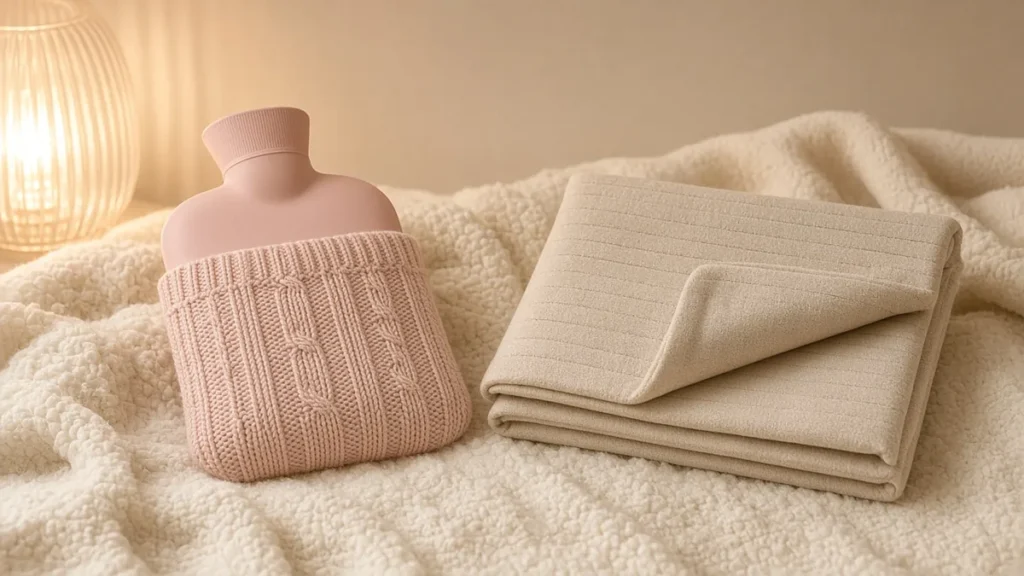
For period cramps, a hot water bottle and an electric heating pad work about equally well, because what eases the pain is the warmth itself, not the device. The real differences are practical: a heating pad stays at a steady temperature and shuts itself off, while a hot water bottle needs no outlet but cools down over time and carries a scald risk if it leaks or bursts.
So the better pick depends on where you'll be and how you like to rest. Below I compare the two on comfort, safety, cost and convenience, explain what the research says about heat for cramps, and share how to use each one without burning your skin.
Affiliate disclosure: As an Amazon Associate, I earn from qualifying purchases. If you buy through a product link on this page, the price is the same for you.
- Does heat actually help cramps?
- Hot water bottle vs heating pad at a glance
- Where a hot water bottle wins
- Where a heating pad wins
- The safety question: how risky are hot water bottles?
- Which one should you get?
- Options worth a look
- When to see a doctor
- Frequently asked questions
- Is a hot water bottle as good as a heating pad for cramps?
- Can I sleep with a hot water bottle?
- Should I use boiling water in a hot water bottle?
- How long does a hot water bottle stay warm?
- Is a microwavable heat pack better than a hot water bottle?
- Can I use a heating pad or hot water bottle while pregnant?
- Are hot water bottles safer than heating pads?
- Sources
Does heat actually help cramps?
Yes. A 2018 systematic review of randomized trials found that heat therapy eased menstrual pain compared with an unheated placebo or no treatment, and in three trials heating pads compared favorably with pain medication. The authors called the evidence "suggestive" because the trials were small (Jo and Lee, 2018). The American College of Obstetricians and Gynecologists (ACOG) and Mayo Clinic both list a heating pad or a heat patch on the lower belly among the things to try at home.
None of these studies compared hot water bottles head to head with electric pads. That matters less than it sounds, because both deliver the same thing: warmth to your lower belly or back. If you want the full breakdown of heat for cramps, including how long to use it and the different types of pads, see my guide to the best way to use a heating pad for period cramps.
Hot water bottle vs heating pad at a glance
| Hot water bottle | Electric heating pad | |
|---|---|---|
| Heat over time | Hottest at first, then cools gradually | Steady at the setting you choose |
| Power | None needed | Needs an outlet (unless it's a rechargeable belt) |
| Auto shut-off | No | Most modern pads have one, often after 2 hours |
| Shape | Soft and heavy, molds to your belly | Flat, light, larger coverage |
| Main safety risk | Scalds from leaks, bursts or overfilling | Contact burns from long sessions on high |
| Portability | Works anywhere you can get hot water | Tied to a cord, or a battery for belts |
| Upkeep | Replace the bottle every couple of years | Check the cord and controller for damage |
Where a hot water bottle wins
No cord, no battery. You can use it on the couch, in a car, during a power outage or while traveling, as long as you can get hot water.
It molds to you. A partly filled bottle drapes over the curve of your lower belly and has a gentle weight that a lot of people find comforting on cramp days. Kaiser Permanente suggests filling a hot water bottle about halfway so it stays flexible, and using one with a removable cloth cover to protect your skin (Kaiser Permanente).
It naturally cools down. Because the heat fades on its own, you're less likely to keep a high temperature on the same patch of skin for hours.
It doubles as a cold pack. Many bottles can hold cold water too, which is handy for headaches or a sore muscle.
Where a heating pad wins
Steady, adjustable heat. You pick a level and it stays there. If you like low heat for a long stretch, a pad is easier to manage than refilling a bottle.
Auto shut-off. This is the biggest safety advantage. Kaiser Permanente advises against falling asleep with an electric heating pad on, and a timer gives you a backup if you doze off anyway.
More coverage. An extra-large pad can cover your lower belly and wrap partway around your back, which helps when cramps radiate.
No boiling water. You never have to handle a kettle when you're already hurting.
The safety question: how risky are hot water bottles?
This is where the two really differ. Hot water bottles are a well-documented cause of burns, and women are affected more often than men.
- A UK burns unit treated 80 people for hot water bottle burns over about 15 months. About half were contact burns from leaving the bottle on the skin too long and about half were scalds from leaks or bursts. Thirty had full-thickness burns (Begum et al., Burns, 2019).
- In Sydney, a burns unit study found that most hot water bottle burns came from the bottle rupturing while it was being used for pain relief, and that bottles in real-life conditions stayed above 50 °C (122 °F) for at least 3 hours (Goltsman et al., Burns, 2015).
- A review of burns from body heating devices found that the abdomen and pelvis were among the areas injured, and concluded that most of these burns are preventable with better education and labeling (Kornhaber et al., Wounds, 2020).
Heating pads aren't risk-free either. The same review counted heating pads among the devices that cause burns. Long, repeated sessions with any heat source can also cause erythema ab igne, a net-like brown or red skin pattern (DermNet).
How to use a hot water bottle safely
- Don't use boiling water straight from the kettle. Let it cool for a few minutes first, or use very hot tap water.
- Fill it about halfway, and never above the maker's maximum line. The Attmu bottle below says two-thirds full at most.
- Squeeze out the extra air, then screw the stopper on tightly and turn the bottle upside down over the sink to check for leaks.
- Always use the cover, or wrap it in a towel.
- Don't lie or sit on it. Pressure is what makes a weak bottle burst.
- Never heat the bottle itself in the microwave.
- Replace it regularly and check the rubber and stopper for cracks. Attmu recommends replacing its bottle after two years.
How to use a heating pad safely
- Start on low and use the pad's cover or a thin layer of clothing.
- Use it for 10 to 20 minutes at a time, several times a day, as Kaiser Permanente suggests.
- Don't fall asleep with it on, and choose a model with an auto shut-off.
- Don't use heat on numb skin, on areas with poor blood flow, or on your belly if you're pregnant (Kaiser Permanente).
- Stop using a pad if the cord or controller looks damaged.
Which one should you get?
Choose a hot water bottle if you want something cheap and cordless, you like a soft weight on your belly, and you're comfortable handling hot water carefully.
Choose a heating pad if you want steady heat for longer, you tend to doze off with heat on, or you'd rather not deal with a kettle.
Choose a heat patch if you need relief at work or school. It's the option neither of the above can match for a full day out.
Plenty of people keep both: a pad for the couch and a bottle for the bedroom or travel. If cramps are what keep you awake, my guide on how to sleep with period cramps covers using heat before bed rather than during sleep.
Options worth a look
These are based on each product's Amazon listing.
| Product | Type | What the listing highlights | Best for |
|---|---|---|---|
| Attmu 2L Hot Water Bottle | Hot water bottle with knit cover | Wide mouth with anti-spurt lip, fill to two-thirds max, not for the microwave, replace after two years | A classic, low-cost option |
| Pure Enrichment PureRelief XL | Electric pad, 12 x 24 in | 6 heat settings, auto-off, moist heat option, machine-washable cover | Longer couch sessions |
| Sunbeam XL Heating Pad | Electric pad, 12 x 24 in | Auto shut-off, simple controller | A basic, no-fuss pad |
| ThermaCare Menstrual Relief Patches | Air-activated adhesive patch | Thin, wearable heat for hours | Work, school or travel |
Attmu hot water bottle
The Attmu 2-liter bottle is made of thermoplastic rather than old-style rubber, and the brand says it holds heat longer than traditional bottles. The transparent body makes it easy to see how much water is inside, which helps you avoid overfilling. It comes with a knit cover. Follow its limits: two-thirds full at most, and no microwave.
PureRelief XL and Sunbeam XL heating pads
Both are 12 x 24 inch pads, big enough for your lower belly and part of your back. The PureRelief XL adds six heat settings and a moist-heat option, while the Sunbeam XL keeps things simple. Both listings mention an automatic shut-off, which is the feature I'd insist on.
ThermaCare patches for days out
When you can't sit with a pad or a bottle, ThermaCare Menstrual Relief Patches stick inside your underwear and give low, steady heat. Follow the package directions and move the patch over a layer of clothing if it ever feels too hot.
When to see a doctor
Heat is for ordinary period cramps. Mayo Clinic says to see your clinician if cramps disrupt your life every month, if they keep getting worse, or if you started having severe cramps after age 25. Conditions such as endometriosis, fibroids or adenomyosis can cause painful periods and need more than heat. And if heat ever leaves you with a blister or a burn that looks deep, get it checked rather than treating it yourself.
Frequently asked questions
Is a hot water bottle as good as a heating pad for cramps?
For pain relief, yes. Both deliver warmth to your lower belly, which is what helps. A heating pad is steadier and has an auto shut-off, while a hot water bottle is cordless and cheaper.
Can I sleep with a hot water bottle?
It's safer not to. Kaiser Permanente advises against using heat while you sleep. If you want warmth at bedtime, warm the bed or your belly first, then move the bottle away before you fall asleep.
Should I use boiling water in a hot water bottle?
No. Boiling water makes scalds more likely if the bottle leaks or bursts. Let the water cool for a few minutes or use very hot tap water, and keep the cover on.
How long does a hot water bottle stay warm?
It depends on the bottle, the water and the cover. In one burns study, bottles stayed above 50 °C (122 °F) for at least 3 hours in real-life conditions, which is also why they can burn skin left in contact for too long.
Is a microwavable heat pack better than a hot water bottle?
They're similar. Microwavable packs avoid the scald risk of water, but they can overheat if you microwave them for too long, and wheat bag burns show up in burns research too. Follow the heating time on the label exactly.
Can I use a heating pad or hot water bottle while pregnant?
Kaiser Permanente advises against using heat on your belly if you're pregnant. Heat on your lower back or shoulders may be fine, but ask your clinician what's safe for you.
Are hot water bottles safer than heating pads?
Not really, they just carry different risks. Hot water bottles can scald if they leak or burst, especially with boiling water. Heating pads usually shut off automatically, but either one can damage skin if you use it too long. For safe times and settings, see how to use a heating pad for period cramps.
This article is for informational purposes and doesn't replace advice from a healthcare professional.
Sources
- Jo J, Lee SH. Heat therapy for primary dysmenorrhea: A systematic review and meta-analysis of its effects on pain relief and quality of life. Sci Rep, 2018 – PMC
- Dysmenorrhea: Painful Periods – ACOG
- Menstrual cramps: Diagnosis and treatment – Mayo Clinic
- Menstrual cramps: Symptoms and causes – Mayo Clinic
- Using Cold and Heat Therapies – Kaiser Permanente
- Begum F et al. In hot water: The impact of burn injuries from hot water bottles. Burns, 2019 – PubMed
- Goltsman D et al. Too hot to handle? Hot water bottle injuries in Sydney, Australia. Burns, 2015 – PubMed
- Kornhaber R et al. Burns Sustained From Body Heating Devices: An Integrative Review. Wounds, 2020 – PubMed
- Erythema ab igne – DermNet
If you want to read more articles like Hot Water Bottle vs Heating Pad for Cramps: Which Is Better, and Which Is Safer?, check out the Women's Health category.