
Magnesium for Period Cramps: Does It Work, How Much Is Safe, and Which Type to Take
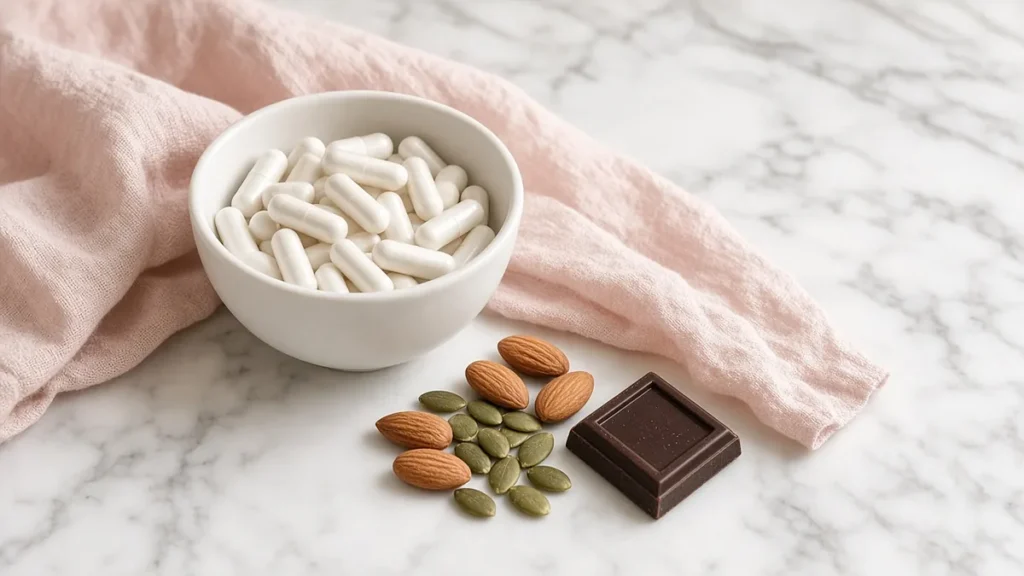
Magnesium may ease period cramps a little, but the evidence is thin. A Cochrane review found that magnesium beat a placebo for period pain in three small trials, yet the authors couldn't say which dose works and stopped short of recommending it. If you want to try it, stay within the safe supplement limit of 350 mg a day, and keep proven options like ibuprofen and heat in your plan.
I take cramps seriously and supplements with some skepticism, so below I go through what the studies actually show, how much magnesium is safe, which form to pick, who should skip it, and two supplements I'd consider.
Affiliate disclosure: As an Amazon Associate, I earn from qualifying purchases. If you buy through a product link on this page, the price is the same for you.
What the research actually says
The best summary is still a Cochrane review from 2001. It pooled three small randomized trials and found that magnesium was more effective than a placebo for pain, and women taking it needed less extra pain medication. Side effects were no more common than with the placebo. The authors called magnesium "a promising treatment" but said it was unclear what dose or regimen to use, so they made no strong recommendation (Proctor and Murphy, Cochrane, 2001).
Newer reviews haven't settled it:
- A 2016 Cochrane review of dietary supplements for period pain, covering 27 randomized trials, found no high-quality evidence that any supplement works (Pattanittum et al., 2016).
- A 2020 meta-analysis of micronutrients for primary dysmenorrhea found only one trial that tested magnesium, combined with calcium, and the authors wrote that little is known about magnesium and more studies are needed (Saei Ghare Naz et al., 2020 – PMC).
- A 2017 narrative review in Magnesium Research was more upbeat and described magnesium as effective for period pain and PMS, but a narrative review isn't the same as a pooled analysis of trials (Parazzini et al., 2017).
Mainstream medical sites land in the same cautious place. Mayo Clinic says a number of studies suggest magnesium, along with vitamin E, omega-3s, vitamin B1 and vitamin B6, might reduce menstrual cramps. MedlinePlus suggests trying vitamin B6, calcium and magnesium, especially if your pain comes with PMS.
My honest read: magnesium is a reasonable, low-cost thing to try if you're otherwise healthy and stay under the limit. It's a side dish, not the main treatment.
How much magnesium is safe?
This is where people get into trouble, because "more" doesn't mean "better" with supplements.
| Amount for adult women | What it means | |
|---|---|---|
| Recommended daily intake (food plus supplements) | 310 to 320 mg | What most adult women should get each day, mostly from food |
| Upper limit from supplements and medicines | 350 mg | The most you should take from pills, powders or laxatives unless a clinician advises more |
| Magnesium from food | No limit | Healthy kidneys clear the extra in urine |
All three figures come from the NIH Office of Dietary Supplements. The 350 mg limit applies only to supplements and medicines. Food sources such as legumes, nuts, seeds, whole grains and leafy greens like spinach don't count toward it.
Going over the limit usually announces itself: high doses of supplemental magnesium can cause diarrhea, nausea and abdominal cramping, which is the last thing you need during your period. Extremely high intakes can lead to an irregular heartbeat (NIH ODS).
Both supplements I list below give 200 mg per serving, which leaves room under the 350 mg ceiling. Check the label of anything else you take, too. NIH notes that magnesium shows up in multivitamins, some laxatives and some heartburn and indigestion remedies, and it all adds up.
Which type of magnesium is best?
There's no form proven to work best for cramps, because the trials didn't compare forms. What we do know is about absorption. According to the NIH ODS fact sheet for health professionals, small studies found magnesium aspartate, citrate, lactate and chloride are absorbed more completely than magnesium oxide and sulfate.
Magnesium glycinate isn't on that list, so I won't claim it's been proven better. I lean toward it anyway for a practical reason: it's widely sold in moderate doses, and it's the form most people searching for cramp relief end up buying. If your budget favors citrate, that's a reasonable choice too, since it's one of the better-absorbed forms on the NIH list.
Who should check with a doctor first
Talk to your doctor or pharmacist before taking magnesium if any of these apply:
- You have kidney disease. Healthy kidneys are what get rid of the excess (NIH ODS).
- You take bisphosphonates for osteoporosis. They aren't absorbed well when taken too close to a high-magnesium supplement.
- You take antibiotics. Some might not be absorbed if taken too soon before or after magnesium.
- You take diuretics. Depending on the type, they can raise or lower how much magnesium you lose in urine.
Those interactions are all listed by the NIH Office of Dietary Supplements. The fix is often just spacing the doses apart, but your pharmacist can tell you how.
Two magnesium glycinate supplements I'd look at
These descriptions come from each product's Amazon listing, not from cramp trials.
| Product | What the listing says | Good for |
|---|---|---|
| Doctor's Best Magnesium Glycinate Lysinate, 240 count | 200 mg per serving, described as 100% chelated, can be taken any time of day | A large bottle if you plan to try it for a few cycles |
| Nature Made Magnesium Glycinate, 60 capsules | 200 mg per serving, two capsules daily with a meal | A smaller bottle from a familiar brand |
Doctor's Best is the one I'd pick for a fair trial. The 240-count bottle lasts a while, so you can take it through two or three cycles and see whether your cramps change.
Nature Made is the easy, smaller option. Taking it with a meal, as the label suggests, may also be gentler on your stomach.
Whichever you choose, give it a few cycles and keep a simple note of your pain on day one and day two. If nothing changes after three months, it's probably not your answer.
What works better than magnesium
If cramps are wrecking a day or two every month, these have stronger backing:
- An NSAID, started early. MedlinePlus suggests taking ibuprofen or naproxen the day before your period is expected and continuing for the first few days (MedlinePlus). Mayo Clinic gives similar advice.
- Heat on your lower belly. Mayo Clinic lists a heating pad, hot water bottle, heat patch or hot bath. Here's my guide to using a heating pad for period cramps safely, and if you're choosing between the two classics, my comparison of a hot water bottle vs heating pad.
- Hormonal birth control. Pills, patches, rings, implants and hormonal IUDs can reduce cramps by preventing ovulation (Mayo Clinic).
- Regular exercise. Both Mayo Clinic and MedlinePlus list it among self-care steps.
If heavy bleeding comes with your cramps, it helps to sort that out too. My guide to period underwear for heavy flow covers the signs your bleeding is heavier than normal.
When to see a doctor
MedlinePlus recommends contacting your provider if treatments don't relieve your pain after 3 months, if you pass blood clots or have other symptoms with the pain, or if the pain happens at times other than your period, begins more than 5 days before it or continues after it ends. Get care right away for fever with pelvic pain, foul-smelling discharge, or sudden, severe pain, especially if your period is more than a week late and you've been sexually active (MedlinePlus).
Cramps that get worse over time can point to conditions like endometriosis or fibroids, which ACOG describes as causes of secondary dysmenorrhea. Those need a diagnosis, not a supplement.
Frequently asked questions
Which magnesium is best for period cramps?
No form has been proven best for cramps, because the trials didn't compare forms. NIH notes that citrate, aspartate, lactate and chloride are absorbed better than oxide and sulfate. I lean toward glycinate because it's sold in moderate 200 mg doses, but citrate is a reasonable, cheaper choice.
How much magnesium should I take for period cramps?
The trials didn't agree on a dose, so there's no proven amount for cramps. What is clear is the safety ceiling: adults shouldn't take more than 350 mg a day from supplements and medicines unless a clinician says otherwise, according to NIH. Magnesium from food doesn't count toward that limit.
When should I take magnesium for period cramps?
Nobody has tested a best time of day for cramps. Pick a time you'll remember and take it daily for a few cycles, so you can judge whether your pain changes. Follow your product's label. Doctor's Best says any time of day, while Nature Made says to take it with a meal.
Can magnesium cause diarrhea?
Yes. NIH says high intakes of magnesium from supplements and medicines can cause diarrhea, nausea and abdominal cramping. That's one reason to stay at or below 350 mg a day from supplements. Magnesium is also a key ingredient in some laxatives, so if your stomach reacts, lower the dose or stop.
Is magnesium glycinate good for period cramps?
It may help, but no trial I found tested glycinate specifically for cramps. The small studies behind magnesium for period pain used other forms. Glycinate is a sensible way to try magnesium at a moderate dose, as long as you stay under 350 mg a day from supplements and check your medications first.
What foods are high in magnesium?
NIH lists legumes, nuts, seeds, whole grains and green leafy vegetables such as spinach as good sources. Magnesium from food isn't harmful and doesn't need to be limited, because healthy kidneys clear the extra. Eating more of these foods is a safe first step before reaching for a supplement.
Does magnesium help with cramps at night?
None of the trials I found looked at nighttime cramps specifically, so I can't promise it will. If cramps keep you awake, an NSAID started the day before your period has better support, and MedlinePlus suggests warm baths and lying on your side with your knees bent. Never fall asleep with a heating pad on.
This article is for informational purposes and doesn't replace advice from a healthcare professional.
Sources
- Proctor ML, Murphy PA. Herbal and dietary therapies for primary and secondary dysmenorrhoea. Cochrane Database Syst Rev, 2001 – PubMed
- Pattanittum P et al. Dietary supplements for dysmenorrhoea. Cochrane Database Syst Rev, 2016 – PubMed
- Saei Ghare Naz M et al. The Effect of Micronutrients on Pain Management of Primary Dysmenorrhea: a Systematic Review and Meta-Analysis. J Caring Sci, 2020 – PMC
- Parazzini F et al. Magnesium in the gynecological practice: a literature review. Magnes Res, 2017 – PubMed
- Magnesium: Fact Sheet for Consumers – NIH Office of Dietary Supplements
- Magnesium: Fact Sheet for Health Professionals – NIH Office of Dietary Supplements
- Menstrual cramps: Diagnosis and treatment – Mayo Clinic
- Painful menstrual periods – MedlinePlus
- Dysmenorrhea: Painful Periods – ACOG
If you want to read more articles like Magnesium for Period Cramps: Does It Work, How Much Is Safe, and Which Type to Take, check out the Women's Health category.