
Ferritin Level for Hair Loss: What Number Causes Shedding, and What Helps Regrowth

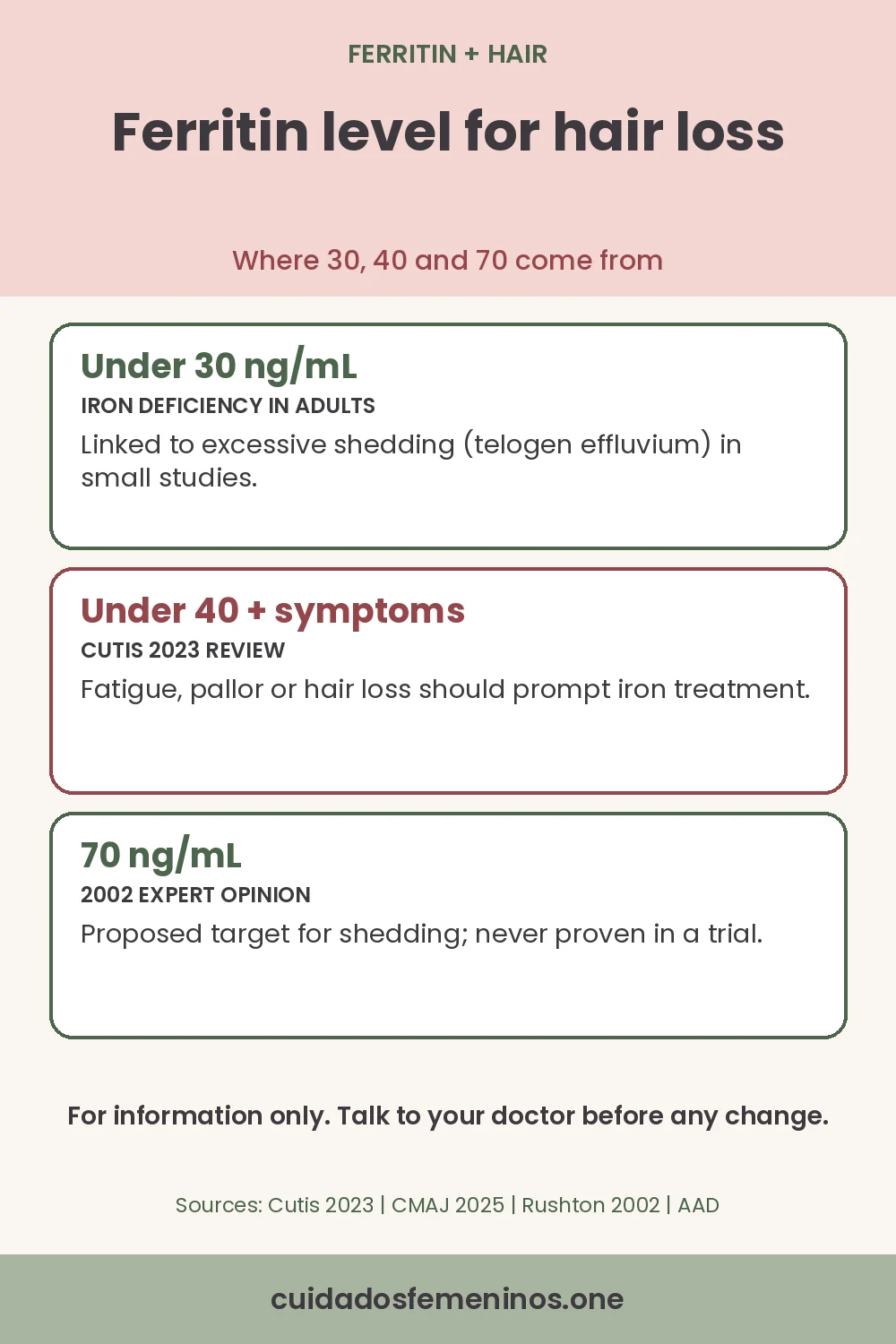
There is no single ferritin level for hair loss that experts agree on, and that is why you see 30, 40 and 70 quoted online. Below 30 ng/mL is iron deficiency by the usual adult cutoff. A 2023 dermatology review says a ferritin under 40 with symptoms such as hair loss should prompt iron treatment. The often-repeated 70 comes from a 2002 expert recommendation, not from a trial.
For information only. This article does not replace your doctor or dermatologist. Please do not start iron without a blood test.
- Quick answer
- What ferritin level causes hair loss?
- Where the “ferritin 70 for hair” rule comes from
- Which kind of hair loss does iron affect?
- Does hair grow back after low ferritin?
- How to raise ferritin for hair growth
- Which blood tests to ask for
- When iron is the wrong move
- When to see a doctor
- Frequently asked questions
- What ferritin level causes hair loss?
- What ferritin level is good for hair growth?
- Does hair grow back after low ferritin?
- How to raise ferritin levels for hair growth?
- What is the best ferritin supplement for hair loss?
- Is ferritin 20 too low for hair?
- Can low ferritin cause female pattern hair loss?
- How long after taking iron does shedding stop?
- Can too much iron cause hair loss?
- Should I take iron and minoxidil together?
- Sources
Quick answer
- Under 30 ng/mL: iron deficiency in adults. In one small study, a ferritin at or below 30 came with 21 times the odds of excessive shedding.
- Under 40 ng/mL plus symptoms (fatigue, pallor, breathlessness, hair loss): treatment threshold suggested in a 2023 review in Cutis.
- 70 ng/mL: a target proposed in 2002 for women with increased shedding. Its author wrote that the right level was “yet to be definitively established.”
- Iron helps shedding (telogen effluvium), not genetic thinning. For female pattern hair loss, low iron has not been shown to be the cause.
What ferritin level causes hair loss?
Ferritin is the protein that stores iron, and your blood level mirrors your iron stores. A 2025 review in the Canadian Medical Association Journal defines iron deficiency in adults as a ferritin below 30 μg/L, which is the same as 30 ng/mL. It lists hair and nail changes among the symptoms of iron deficiency without anemia.
For hair specifically, the evidence is mixed. Here is what the studies summarized in the 2023 Cutis clinical guide found, side by side, with how much weight each number can carry:
| Number | Where it comes from | What it showed | How solid it is |
|---|---|---|---|
| ≤30 ng/mL | Case-control study, 30 women aged 15 to 45 | Women with telogen effluvium averaged 16.3 ng/mL vs 60.3 in women without hair loss; odds of shedding were 21 times higher at ≤30 | Strong signal, very small study |
| 14.7 vs 25.3 ng/mL | Retrospective review, 54 patients with diffuse hair loss and 55 controls | Patients with diffuse nonscarring hair loss had lower ferritin and lower vitamin D than controls | Supports a link, retrospective |
| ≤15 or ≤40 ng/mL | Case-control study, 381 women and 76 controls | No higher rate of iron deficiency in women with female pattern hair loss or chronic telogen effluvium | The main contrary finding |
| <40 ng/mL with symptoms | Cutis 2023 review recommendation | Low ferritin plus fatigue, pallor, breathlessness or hair loss should prompt iron treatment | Expert guidance |
| 70 ng/mL (with normal ESR) | Rushton, Clinical and Experimental Dermatology, 2002 | Recommended for women with increased shedding; the author said the ideal level was not yet established | Expert opinion, 20+ years old |
So if your ferritin is 12, iron is a very plausible piece of your shedding. If it is 55, low iron is a less likely explanation, and chasing 70 with extra pills may not change much. Between those, it is a judgment call with your doctor.
Where the “ferritin 70 for hair” rule comes from
You will find 70 on forums, in hair clinic blogs and in Reddit threads. The source is a 2002 review by D. H. Rushton on nutrition and hair loss. Rushton wrote that the serum ferritin level to aim for in people with increased shedding was “yet to be definitively established,” but recommended 70 μg/L along with a normal erythrocyte sedimentation rate (under 10 mm/h), a marker of inflammation.
That second condition is usually left out. It matters because ferritin rises with inflammation. The Cutis guide calls ferritin an acute-phase reactant: infection or inflammation can make it look normal or high even when stores are low. A ferritin of 70 during a flare of an inflammatory condition is not the same as a ferritin of 70 on a healthy day.
The same 2002 review also warned that excessive supplements can themselves cause hair loss and are not recommended without a proven deficiency. Seventy is a reasonable conversation starter with a dermatologist. It is not a number to reach by doubling up on iron on your own.
Which kind of hair loss does iron affect?
This is the question that decides whether raising ferritin will help you. Iron is linked to shedding, not to the slow, genetic widening of a part.
| Type of hair loss | What it looks like | Role of low ferritin | What else to discuss |
|---|---|---|---|
| Telogen effluvium (excessive shedding) | More hairs than usual on the pillow, brush or shower drain, all over the scalp | The Cutis review says iron status may play a role | Recent triggers: birth, illness, high fever, surgery, losing 20 pounds or more, stopping the pill, major stress |
| Female pattern hair loss (androgenetic alopecia) | Gradual thinning at the crown or a wider part, less volume over years | Insufficient evidence that low iron causes it; genes and hormones drive it | Treatments such as oral or topical minoxidil |
| Alopecia areata | Round, smooth bald patches | Some studies suggest a link and others do not (Trost, 2006) | A dermatologist visit for diagnosis |
The two can overlap. You can have pattern thinning that suddenly gets worse because you also became iron deficient. Fixing the iron may stop the extra shedding while the underlying thinning still needs its own treatment.
Does hair grow back after low ferritin?
Shedding from telogen effluvium is usually temporary, and the American Academy of Dermatology says hair tends to regain its normal fullness within six to nine months once the trigger is gone. Its example is postpartum shedding: it starts about two months after birth, peaks about four months after, then settles. If the trigger continues, the shedding can last much longer.
Low iron is a trigger that can continue quietly for months. That is the best argument for testing. The honest caveat: the Cutis authors write that it is unclear whether iron supplements improve hair density or thickness. The reviews behind this article give no reliable “regrowth in X weeks” figure after iron is corrected, so be wary of anyone who does.
A realistic timeline looks like this. The CMAJ algorithm rechecks ferritin about 3 months after starting iron. Shedding that is driven by iron can then take several more months to settle, and new growth is short at first. Expect to judge results in months, not weeks.
How to raise ferritin for hair growth
Start with the cause. In women before menopause, the most common causes of iron deficiency anemia are menstrual blood loss and pregnancy, according to a 2006 review in the Journal of the American Academy of Dermatology. After menopause, blood loss from the gut and malabsorption need to be checked first. Heavy periods also need treatment, or the iron keeps draining away.
Then the iron itself. The CMAJ review says iron salts (ferrous gluconate, sulfate or fumarate) are first-line because they are cheaper, and that there is no robust evidence that pricier forms work better. It advises taking iron once a day and notes that every-other-day dosing may be easier on the stomach. The Cutis guide mentions a study suggesting 40 to 80 mg of elemental iron every other day to improve absorption.
Affiliate disclosure: As an Amazon Associate, I earn from qualifying purchases. I may also earn from some brand partner links. If you buy through a product link on this page, the price is the same for you. Read the full disclosure.
If your doctor confirms low ferritin and suggests an over-the-counter iron, the common option in US stores is ferrous sulfate 325 mg, which the Cutis guide notes provides 65 mg of elemental iron. If sulfate upsets your stomach, ask whether a gentler form such as ferrous bisglycinate is reasonable for you. We compare forms in detail in sucrosomial iron vs ferrous sulfate.
Food helps, but slowly when stores are low. Our guide to low ferritin with normal hemoglobin has an iron-per-serving food table and what blocks absorption.
Which blood tests to ask for
- Ferritin and a complete blood count. The CMAJ review calls these the key first tests. The blood count is usually normal when iron is low but you are not anemic.
- Iron studies if you have inflammation. With a ferritin of 30 or more and a condition that raises inflammation, a transferrin saturation below 20% still points to iron deficiency.
- Vitamin D and thyroid. In the 54-patient study above, vitamin D was also lower in people with diffuse hair loss; that study compared thyroid hormone, B12, folate and zinc too.
- A recheck. Ask when to repeat ferritin after you start iron; the CMAJ algorithm uses 3 months.
Seen the “ferritin face” videos on TikTok? Hair shedding is one of the signs they list, but a mirror can’t tell you your ferritin. Here is what the ferritin face trend gets right and wrong, and why the blood test comes before the iron.
When iron is the wrong move
Iron is not harmless “just in case.” The 2006 JAAD review warns that excessive iron supplementation can cause iron overload, especially in people with hereditary hemochromatosis. It also says there is not enough evidence to give iron to everyone with hair loss and iron deficiency without anemia; the decision rests on clinical judgment. If your ferritin is already normal or high, extra iron is not recommended and is unlikely to help your hair.
Shedding in your 40s can also be tied to hormone changes; see perimenopause symptoms and HRT for the bigger picture.
When to see a doctor
- Shedding that lasts more than a few months, or bald patches, scarring, redness or pain on the scalp.
- Heavy periods, or any bleeding after menopause.
- Severe fatigue, shortness of breath, chest discomfort or dizziness when you stand up, which can mean anemia.
- Black stools or blood in the stool. Iron deficiency in men and in women after menopause needs a search for gut blood loss.
- Ferritin that does not rise after about 3 months of iron.
Frequently asked questions
What ferritin level causes hair loss?
There is no agreed number. Below 30 ng/mL is iron deficiency in adults, and in one small study a ferritin at or below 30 carried 21 times the odds of excessive shedding. A 2023 review suggests treating a ferritin under 40 when symptoms such as hair loss are present.
What ferritin level is good for hair growth?
A 2002 review recommended 70 ng/mL, with a normal inflammation marker, for women with increased shedding, while admitting the right level was not established. No trial has proven that reaching 70 regrows hair. Most guidance focuses on correcting deficiency, meaning getting above 30 to 40, with your doctor.
Does hair grow back after low ferritin?
Shedding caused by a trigger such as low iron is usually temporary. The AAD says hair tends to regain normal fullness within six to nine months once the trigger is gone. Reviews note it is unclear whether iron itself improves hair density, and pattern thinning will not reverse with iron.
How to raise ferritin levels for hair growth?
Treat the cause, such as heavy periods, then take iron as your doctor advises. A 2025 CMAJ review says iron salts such as ferrous sulfate are first-line, once daily, with every-other-day dosing possibly easier to tolerate. It suggests rechecking ferritin after about 3 months. Food helps, but slowly.
What is the best ferritin supplement for hair loss?
There is no hair-specific iron. The CMAJ review says iron salts such as ferrous sulfate, gluconate or fumarate are first-line and that pricier forms have no robust evidence of working better. If sulfate upsets your stomach, ask your doctor about a gentler form. Take iron only after a blood test.
Is ferritin 20 too low for hair?
A ferritin of 20 ng/mL is below the usual adult cutoff of 30 for iron deficiency, so it is worth treating with your doctor, especially if you are shedding. In one small study, women with excessive shedding averaged about 16 ng/mL, compared with about 60 in women without hair loss.
Can low ferritin cause female pattern hair loss?
The evidence says no. A 2023 dermatology review found insufficient evidence that low iron affects androgenetic alopecia, which is driven by genes and hormones. A study of 381 women found no higher rate of iron deficiency in pattern hair loss. Low iron can still add shedding on top of it.
How long after taking iron does shedding stop?
No study we reviewed gives a reliable timeline. Ferritin is usually rechecked about 3 months after starting iron, and shedding from any trigger tends to settle over the following months. The AAD describes full recovery from shedding in six to nine months once the cause is removed.
Can too much iron cause hair loss?
Yes, it can. A 2002 review warned that excessive nutritional supplements may cause hair loss and should not be taken without a proven deficiency. A 2006 review adds that too much iron can cause iron overload, especially with hereditary hemochromatosis. Test first and recheck while you supplement.
Should I take iron and minoxidil together?
They work on different problems, so some women need both. Iron corrects a deficiency that can drive shedding, while minoxidil treats pattern thinning. Neither replaces the other. Ask your dermatologist to check ferritin before or alongside minoxidil, because shedding from low iron can overlap with pattern thinning.
Last updated: November 2026. This guide is for information only and does not replace your doctor or dermatologist. Do not start iron without a blood test.
Sources
- Zhang D, Lasenna C, Shields BE. Serum Ferritin Levels: A Clinical Guide in Patients With Hair Loss. Cutis, 2023.
- Rushton DH. Nutritional factors and hair loss. Clinical and Experimental Dermatology, 2002;27(5):396-404.
- Trost LB, Bergfeld WF, Calogeras E. The diagnosis and treatment of iron deficiency and its potential relationship to hair loss. J Am Acad Dermatol, 2006;54(5):824-44.
- Diagnosis and management of iron deficiency in females. CMAJ, 2025 (PMC12237530).
- American Academy of Dermatology. Hair loss or hair shedding? (Hair shedding).
Keep reading
- Low ferritin, normal hemoglobin Cutoffs, tests and foods.
- Oral minoxidil for women
- Sucrosomial iron vs ferrous sulfate
- Ferritina baja sin anemia (Spanish)
 How Long Before Pregnancy Should You Stop Ozempic, Wegovy or Zepbound? (2026 Labels + ACOG)
 How Long Should You Use a Heating Pad for Period Cramps? Safe Times, Settings and What Works
 When to Take an Ovulation Test: The Right Cycle Day and Time of Day
If you want to read more articles like Ferritin Level for Hair Loss: What Number Causes Shedding, and What Helps Regrowth, check out the Women's Health category.