Oral Minoxidil for Women: What Studies Used and What Side Effects to Expect

If you are tired of minoxidil foam flattening your hair every night, or your scalp burns every time you apply it, you have probably heard dermatologists now prescribe a tiny daily pill instead. This guide to oral minoxidil for women covers what the studies actually used, what happened, and the side effects worth knowing before you ask about it.
This article is for information only and does not replace advice from your doctor or dermatologist. Do not start, stop or change a prescription on your own.
- Quick answer
- Oral vs topical minoxidil: what actually changes
- What dose have studies used in women?
- Side effects: extra hair, shedding, swelling and heart warnings
- Do women gain weight on oral minoxidil?
- When topical may still be enough
- Cost: topical minoxidil, a prescribed pill and PRP
- Could low ferritin be part of the story?
- When to call your doctor
- Frequently asked questions
- Do women gain weight on oral minoxidil?
- What are the downsides of taking oral minoxidil?
- What is the best oral minoxidil for women?
- What dose do studies use for female hair loss?
- Is 2.5 mg of oral minoxidil used in women?
- Does oral minoxidil cause shedding?
- How does oral minoxidil compare with topical foam or solution?
- Can low ferritin cause hair loss?
- Does spironolactone help female hair loss?
- How much does PRP for hair cost?
- Sources
Quick answer
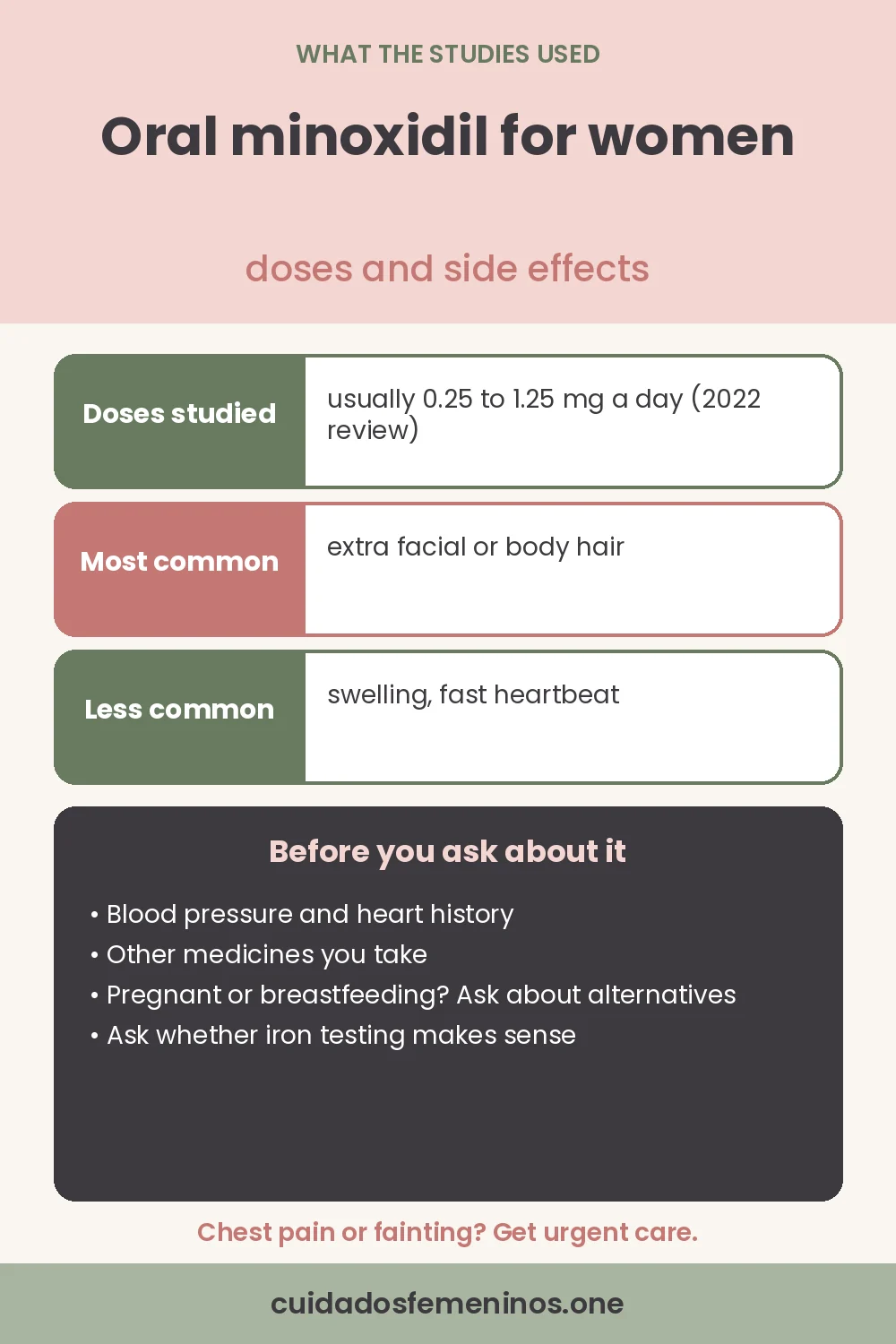
Low-dose oral minoxidil is used off-label for female pattern hair loss, often when topical is hard to stick with. Studies in women usually used about 0.25 mg to 1.25 mg a day. The most common side effect is extra facial or body hair; swelling and a fast heartbeat are less common. A clinician decides if it fits you.
Oral vs topical minoxidil: what actually changes
Topical minoxidil is the over-the-counter starting point. Mayo Clinic says women get the best effect applying it to the scalp skin once daily, that it takes at least six months to stop further loss and start regrowth, and that you have to keep using it indefinitely to keep the benefit. Possible side effects include scalp irritation and unwanted hair on the nearby skin of the face and hands. The American Academy of Dermatology adds that results usually take 6 to 12 months and that if you stop, you lose the benefits.
Oral minoxidil is a different story. It is an old blood pressure drug: the 2022 review notes hypertension doses are usually 10 to 40 mg a day, while hair loss uses much lower doses, off-label. The 2020 review by Randolph and Tosti (17 studies, 634 patients) found oral minoxidil an effective and well-tolerated alternative for healthy patients having difficulty with topical formulations. The reasons people struggle with topical are familiar: applying it twice a day, the hair texture it leaves, and scalp irritation.
Because a pill reaches your whole body, extra hair on the face or body is more likely than with topical, though topical can cause it too. Neither form is a one-time fix.
What dose have studies used in women?
There is no single dose that is right for every woman. What a clinician chooses depends on your blood pressure, your other medicines and how you respond.
The 2022 review by Ramírez-Marín and Tosti says doses of 0.25 to 1.25 mg daily are usually used for female pattern hair loss, and 2.5 to 5 mg a day for male pattern hair loss. Papers it cites reported improvement in 61% to 86% of patients. It mentions Therianou et al. using 0.25 mg twice daily as a satisfactory alternative to topical in women, and Sinclair reporting positive outcomes with 0.25 mg combined with spironolactone 25 mg. Those are reported study regimens, not a prescription.
The 148-woman study, and the catch
In a retrospective study from one center, Rodrigues-Barata and colleagues looked at 148 women (mean age 47.2) on doses between 0.25 and 2 mg a day (median 1 mg) for a mean of 9 months. Three dermatologists compared photos: 20.3% had stabilized and 79.7% improved (64.2% slightly, 15.5% markedly). The catch: 125 of the 148 women (84.5%) were also using other treatments, and only 23 (15.5%) took oral minoxidil alone. In that small monotherapy group, 52% improved slightly and 13% markedly. So the headline numbers cannot be credited to the pill alone, and they are not your personal odds.
Side effects showed up in 19%, mostly extra hair growth (17%). Three women (2%) stopped: two for a fast heartbeat and one for lower-leg swelling with general malaise.
The 0.25 mg vs 1 mg randomized trial
In a 24-week randomized double-blind trial, Nascimento e Silva and colleagues assigned 30 women to compounded capsules of 0.25 mg or 1 mg a day; 26 finished. In the 1 mg group, hair count in the target area rose from 277.2 to 304.0 per cm² (P<.001). In the 0.25 mg group it went from 292.0 to 299.8 (P=.20), which was not a statistically significant increase. The difference between groups was significant (P=.008), though blinded photo ratings did not differ significantly.
Side effects were mild: facial hypertrichosis in two women on 1 mg, and one woman on 1 mg who reported worse shedding at week 8 that had resolved by week 24. Nobody withdrew because of side effects. Keep the limits in mind: a small, single-center study with no placebo group and a short follow-up. As Randolph and Tosti wrote, larger randomized studies comparing doses are still needed.
| Source (year) | Who was studied | Daily dose | What happened | Main side effects |
|---|---|---|---|---|
| Randolph & Tosti, 2020 (print 2021) | Review: 17 studies, 634 patients | Varied low doses | Effective and well tolerated for healthy patients having difficulty with topical; larger randomized studies needed | Described as well tolerated overall |
| Ramírez-Marín & Tosti, 2022 | Review of papers on patterned hair loss | Usually 0.25–1.25 mg for women | Improvement in 61–86% of patients in cited papers; Therianou: 0.25 mg twice daily; Sinclair: 0.25 mg + spironolactone 25 mg | Hypertrichosis most common, more frequent at 5 mg/day; low side-effect profile at low doses |
| Rodrigues-Barata et al., 2020 | 148 women, retrospective; 84.5% also on other treatments | Median 1 mg (0.25–2 mg), mean 9 months | 20.3% stabilized, 79.7% improved (64.2% slight, 15.5% marked); monotherapy group: 52% slight, 13% marked | 19% any side effect, mainly hypertrichosis (17%); 2% stopped (tachycardia, or edema with malaise) |
| Nascimento e Silva et al., 2022 | Randomized trial, 30 women (26 finished), 24 weeks | 0.25 mg vs 1 mg | 1 mg: 277.2 → 304.0 hairs/cm² (P<.001); 0.25 mg: 292.0 → 299.8 (P=.20); between groups P=.008 | Mild facial hypertrichosis in 2 (1 mg); one temporary worsening of shedding at week 8, resolved by week 24; no withdrawals |
Side effects: extra hair, shedding, swelling and heart warnings
Extra hair (hypertrichosis) is the side effect you are most likely to notice. It made up most of the 19% with any side effect in the 148-woman study, and the 2022 review says it is more common at 5 mg a day.
Shedding. The 2022 review says a temporary shedding phase is less common with oral than with topical minoxidil. Most studies didn’t report it, but it cites Sinclair et al. reporting it in 22 of 100 women; none stopped treatment over it, and for most it ended within four weeks. That is one study’s figure, not a universal rate.
Swelling and a fast heartbeat. Less common, but reasons to call your doctor. In the 148-woman study, those were the reasons the three women stopped.
The boxed warning. As a blood pressure drug, oral minoxidil carries a boxed warning for pericardial effusion that can progress to cardiac tamponade, and for worsening angina. That warning comes from its labeled use for hard-to-control hypertension, at far higher doses than hair loss uses. The 2022 review says use in people with severe hypertension or cardiovascular risk should be carefully planned, and lists hypotension, cardiac comorbidities (in doses above 5 mg a day) and pregnancy as relative contraindications. Low-dose hair studies have generally been well tolerated, but small studies can’t rule out rare serious problems. That is why a blood pressure check and a medical history come first, and why you should never adjust your other medicines on your own.
Do women gain weight on oral minoxidil?
The studies here don’t describe fat gain. They do describe fluid retention, such as lower-leg swelling. Retained fluid can push the scale up without any change in body fat. If your legs, ankles or face swell suddenly or noticeably, tell your doctor.
When topical may still be enough
Plenty of women stay on topical minoxidil: no prescription, a long track record, and less extra hair elsewhere. Here is how the decision usually breaks down:
| Your situation | What to discuss with a dermatologist |
|---|---|
| Topical irritates your scalp, feels greasy, or you can’t keep up with it | Whether low-dose oral minoxidil is reasonable for you |
| You would rather take one pill than apply foam or liquid | Convenience versus a higher chance of extra facial or body hair |
| You have low blood pressure, heart disease, or take blood pressure medicine | Whether the drug’s vasodilator effect makes it a poor fit |
| You are pregnant, trying to conceive, or breastfeeding | Alternatives. The 2022 review says oral minoxidil is not safe in pregnancy and is contraindicated while nursing; don’t self-start |
Affiliate disclosure: As an Amazon Associate, I earn from qualifying purchases. I may also earn from some brand partner links. If you buy through a product link on this page, the price is the same for you. Read the full disclosure.
If you want to give topical a fair six-month trial first, you can browse women’s topical minoxidil on Amazon. Prices change, so check the current listing, and follow the label directions.
Cost: topical minoxidil, a prescribed pill and PRP
Topical minoxidil is sold in drugstores and online; check current prices before you buy. Oral minoxidil for hair loss needs a prescription. What you pay depends on the formulation (the trial above used compounded capsules), the pharmacy and your insurance, so there is no single cash price.
Platelet-rich plasma (PRP) is an in-office procedure. The AAD describes drawing your blood, processing it and injecting it into the scalp, with most patients returning once a month for three months and then every three to six months. Cost varies widely by clinic and by how many sessions you need.
Could low ferritin be part of the story?
Thinning can have more than one cause at once. The AAD says that if a blood test shows you are low in biotin, iron or zinc, your dermatologist may recommend a supplement, and that taking one when your levels are normal can be harmful (too much iron can cause iron poisoning).
So if nobody has checked your iron, ask whether testing makes sense and whether other causes should be looked at. Don’t start iron on your own, and don’t expect a particular ferritin number to reverse pattern thinning. Our guide to low ferritin with normal hemoglobin explains what that result can mean.
If your thinning started or sped up in your 40s, it may overlap with other midlife changes; see perimenopause symptoms and HRT. And if you are wondering about home remedies, our Spanish piece on coconut oil for hair covers what it can and can’t do (it is not a treatment for pattern hair loss).
Wondering which number counts as low for hair? Our guide to the ferritin level for hair loss explains where the 30, 40 and 70 cutoffs come from and which kind of shedding iron can actually fix.
When to call your doctor
Get urgent care for fainting, chest pain, trouble breathing, or severe dizziness. Call your doctor promptly for a racing heartbeat or sudden swelling of the face, legs or ankles. Also call before any dose change, and right away if you become pregnant.
Frequently asked questions
Do women gain weight on oral minoxidil?
The studies reviewed here do not report fat gain. They do report fluid retention, such as swelling of the lower legs, which can raise the number on the scale without any change in body fat. Report sudden or noticeable swelling of your legs, ankles or face to your doctor instead of assuming it is ordinary weight gain.
What are the downsides of taking oral minoxidil?
Extra facial or body hair is the most common issue in the studies. Less common but important are swelling from fluid retention and a fast heartbeat. The drug’s high-dose blood pressure use carries a boxed warning for pericardial effusion and worsening angina; low-dose hair studies were generally well tolerated but cannot rule out rare risks.
What is the best oral minoxidil for women?
There is no single best product or dose. Studies in women have mostly used about 0.25 mg to 1.25 mg a day, and a small trial found 1 mg raised hair counts more than 0.25 mg. The right choice is made with a dermatologist who knows your blood pressure, your other medicines and your history.
What dose do studies use for female hair loss?
Reviews and trials most often describe 0.25 mg to 1.25 mg a day for women. In one randomized trial, 1 mg increased hair counts over 24 weeks while 0.25 mg did not show a statistically significant increase. These are study doses, not instructions; your clinician sets the actual dose and adjusts it based on your response.
Is 2.5 mg of oral minoxidil used in women?
The 2022 review lists 2.5 mg to 5 mg a day as the range used for male pattern hair loss, while 0.25 mg to 1.25 mg is the usual range for women. It is not presented as a standard women’s dose, side effects such as extra hair are more common at higher doses, and higher is not automatically better.
Does oral minoxidil cause shedding?
It can. The 2022 review says temporary shedding is less common than with topical minoxidil, and cites Sinclair et al., who reported it in 22 of 100 women; none stopped treatment for it, and for most it ended within four weeks. That is one study’s number, so treat it as a rough signal rather than your personal risk.
How does oral minoxidil compare with topical foam or solution?
Topical is applied to the scalp, once daily for women according to Mayo Clinic, and is sold without a prescription. Low-dose oral is off-label and can be easier for women who dislike the mess or irritation of topical, but it raises the chance of extra hair elsewhere. Topical can also cause unwanted hair on the face or hands.
Can low ferritin cause hair loss?
Low iron can be one of several factors behind thinning, and the AAD recommends iron only when a blood test shows a deficiency. Pattern hair loss has its own causes, so iron alone may not fix it. Ask your clinician whether testing makes sense, and do not start iron on your own. Our low ferritin guide explains the numbers.
Does spironolactone help female hair loss?
The 2022 review notes that Sinclair reported positive outcomes combining 0.25 mg of oral minoxidil with spironolactone 25 mg, and says spironolactone helps offset minoxidil’s fluid and sodium retention. Spironolactone is a prescription medicine that is not used in pregnancy, so whether it fits you is a decision for your dermatologist or doctor.
How much does PRP for hair cost?
PRP is an in-office procedure, and the cost varies widely by city, clinic and number of sessions. The AAD describes the usual schedule, with most patients returning once a month for three months and then every three to six months, but it does not give a national average price. Ask the clinic for a full written quote first.
This article is general information, last updated November 2026. It is not medical advice. Talk to your dermatologist or doctor before you start, stop or change any hair loss treatment.
Sources
- Randolph M, Tosti A. Oral minoxidil treatment for hair loss: A review of efficacy and safety. J Am Acad Dermatol, online 2020 (print 2021)
- Ramírez-Marín HA, Tosti A. Role of Oral Minoxidil in Patterned Hair Loss. Indian Dermatol Online J, 2022
- Rodrigues-Barata R, et al. Low-Dose Oral Minoxidil for Female Pattern Hair Loss: A Unicenter Descriptive Study of 148 Women. Skin Appendage Disord, 2020
- Nascimento e Silva M, et al. Randomized clinical trial of low-dose oral minoxidil for the treatment of female pattern hair loss: 0.25 mg versus 1 mg. J Am Acad Dermatol, 2022
- Mayo Clinic: Hair loss, diagnosis and treatment
- American Academy of Dermatology: Hair loss, diagnosis and treatment
Keep reading
- Low ferritin, normal hemoglobin What it means for shedding.
- Perimenopause symptoms and HRT
- Aceite de coco para el cabello (Spanish)
- Ferritina baja sin anemia (Spanish)
 Ozempic While Breastfeeding: What ACOG’s 2026 Guidance Says (Wegovy, Mounjaro, Zepbound)
 Progesterone Shortage 2026: Which Capsules Are Available and What to Use Instead
 Ferritin Level for Hair Loss: What Number Causes Shedding, and What Helps Regrowth
If you want to read more articles like Oral Minoxidil for Women: What Studies Used and What Side Effects to Expect, check out the Women's Health category.