
Low Ferritin but Normal Hemoglobin: What the New 2026 Cutoffs Mean for Women
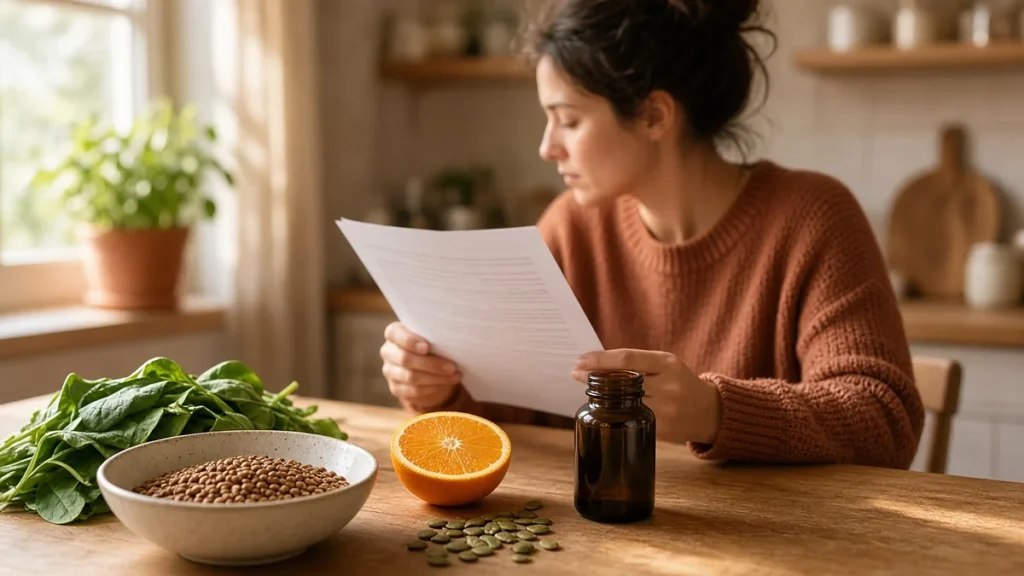
Low ferritin but normal hemoglobin is one of the most common lab results women get, and one of the most often brushed off. You feel wiped out, your doctor runs a blood count, it comes back normal, and that's the end of the conversation. But ferritin measures your iron stores, and they run out long before your hemoglobin drops. In September 2026, the American Society of Hematology (ASH) raised the ferritin cutoffs for diagnosing iron deficiency, so a number that used to pass as normal may now count as low. Here's what changed, what your result means, and what to ask for.
- Why ferritin can be low when hemoglobin is normal
- The new 2026 ferritin cutoffs
- Symptoms of low ferritin in women
- Which blood tests to ask for
- Why women run low: heavy periods, pregnancy and diet
- How to raise ferritin (with your doctor)
- Iron-rich foods: mg of iron per serving
- When to see a doctor
- Frequently asked questions
- Can you have low ferritin with normal hemoglobin?
- What ferritin level is too low for a woman?
- Is a ferritin of 20 low?
- What are the symptoms of low ferritin in women?
- Should I take iron if my ferritin is low but hemoglobin is normal?
- Is it better to take iron every other day?
- Do I need vitamin C with iron?
- Can inflammation make ferritin look normal?
- Can you raise ferritin naturally with food?
- How long does it take to raise ferritin levels?
- What foods raise ferritin the fastest?
- Sources
Why ferritin can be low when hemoglobin is normal
Think of ferritin as your iron savings account and hemoglobin as your checking account. Your body pays for new red blood cells from savings first. Ferritin can drain for months while hemoglobin stays normal, and only when savings are nearly empty does hemoglobin start to fall. At that point, you have iron deficiency anemia. Before it, you have iron deficiency without anemia, which can cause symptoms on its own.
It's common. In a 2023 JAMA study of US females aged 12 to 21, 38.6% had a ferritin under 25, but only 6.3% had iron deficiency anemia. Most of the iron deficiency in that group would have been missed by a blood count alone. ASH estimates that iron deficiency affects about 10 million adults in the US and that up to 70% of cases are missed in high-risk groups.
The new 2026 ferritin cutoffs
The new ASH guideline, published in Blood Advances, sets these thresholds. At or below them, ferritin points to iron deficiency:
| Who | ASH 2026 cutoff | Older common cutoff |
|---|---|---|
| Children 9 months to 4 years | 20 ng/mL or lower | Under 12 (WHO, children under 5) |
| Adults, including menstruating and pregnant women | 30 ng/mL or lower | Under 15 (WHO, 2020) |
| Heavy periods, symptoms, planning pregnancy, pregnancy with anemia | 50 ng/mL or lower may be appropriate | No separate cutoff |
| Adults with inflammation (cancer, IBD, infection) | Ferritin under 100 ng/mL or transferrin saturation under 20% | Varied by lab |
Two details matter. First, ng/mL and µg/L are the same number, so a 22 on a European or Latin American lab report means the same as 22 ng/mL. Second, these are conditional recommendations based on low-certainty evidence, so your doctor will weigh your symptoms and history as well. ASH's visual summary also advises against using a cutoff of 15 for menstruating people.
Your lab's printed reference range may not have caught up. If your ferritin is 18 or 25, don't rely on the absence of a red flag on the report. Look at the number.
Ferritin levels chart: what your number means
Ferritin is reported in ng/mL (the same number as µg/L). Here is how the main cutoffs fit together, from lowest to highest:
| Ferritin (ng/mL) | What it usually means | Source |
|---|---|---|
| Under 15 | Iron deficiency by the older WHO cutoff for adults. ASH now advises against using 15 for menstruating people | WHO 2020; ASH 2026 |
| 30 or lower | Iron deficiency in adults, including menstruating and pregnant women | ASH 2026 |
| 31 to 50 | Can still count as iron deficiency if you have heavy periods or symptoms, are planning a pregnancy, or are pregnant with anemia | ASH 2026 |
| Under 100, with inflammation | Can still be iron deficiency in conditions such as IBD, cancer or infection; a transferrin saturation under 20% also counts | ASH 2026 |
| Above your lab's upper limit | High ferritin. Most often a sign of inflammation, liver disease or another condition, and less often of iron overload. It needs a doctor's look, not more iron | Mayo Clinic |
What labs print as "normal." Reference ranges differ from lab to lab. Mayo Clinic lists 11 to 307 µg/L for women, and Cleveland Clinic gives 15 to 205 ng/mL. That is why a ferritin of 18 or 25 can sit inside the printed range without a flag and still be below the 2026 ASH cutoff of 30.
Why "optimal ferritin" numbers online don't match. Search for optimal ferritin levels and you'll find charts with targets well above anything a lab flags. No major guideline sets one optimal ferritin for everyone. The ASH numbers are diagnostic cutoffs, the points below which iron deficiency is likely, not goals to chase, and the 50 threshold applies only in the situations above. Where you should be depends on your symptoms, your bleeding and the rest of your iron panel, which is a conversation for your doctor.
Symptoms of low ferritin in women
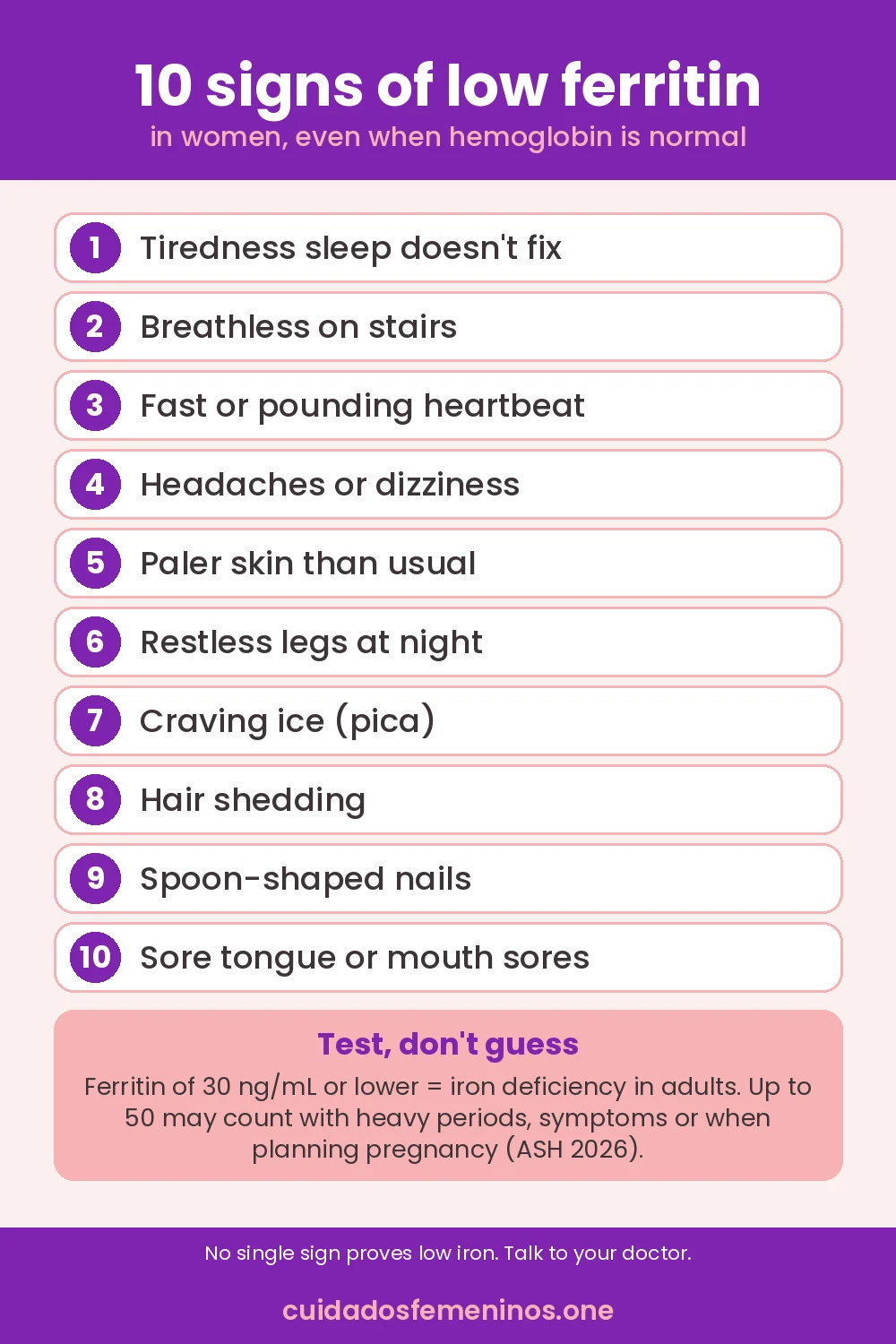
- Tiredness that sleep doesn't fix, or feeling weak on normal days
- Shortness of breath on stairs or during exercise you used to manage
- A fast or pounding heartbeat
- Headaches, dizziness or trouble concentrating
- Pale skin
- Restless legs at night, reported in 32% to 40% of people with iron deficiency in a 2025 JAMA review
- Craving ice or non-food items (pica), reported in 40% to 50%
- Hair shedding: more hair than usual in your brush or the shower drain. The NHS lists hair loss among the less common symptoms of iron deficiency anemia
- Nail changes, such as spoon-shaped nails
- A sore tongue, or painful sores at the corners of your mouth
None of these is specific to iron. Thyroid problems, poor sleep, depression and perimenopause can feel similar, so a blood test is the only way to know. If your energy dipped around the same time your periods changed after 40, perimenopause may be part of the picture too.
Which blood tests to ask for
| Test | What it tells you | Why it matters |
|---|---|---|
| Complete blood count (CBC) | Hemoglobin and red cell size | Shows whether you already have anemia |
| Ferritin | Your iron stores | The main test for iron deficiency; low means low |
| Transferrin saturation (TSAT) | How much iron is moving in your blood | Helps when ferritin may be falsely normal |
| C-reactive protein (CRP) | Inflammation | A high CRP means ferritin can read higher than your real stores |
Try to test when you're well. A cold or flare-up can push ferritin up for a while and hide a low result. And ask for the actual numbers, not just "your iron is fine."
Why women run low: heavy periods, pregnancy and diet
Menstruation is the biggest reason. The CDC defines heavy bleeding as soaking through a pad or tampon every hour for several hours in a row, bleeding for more than 7 days, passing clots the size of a quarter or larger, or needing to double up on protection. Many women live with that for years without knowing it isn't normal. If that sounds familiar, here's what counts as a heavy flow and what helps.
Pregnancy raises iron needs to 27 mg a day, compared with 18 mg for women aged 19 to 50, according to the NIH. ASH says a cutoff of 50 may be appropriate if you're planning a pregnancy, which makes ferritin a reasonable test to ask for before you start trying. If you're already tracking your cycle, see Inito vs Mira for how fertility monitors compare. Vegetarian or vegan eating, frequent blood donation, bariatric surgery, celiac disease and long-term use of stomach acid medicines can also lower iron.
How to raise ferritin (with your doctor)
ASH plans to publish treatment guidance in 2027. Until then, the dose and the plan should come from your doctor, but a few things are well supported:
- Every other day may work better than every day. In a 2017 study of iron-depleted women, absorption was 21.8% with alternate-day dosing versus 16.3% with daily dosing, and twice-daily split doses raised hepcidin, the hormone that blocks iron absorption.
- You don't need extra vitamin C. A 2020 randomized trial found vitamin C added nothing to oral iron in adults with iron deficiency anemia.
- Take it away from tea, coffee and calcium. They reduce how much iron you absorb, so space them out from your dose.
- Stomach upset is the main side effect. Some people find gentler forms such as iron bisglycinate easier on the stomach. Tell your doctor if you can't stick with it, because intravenous iron is an option when pills don't work or aren't tolerated.
- Food helps, but it rarely fixes a real deficit by itself. Red meat, poultry and fish provide heme iron, the form your body absorbs most easily. Beans, lentils, tofu and fortified cereals add non-heme iron.
Affiliate disclosure: As an Amazon Associate, I earn from qualifying purchases. I may also earn from some brand partner links. If you buy through a product link on this page, the price is the same for you. Read the full disclosure.
If your doctor suggests a low-dose over-the-counter iron, a commonly used gentle option is Solgar Gentle Iron 25 mg (iron bisglycinate) on Amazon, also available on iHerb. At 25 mg it's below the 45 mg daily upper limit the NIH sets for adults, and higher doses should only be taken under medical supervision. Keep any iron product locked away from children: accidental iron overdose is dangerous for kids.
| What to check | Why |
|---|---|
| Iron form and amount per capsule | Labels list elemental iron; compare it with what your doctor prescribed |
| Other ingredients | Many multivitamins include calcium, which competes with iron |
| When you'll recheck | Ask your doctor when to repeat ferritin so you know whether it's working |
Iron-rich foods: mg of iron per serving
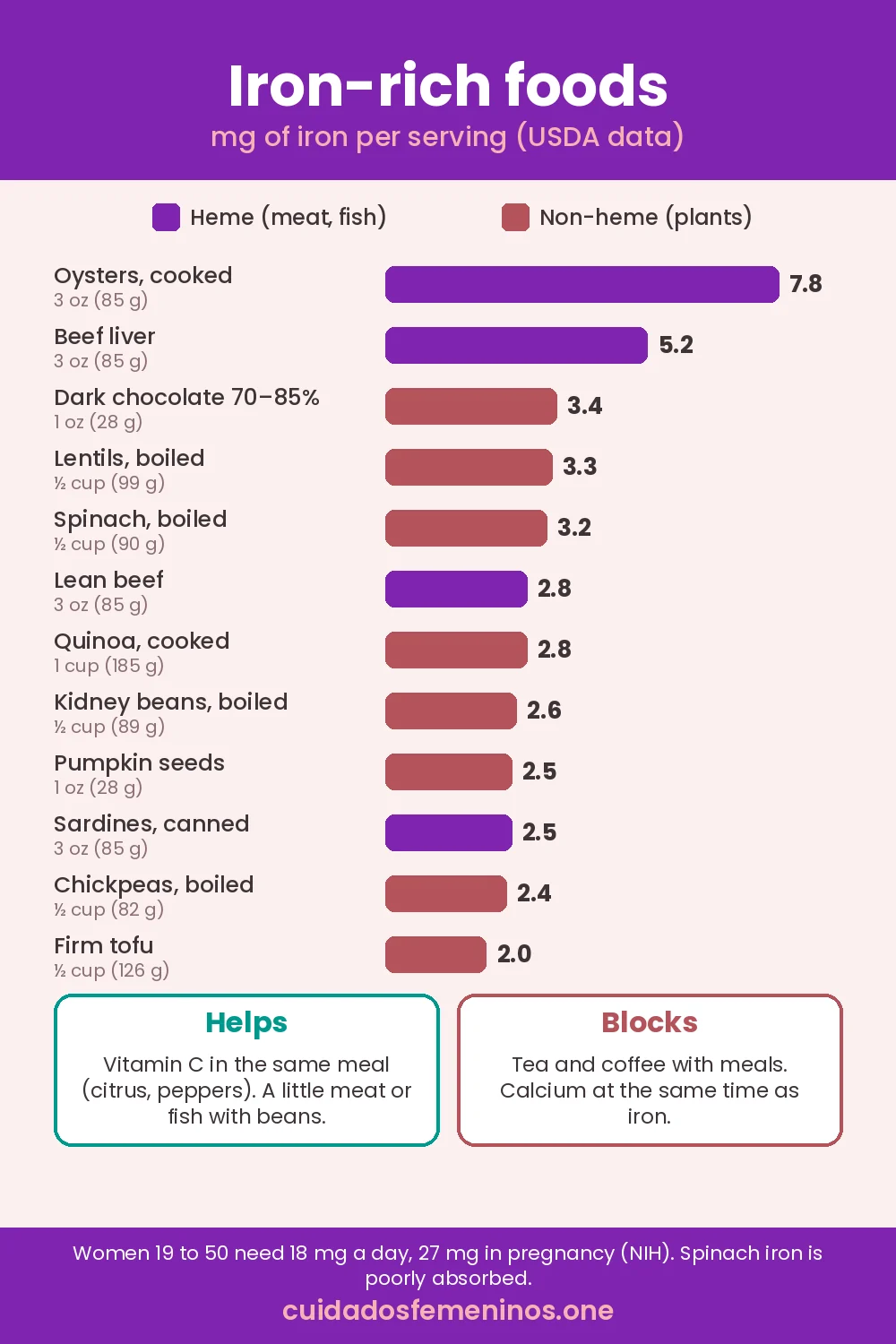
The foods with the most iron per serving are oysters (7.8 mg per 3 oz), beef liver (5.2 mg), dark chocolate, lentils and cooked spinach (each over 3 mg). But the amount on the label isn't the whole story. Heme iron, found in meat, fish and seafood, is absorbed better than the non-heme iron in plants and fortified foods, according to the NIH. Here are common foods ranked by iron per typical serving, calculated from USDA FoodData Central:
| Food | Serving | Iron (mg) | Type of iron |
|---|---|---|---|
| Oysters, wild, cooked | 3 oz (85 g) | 7.8 | Heme + non-heme |
| Beef liver, pan-fried | 3 oz (85 g) | 5.2 | Heme + non-heme |
| Dark chocolate, 70–85% cacao | 1 oz (28 g) | 3.4 | Non-heme |
| Lentils, boiled | ½ cup (99 g) | 3.3 | Non-heme |
| Spinach, boiled | ½ cup (90 g) | 3.2 | Non-heme |
| Lean beef (top round), braised | 3 oz (85 g) | 2.8 | Heme + non-heme |
| Quinoa, cooked | 1 cup (185 g) | 2.8 | Non-heme |
| Kidney beans, boiled | ½ cup (89 g) | 2.6 | Non-heme |
| Pumpkin seeds (pepitas) | 1 oz (28 g) | 2.5 | Non-heme |
| Sardines, canned in oil | 3 oz (85 g) | 2.5 | Heme + non-heme |
| Chickpeas, boiled | ½ cup (82 g) | 2.4 | Non-heme |
| Ground beef 85% lean, broiled | 3 oz (85 g) | 2.2 | Heme + non-heme |
| Firm tofu | ½ cup (126 g) | 2.0 | Non-heme |
| Black beans, boiled | ½ cup (86 g) | 1.8 | Non-heme |
| Light tuna, canned in water | 3 oz (85 g) | 1.4 | Heme + non-heme |
| Chicken thigh, roasted | 3 oz (85 g) | 1.0 | Heme + non-heme |
| Egg, hard-boiled | 1 large egg | 0.6 | Non-heme |
| Fortified breakfast cereal | 1 serving | Up to 18 (check the label) | Non-heme |
For reference, women aged 19 to 50 need 18 mg a day, and 27 mg during pregnancy. Fortified cereals vary a lot by brand, so read the Nutrition Facts label. Spinach looks great on paper, but its polyphenols make its iron hard to absorb, so don't count on it as your main source.
What helps and what blocks iron absorption
- Helps: vitamin C in the same meal, from foods like citrus, bell peppers, tomatoes or strawberries, raises how much plant iron you absorb.
- Helps: a little meat, poultry or seafood in a meal also boosts absorption of the non-heme iron from beans, grains and vegetables on the same plate.
- Blocks: tea and coffee (their polyphenols) and phytates in whole grains and beans reduce non-heme iron absorption. Have tea or coffee between meals rather than with them.
- Blocks: calcium, from dairy or supplements, may reduce absorption of both heme and non-heme iron, so take calcium and iron supplements at different times.
Two honest caveats. The NIH notes that in a typical mixed diet these effects are modest, so you don't need to plan every bite. They matter most if you eat little or no meat: only 5% to 12% of iron is absorbed from vegetarian diets, versus 14% to 18% from mixed diets, which is why the NIH sets vegetarians' iron needs 1.8 times higher. And vitamin C from food is different from the supplement question above: it helps plant iron, but adding a vitamin C pill to iron tablets didn't help in the 2020 trial.
What 18 mg of iron looks like in a day
Here is one way to reach the 18 mg a day women need without fortified foods, using the USDA figures above: a lentil soup made with 1 cup of cooked lentils (6.6 mg) and red peppers for vitamin C, a 1-ounce handful of pumpkin seeds (2.5 mg), 3 ounces of lean beef (2.8 mg) with half a cup of cooked spinach (3.2 mg), and an ounce of 70% to 85% dark chocolate (3.4 mg). That adds up to about 18.5 mg. Eating like this helps keep your stores steady, but refilling a ferritin that is already low usually takes longer, which is why doctors often add a supplement.
If you're pregnant, there's one birth decision that helps your baby's iron stores too: ACOG recommends waiting at least 30 to 60 seconds before clamping the cord, which improves a term baby's iron for the first several months. It also leaves less cord blood to collect, which matters if you're thinking about banking. Here's what cord blood banking really costs and how it fits with delayed clamping.
When to see a doctor
- You have symptoms of iron deficiency and haven't had ferritin tested, or your ferritin was 30 or lower and nobody discussed it.
- Your periods meet the CDC definition of heavy bleeding. The cause, such as fibroids, polyps or a bleeding disorder, needs to be checked, not just the iron.
- You're past menopause, or you're not menstruating, and you're low in iron. Guidelines from the American Gastroenterological Association recommend checking the digestive tract for bleeding in postmenopausal women with iron deficiency anemia.
- You see black or bloody stools, or you have stomach pain or unexplained weight loss.
- You're pregnant or planning to be, and you haven't had your iron checked.
- You've been taking iron for a few months and your levels or symptoms haven't improved.
- Get urgent care for chest pain, fainting or severe shortness of breath.
If your fatigue comes back every winter and improves in spring, it may not be iron at all. Here's how to tell seasonal depression apart, and if painful periods come with the heavy ones, see what the research says about magnesium for cramps.
Frequently asked questions
Can you have low ferritin with normal hemoglobin?
Yes. Ferritin reflects your iron stores, and they run low before your hemoglobin drops. That stage is called iron deficiency without anemia. It is common in women who menstruate, and it can still cause tiredness, shortness of breath, headaches and a racing heart, so a normal blood count does not rule it out.
What ferritin level is too low for a woman?
Under the 2026 American Society of Hematology guideline, a ferritin of 30 ng/mL or lower points to iron deficiency in adults, including menstruating and pregnant women. A cutoff of 50 ng/mL or lower may fit if you have heavy periods, symptoms or are planning a pregnancy. Older cutoffs were around 15.
Is a ferritin of 20 low?
By the new ASH cutoffs, yes. A ferritin of 20 ng/mL is below the 30 ng/mL threshold for adults, even if your lab report shows it in the normal range. Ask your doctor whether your results fit iron deficiency and what should happen next, especially if you have symptoms or heavy periods.
What are the symptoms of low ferritin in women?
The most common are tiredness that sleep does not fix, shortness of breath on stairs, a fast heartbeat, headaches and pale skin. A 2025 JAMA review also links iron deficiency to restless legs and to craving ice. Many women have no clear symptoms, which is why testing matters if you are at risk.
Should I take iron if my ferritin is low but hemoglobin is normal?
Talk to your doctor first. Iron deficiency without anemia is often treated, but your doctor should confirm it, look for the cause and choose the dose. Taking iron without testing can hide a problem such as bleeding, and iron is harmful in conditions like hemochromatosis. Keep supplements away from children.
Is it better to take iron every other day?
It can be. In a 2017 study of iron-depleted women, a dose taken every other day was absorbed better than the same dose taken on consecutive days, and splitting the dose twice daily did not help. Many doctors now suggest alternate-day dosing. Ask yours, because the right schedule depends on how low you are.
Do I need vitamin C with iron?
Probably not. A 2020 randomized trial in adults with iron deficiency anemia found that adding vitamin C to oral iron did not improve hemoglobin or ferritin compared with iron alone. Taking iron with orange juice is harmless, but you don't need to buy a separate vitamin C supplement for it to work.
Can inflammation make ferritin look normal?
Yes. Ferritin rises with infection and inflammation, so it can look normal even when your iron stores are low. For adults with conditions like inflammatory bowel disease or cancer, ASH uses a ferritin under 100 ng/mL or a transferrin saturation under 20% to diagnose iron deficiency. Avoid testing while acutely ill.
Can you raise ferritin naturally with food?
Sometimes, if you are only slightly low and the cause, such as heavy periods, is under control. Food works slowly, though. Women need 18 mg of iron a day, and only about 14% to 18% of the iron in a mixed diet is absorbed, according to the NIH. When ferritin is clearly low, doctors usually add a supplement.
How long does it take to raise ferritin levels?
Expect months, not weeks. The NHS says iron tablets for anemia are usually taken for about 6 months, with repeat blood tests along the way. In a 2015 JAMA trial in blood donors, iron supplements restored lost iron in less than half the time, while two-thirds of donors without them had not recovered by 24 weeks.
What foods raise ferritin the fastest?
No food raises ferritin quickly, but heme iron is absorbed best. Oysters, beef liver, beef and sardines lead that group. Lentils, beans, tofu, pumpkin seeds and fortified cereals add non-heme iron, which absorbs better alongside vitamin C. A diet like this maintains your stores; refilling them usually needs a supplement your doctor recommends.
This article is for informational purposes and doesn't replace advice from a healthcare professional. Reviewed by Sofía Castillo on October 21, 2026.
Sources
- ASH Sets New Standards for Diagnosing Iron Deficiency – American Society of Hematology, September 16, 2026
- American Society of Hematology 2026 guidelines for the diagnosis of iron deficiency – Blood Advances
- ASH 2026 iron deficiency guideline: visual summary (PDF) – American Society of Hematology
- WHO guideline on use of ferritin concentrations to assess iron status in individuals and populations – World Health Organization, 2020
- Weyand AC et al. Prevalence of iron deficiency and iron-deficiency anemia in US females aged 12-21 years, 2003-2020. JAMA, 2023
- Auerbach M et al. Iron deficiency in adults: a review. JAMA, 2025
- Stoffel NU et al. Iron absorption from oral iron supplements given on consecutive versus alternate days and as single morning doses versus twice-daily split dosing in iron-depleted women. Lancet Haematology, 2017
- Li N et al. Comparison of oral iron supplement with and without vitamin C for iron deficiency anemia. JAMA Network Open, 2020
- Iron: Fact Sheet for Health Professionals – NIH Office of Dietary Supplements
- Heavy Menstrual Bleeding – Centers for Disease Control and Prevention (CDC)
- AGA Clinical Practice Guidelines on the Gastrointestinal Evaluation of Iron Deficiency Anemia – Gastroenterology, 2020
- USDA FoodData Central (SR Legacy): iron content per 100 g, used to calculate iron per serving
- Iron deficiency anaemia: symptoms and treatment – NHS
- Ferritin test: typical range and causes of high ferritin – Mayo Clinic
- Ferritin Test: Levels & Test Results – Cleveland Clinic, August 2025
- Kiss JE et al. Oral iron supplementation after blood donation: a randomized clinical trial. JAMA, 2015
Keep reading
- Period underwear for heavy flow: what counts as heavy and what works
- Magnesium for period cramps: what the research says
- Perimenopause symptoms and HRT: what actually helps
- Light therapy lamp for seasonal depression: how to use one
- Inito vs Mira: which fertility monitor is worth it
- More women's health guides
- Cord blood banking cost comparison, and how delayed cord clamping affects it
If you want to read more articles like Low Ferritin but Normal Hemoglobin: What the New 2026 Cutoffs Mean for Women, check out the Women's Health category.