
Cord Blood Banking Cost Comparison 2026: CBR vs Cryo-Cell vs Americord, and When It's Worth It
A cord blood banking cost comparison is hard to find because almost every page that ranks for it is written by a bank. So I went to the pricing pages of the three best-known private banks in the US, CBR, Cryo-Cell and Americord, on October 21, 2026, and added up what you would really pay. The short version: banking only cord blood costs about $1,190 to $1,715 in the first year, then $199 to $215 a year. Over 18 years that is roughly $4,700 to $5,400 at list prices. Donating to a public bank is free.
Affiliate disclosure: As an Amazon Associate, I earn from qualifying purchases. I may also earn from some brand partner links. If you buy through a product link on this page, the price is the same for you. Read the full disclosure.
- Key takeaways
- How much does it cost to bank a baby's cord blood?
- The real cost over 18 and 20 years
- Cord blood, cord tissue and placenta: what the add-ons buy
- Public donation vs private banking
- Is it worth paying to store cord blood?
- Does insurance pay for cord blood banking?
- Delayed cord clamping vs cord blood banking: the trade-off
- What is the best cord blood banking company?
- Red flags in cord blood bank marketing
- Questions to ask your OB (and the bank) before you sign
- Frequently asked questions
- What are the downsides of cord blood banking?
- How much is cord blood worth?
- How long does cord blood banking last?
- What happens to cord blood after 18 years?
- Is cord blood banking covered by insurance?
- Can I donate cord blood if I have a C-section?
- Is cord tissue banking worth the extra cost?
- Should I bank cord blood for each of my children?
- Sources
Key takeaways
- First year: Americord $1,189, Cryo-Cell $1,685 ($885 with its October coupon) and CBR $1,715, cord blood only.
- Every year after: $199 at Cryo-Cell, $209 at Americord and $215 at CBR, and all three say the fee can go up.
- 18 years, paying yearly: about $4,742 (Americord), $5,068 (Cryo-Cell) and $5,370 (CBR) if fees never rise. Prepaid plans can cut that by $875 or more.
- Public donation costs nothing and is what ACOG and the American Academy of Pediatrics recommend. The catch is that it's only offered at participating hospitals.
- Private banking makes medical sense mainly when a full sibling or parent has a disease that a stem cell transplant can treat. In that case, CBR's program can bank it for free.
How much does it cost to bank a baby's cord blood?
Banking a baby's cord blood at a private US bank costs about $1,190 to $1,715 for the first year, which covers the kit, courier, processing and the first year of storage. After that, you pay $199 to $215 every year, or you prepay a long plan. Here is exactly what each bank listed on its own site on October 21, 2026.
| Cord blood only (one baby) | CBR | Cryo-Cell (standard) | Americord (Essential) |
|---|---|---|---|
| Upfront: kit, courier and processing | $1,500 ($1,330 processing + $170 shipping) | $1,486 (processing, testing and courier) | $980 ($199 kit + $81 shipping + $700 processing) |
| First year of storage | $215, billed at birth | $199 | $209 |
| Total for year one | $1,715 | $1,685 ($885 with code OCT26) | $1,189 |
| Yearly storage after that | $215 | $199 | $209 |
| Long prepaid plan | 18 years: $4,495; lifetime: $6,495 | 18 years: $5,068 ($3,373 with OCT26); lifetime: call | 30 years: $3,280 paid in full ($3,610 financed); lifetime: $4,780 |
| Adding cord tissue | $2,900 first year, then $430 a year | $2,840 first year ($1,635 with OCT26), then $398 a year | $2,098 first year, then $418 a year |
| Current promotion seen | Promo code advertised for $750 off cord blood processing | OCT26: $800 off year one, $1,695 off the 18-year plan | 30-year and lifetime discounts through October 31, 2026 |
Prices are a snapshot from October 21, 2026, for a single baby born in the continental US. Promotions change monthly, and all three banks state that storage fees can increase. Your hospital or doctor may also charge a separate collection fee, so ask about it before you enroll.
The real cost over 18 and 20 years
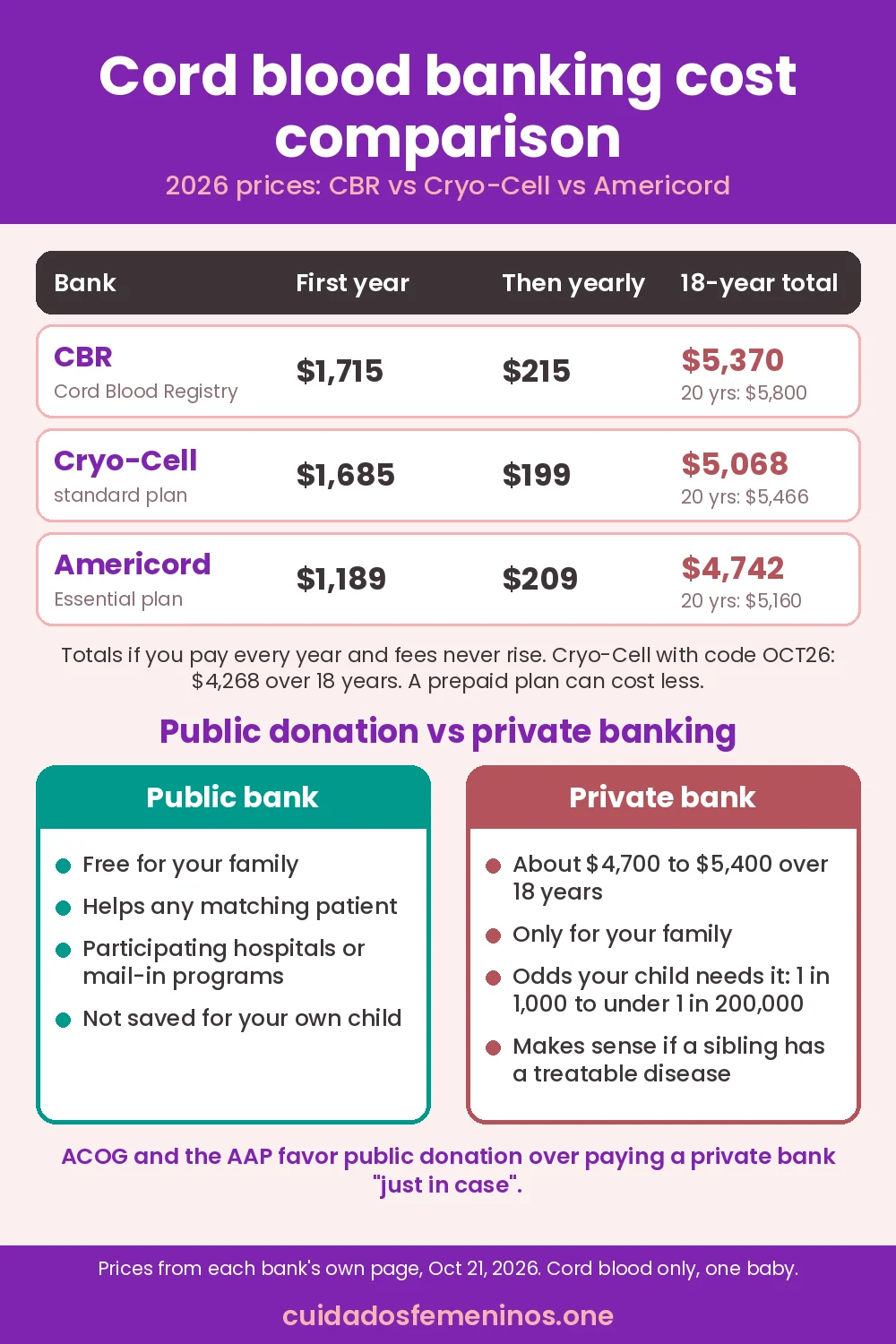
The first-year price is what banks advertise, but the yearly fee is what you keep paying. This table adds them up for families who pay every year, assuming the fee never rises, which is the best case.
| Paying yearly, list prices | CBR | Cryo-Cell | Americord |
|---|---|---|---|
| Total by age 18 (18 storage years) | $5,370 | $5,068 ($4,268 with OCT26) | $4,742 |
| Total by age 20 (20 storage years) | $5,800 | $5,466 ($4,666 with OCT26) | $5,160 |
| Best prepaid option seen | 18-year plan, $4,495 | 18-year plan, $3,373 with OCT26 | 30-year plan, $3,280 paid in full |
| Same prepaid option at 20 years | $4,925 if CBR then charges its current $215 a year | $3,771 ($199 a year after the term, per Cryo-Cell) | $3,280 (still inside the 30 years) |
How I calculated it: upfront fees plus one yearly fee for each storage year, starting with the year billed at birth. A 3% yearly fee increase, which none of the banks promises or rules out, would add roughly $1,100 to $1,200 to each 18-year total. Financing usually costs more: Americord's 30-year plan is $3,610 over 24 months versus $3,280 paid in full.
When a prepaid plan saves money
- If you are sure you would keep paying for 18 years, prepaying beat yearly payments at every bank here, by $875 at CBR and by $895 at Cryo-Cell with its coupon.
- If you might stop paying in a few years, for example once a younger sibling is born, yearly payments keep you flexible.
- Ask in writing what happens to a prepaid plan if the company is sold or closes, and whether the money is refundable.
Cord blood, cord tissue and placenta: what the add-ons buy
Cord blood holds blood-forming stem cells. They are an established transplant treatment for some blood cancers and inherited blood, immune and metabolic disorders, and ACOG estimates more than 35,000 cord blood transplants have been done since 1988. Cord tissue holds a different cell type, mesenchymal cells, which are being studied for repair and immune conditions. Cryo-Cell's own price page says the FDA has not approved any clinical use of products made from cord tissue.
Placental tissue is sold as a further add-on. At Americord, the plan with cord blood, cord tissue and placental tissue cost $3,007 for the first year and $627 a year after that, three times the yearly fee for cord blood alone. Every add-on raises the yearly bill for something that is still experimental.
Public donation vs private banking
| Public donation | Private (family) bank | |
|---|---|---|
| Cost to you | $0. The public bank pays for collection, testing and storage | About $1,190 to $1,715 the first year, then about $200 a year |
| Who can use it | Any patient who matches, worldwide, through the NMDP Registry | Only your child or a relative |
| Can you get it back later? | No. It isn't reserved for your family | Yes, as long as you keep paying |
| Quality rules | Must be licensed by the FDA, or used under an investigational application, for unrelated patients | Registered with the FDA and inspected, but not approved before use |
| How often units are used | About 30 times more often than private units (AAP) | Rarely, roughly 1 in 4,000 reported by 2013 |
| Where it's available | Only at hospitals that work with a public bank | Any hospital, with a kit you bring |
If your hospital doesn't collect for a public bank, NMDP notes that some families can still donate through a mail-in program. You can check the list of participating hospitals on the NMDP website, and HRSA suggests calling the bank between weeks 28 and 34.
Is it worth paying to store cord blood?
For most healthy families, no. ACOG's 2019 committee opinion says the routine use of private cord blood banking "is not supported by available evidence" and that public banking "is the recommended method." The American Academy of Pediatrics calls public banking "the preferred method" and sees "a more limited role" for private banking in families with a known illness that a cord blood transplant could treat.
The odds explain why. The AAP's earlier policy put the chance that a child will ever need their own cord blood at somewhere between 1 in 1,000 and more than 1 in 200,000. A 2015 review in Bone Marrow Transplantation counted about 4 million units in family banks and 1,015 reported uses through 2013, roughly 1 in 4,000. Public banks have released about 30 times more units for treatment.
There are also medical limits that ads rarely mention. ACOG states that a baby's own cord blood "cannot be used to treat a genetic disease or malignancy in that same individual," because the stored cells carry the same variant or early cancer changes. There is also no current evidence for using your own cord blood in regenerative medicine. Many units are small, too: transplant guidelines call for at least 25 million cells per kilogram of body weight, and RAND found most US public units are too small for an adult.
When family banking does make sense
- A full sibling or a parent has a disease that a stem cell transplant can treat, such as leukemia, sickle cell disease or some immune disorders. This is the case AAP and ACOG support.
- Your family carries a known inherited condition that a sibling might need a matched transplant for, after talking with a genetic counselor.
- You want it for its own sake and can afford it without strain, knowing the odds. That is a valid personal choice, not a medical need.
If one of the first two applies, ask about CBR's Newborn Possibilities Program before paying anything. It offers free processing and five years of storage for cord blood and cord tissue when a full sibling or biological parent has been diagnosed with a disease currently treatable with stem cells. Your hospital's collection fee is not included.
Does insurance pay for cord blood banking?
Almost never. The AAP states that private banking is "not covered by insurance." The IRS has said that banking cord blood "as a precaution to treat a disease that might possibly develop in the future" isn't a deductible medical expense, which is why an FSA or HSA usually won't reimburse it either. The exception is an existing or "imminently probable" disease, for example a sick sibling.
- CBR says that to use an FSA or HSA, a healthcare professional must provide evidence of medical necessity for the baby or a covered family member.
- Americord says FSAs and HSAs "will sometimes cover cord blood banking when medically necessary."
- Ask your plan in writing before you pay, and ask your hospital whether it charges a collection fee and whether insurance covers that part.
Delayed cord clamping vs cord blood banking: the trade-off
ACOG recommends waiting at least 30 to 60 seconds before clamping the cord in healthy term and preterm babies. In term babies, the extra blood raises hemoglobin at birth and improves iron stores for the first several months. The trade-off is a small rise in jaundice that needs light therapy, so hospitals that delay clamping watch for it.
Delayed clamping also leaves less blood in the cord to collect. In a 2016 Canadian study of 367 collections, 39% of units reached a high cell count when the cord was clamped right away, compared with 6.2% when clamping waited more than two minutes. ACOG's position is clear: collecting cord blood should not change routine delayed clamping, except in rare cases of medical need, such as directed donation for a sick sibling.
Birth-plan checklist if you bank or donate
- Write "delayed cord clamping for at least 30 to 60 seconds, then cord blood collection" in your birth plan, so the order is clear.
- Pack the collection kit in your hospital bag and tell the nurse when you arrive. Don't leave it in the car.
- Save the bank's 24-hour courier number in your phone.
- For public donation, bring your signed consent form or confirm the bank already has it.
- Ask who will do the collection and whether there's a fee.
- Remember that a sample may be too small to store. Ask the bank what happens to your money if that happens.
What is the best cord blood banking company?
No single bank is best for everyone, and rankings on bank-run sites are marketing. Compare them on these points instead: accreditation from AABB and ideally FACT, a history of releasing units for real transplants, whether the yearly fee is locked or can rise, what happens if the company is sold, and the total cost over the years you would really pay.
On price alone, in October 2026 Americord had the lowest first-year price and the lowest 30-year prepaid price, Cryo-Cell had the lowest yearly fee and the cheapest 18-year plan with its coupon, and CBR, which says it has stored more than 1 million samples, cost the most. If Americord is on your shortlist, you can check Americord's current pricing before you call; I may earn a commission if you enroll through that link, and it doesn't change the table above. Do the same check on CBR's and Cryo-Cell's pages, because coupons change monthly.
Red flags in cord blood bank marketing
- "FDA approved." The FDA says registration "doesn't mean a firm is endorsed by the agency." Private family units are registered and inspected, not approved.
- "Biological insurance" or lists of 80+ treatable conditions without saying most need cells from a donor, not from your own child.
- Pressure in the third trimester, such as deadlines, "today only" coupons or sales calls after a hospital tour.
- Regenerative medicine promises for autism, diabetes or cerebral palsy presented as proven. ACOG says there is no current evidence for this with your own cord blood.
- A doctor or nurse who recommends one bank without disclosing payment. The AAP asks professionals to disclose any financial interest, and Cryo-Cell states it may pay providers for collection.
- Price comparisons that leave out yearly fees, shipping, or what happens after the prepaid term ends.
Questions to ask your OB (and the bank) before you sign
- Does our hospital collect cord blood for a public bank, and how do I sign up?
- Is there anything in our family history that makes directed family banking worth it?
- Will you do delayed cord clamping, and how long will you wait before collecting?
- Do you or the hospital charge a collection fee, and is it billed to insurance?
- Do you or the practice receive anything from a cord blood bank?
- For the bank: what is the total I will pay by age 18 and age 20, and can the yearly fee rise?
- For the bank: how many units have you released for transplant, and are you AABB or FACT accredited?
- For the bank: what happens if the sample is too small, or if the company is sold or closes?
Frequently asked questions
What are the downsides of cord blood banking?
Private banking is expensive, about $4,700 to $5,800 over 18 to 20 years at list prices, and the odds your family ever uses the unit are low. Your child's own cells usually can't treat a genetic disease or leukemia they develop, many units are too small for an adult, and storage fees can rise.
How much is cord blood worth?
To a transplant center, a public cord blood unit is expensive: a 2017 RAND analysis put the average fee US public banks charge at $36,200, with a range of $29,000 to $45,000. Parents can't sell their baby's cord blood, though. Donating it to a public bank costs you nothing.
How long does cord blood banking last?
As long as the bank keeps it frozen in liquid nitrogen and you keep paying. A 2011 study in Blood recovered working stem cells from cord blood frozen for up to 23.5 years. Plans run yearly, 18 years, 30 years or lifetime, so check what happens when a prepaid term ends.
What happens to cord blood after 18 years?
Nothing changes for the cells. What changes is the bill. With an 18-year prepaid plan, yearly storage fees usually start again on your child's 18th birthday. Cryo-Cell says its fee is then $199 a year and can rise, but never above its rate for new clients. Ask any bank what its rule is.
Is cord blood banking covered by insurance?
Usually not. The American Academy of Pediatrics notes that private banking is not covered by insurance. An exception can be a family with a known medical need, such as a sibling with a disease treatable by transplant. In that case, also ask about free family-banking programs.
Can I donate cord blood if I have a C-section?
Usually yes. HRSA notes that most public cord blood banks collect after both vaginal and C-section births. The catch is location: you must deliver at a hospital that works with a public bank. Ask between weeks 28 and 34 so there is time to finish the consent and health history forms.
Is cord tissue banking worth the extra cost?
For most families, not yet. Cord tissue adds about $200 a year in storage at the banks compared here, and as Cryo-Cell itself discloses, the FDA has not approved any clinical use of products made from cord tissue. Treat it as a bet on future research rather than a proven treatment.
Should I bank cord blood for each of my children?
Only if there is a specific reason, such as a known inherited condition in the family or a sibling with a disease treatable by transplant. Cord blood from a brother or sister is a full match only about one time in four, so banking for every child mainly multiplies the yearly fees.
This article is for informational purposes and doesn't replace advice from a healthcare professional. Prices checked on each bank's official page on October 21, 2026. Reviewed by Sofía Castillo on October 21, 2026.
Sources
- CBR (Cord Blood Registry): pricing and storage plans, checked October 21, 2026
- Cryo-Cell: cost of cord blood banking, October 2026 price table
- Americord Registry: cord blood package pricing, checked October 21, 2026
- Umbilical Cord Blood Banking. ACOG Committee Opinion No. 771, March 2019
- Delayed Umbilical Cord Clamping After Birth. ACOG Committee Opinion No. 814 (interim update)
- Shearer WT et al. Cord Blood Banking for Potential Future Transplantation. AAP policy statement, Pediatrics, 2017
- Cord Blood Banking for Potential Future Transplantation. AAP policy statement, Pediatrics, 2007
- Ballen KK, Verter F, Kurtzberg J. Umbilical cord blood donation: public or private? Bone Marrow Transplantation, 2015
- Allan DS et al. Delayed clamping of the umbilical cord after delivery and implications for public cord blood banking. Transfusion, 2016
- Broxmeyer HE et al. Stem and progenitor cells from 21- to 23.5-year cryopreserved cord blood. Blood, 2011
- Cord Blood Banking: Information for Consumers. US Food and Drug Administration
- IRS Information Letter 2010-0017 on private cord blood banking as a medical expense
- Donating Umbilical Cord Blood to a Public Bank. HRSA Blood Stem Cell
- Public cord blood banks and donation hospitals. NMDP
- Newborn Possibilities Program. CBR
- RAND Corporation report on the US public cord blood banking system, summarized by Parent's Guide to Cord Blood Foundation, 2017
Keep reading
- How soon can you take a pregnancy test? A day-by-day guide
- Faint line on a pregnancy test: what it means and what to do next
- Low ferritin but normal hemoglobin: the 2026 cutoffs (and why iron matters in pregnancy)
- Inito vs Mira: which fertility monitor is worth it
- More fertility, pregnancy and baby guides
If you want to read more articles like Cord Blood Banking Cost Comparison 2026: CBR vs Cryo-Cell vs Americord, and When It's Worth It, check out the Fertility, Pregnancy & Baby category.