
Inito vs Mira: Which Fertility Monitor Is Worth It (Especially With PCOS)?
Inito vs Mira is the comparison almost everyone runs into once plain ovulation strips stop being enough. Maybe your cycles are long, maybe you have PCOS and every strip looks "almost positive," or maybe you just want to know whether you're ovulating at all. Both monitors read your hormones from urine and chart them in an app. They differ on cost, on what they've been tested against, and on how well they handle messy cycles. Here's what each one does, what the research behind them really shows, and what a year of testing really costs.
Affiliate disclosure: As an Amazon Associate, I earn from qualifying purchases. I may also earn from some brand partner links. If you buy through a product link on this page, the price is the same for you. Read the full disclosure.
- The short answer
- Inito vs Mira at a glance
- What each monitor actually measures
- How to read your Mira or Inito chart
- What the research shows (and who paid for it)
- What Inito and Mira really cost
- Inito vs Mira for PCOS and irregular cycles
- Ease of use and common complaints
- Inito and Mira vs Daysy, Clearblue and Femometer
- Which one should you buy?
- Before you start trying: one blood test worth asking for
- When to see a doctor
- Frequently asked questions
- Is Inito or Mira better?
- Is Inito or Mira better for PCOS?
- How much does Inito cost per cycle?
- How much does Mira cost per cycle?
- Can Inito or Mira confirm ovulation?
- Are Inito and Mira FSA or HSA eligible?
- Do I still need ovulation strips with Inito or Mira?
- When should I see a doctor instead of buying a monitor?
- What does a normal Mira or Inito chart look like?
- What does it mean if LH peaked but PdG did not rise?
- Is Inito or Mira better than Clearblue?
- Sources
The short answer
- Pick Inito if cost per cycle matters most: about $3.27 per strip versus $4.45 per Mira wand, four hormones on one strip, and results in about 10 minutes.
- Pick Mira if you want a standalone analyzer that doesn't depend on your phone's camera, or you live outside the US: Mira says it ships worldwide.
- With PCOS or very long cycles, neither has been properly validated, but both beat plain LH strips. Expect to use more tests, and budget for it.
- On a tight budget, cheap LH strips plus a few progesterone (PdG) strips after your positive can tell you most of what matters.
Inito vs Mira at a glance
| Inito | Mira (Max wands) | |
|---|---|---|
| Hormones measured | LH, E3G (estrogen), PdG (progesterone), FSH on one strip | LH, E3G, PdG (Ultra4 wands add FSH) |
| How it reads | Reader clips onto your phone and uses the camera | Standalone analyzer, sends results to the app by Bluetooth |
| Time to result | About 10 minutes | About 16 minutes |
| Starter kit (Oct 2026) | $119 at Inito's store, $139 on Amazon (15 strips) | $219 at Mira's store, about $183 on Amazon (20 wands) |
| Refill price | $49 for 15 strips ($3.27 each) | $89 for 20 Max wands ($4.45 each) |
| Tests per cycle (brand guidance) | 12 to 15 | 10 to 20 |
| Amazon rating (Oct 21, 2026) | 4.3 stars, 129 ratings | 3.8 stars, 247 ratings |
| Main published study | Lab accuracy vs ELISA, 100 women (2023) | Timing vs transvaginal ultrasound, 52 women (2026) |
Prices change often and both brands run frequent sales, so treat these as a snapshot from October 21, 2026, not a promise.
What each monitor actually measures
A regular ovulation strip only looks for luteinizing hormone (LH), the surge that tells your ovary to release an egg. Cleveland Clinic notes that LH rises 24 to 48 hours before ovulation, which is why strips are useful for timing sex. What a strip can't tell you is whether ovulation actually happened.
Inito and Mira add two more signals. E3G, a breakdown product of estrogen, climbs in the days before the surge, so it can open your fertile window earlier. PdG, a breakdown product of progesterone, rises after you ovulate. Inito also reads FSH on the same strip, and Mira offers that on its pricier Ultra4 wands. Both give you numbers instead of a line you have to squint at.
Why PdG matters more than most reviews admit
A positive LH test is not proof that you ovulated. In the 2026 Mira ultrasound study, 11% of cycles were anovulatory even though every participant had regular cycles. If you're trying to conceive, a PdG rise a few days after your surge is the reassuring part. Both monitors track it, which is the main reason to pay for one over strips.
How to read your Mira or Inito chart
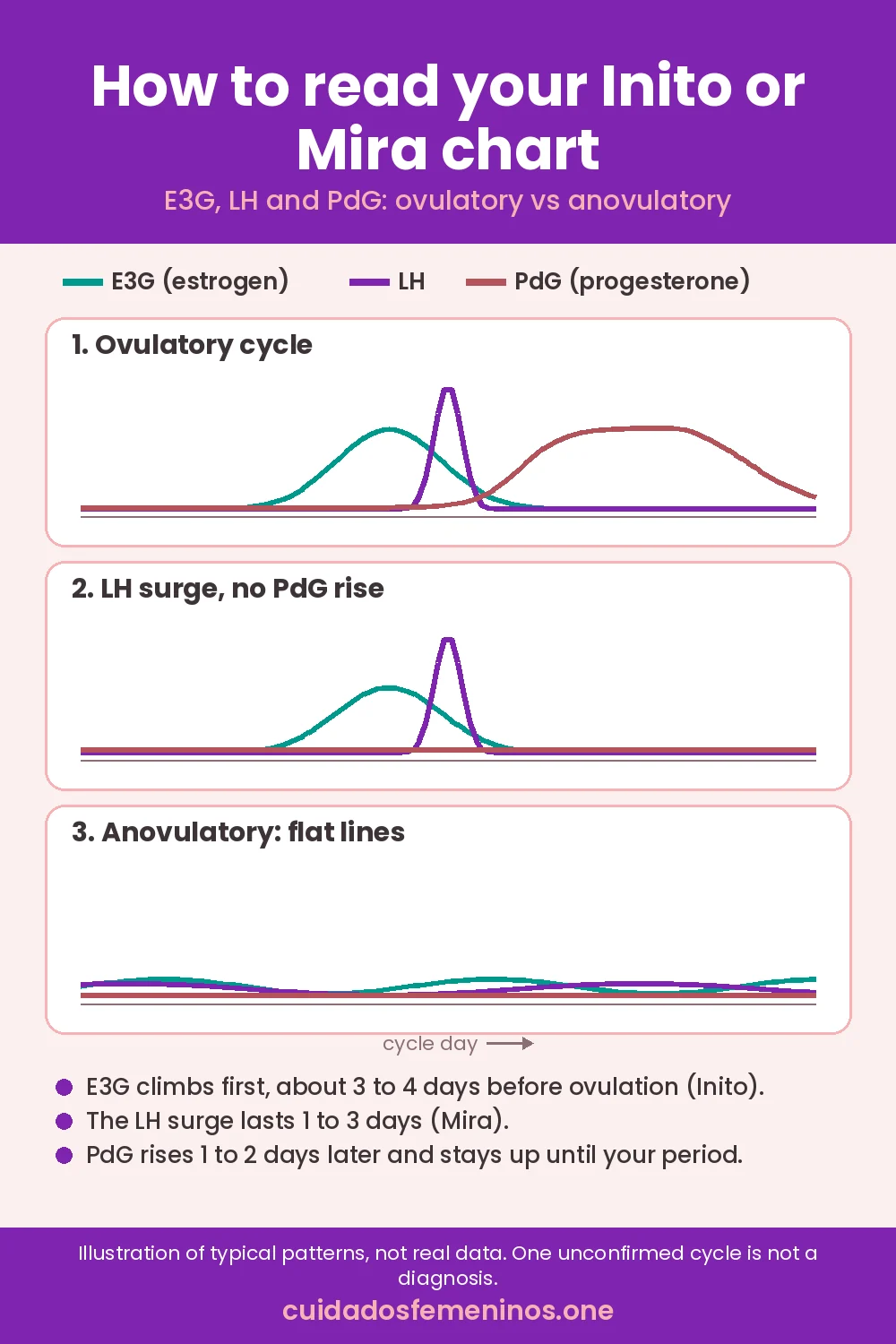
Read the lines in order. In a typical ovulatory cycle, estrogen (E3G) climbs first, LH spikes for 1 to 3 days, and PdG rises a day or two later and stays up until your period. An LH spike with no lasting PdG rise, or flat lines all month, suggests that cycle may not have been ovulatory. Here is what each line means, using the brands' own guides:
| Hormone | What it does | Typical ovulatory pattern | Patterns worth noticing |
|---|---|---|---|
| E3G (estrogen) | Rises as the follicle grows and opens your fertile window | Climbs over several days before the LH peak; Inito says it starts about 3 to 4 days before ovulation. Mira describes a second rise after ovulation | Small early bumps after your period are common, according to Mira, so wait for the main climb |
| LH | Triggers the release of the egg | One clear surge lasting 1 to 3 days. Mira says ovulation typically follows the LH peak within 10 to 12 hours | Several smaller surges before the real peak (seen in 39 of 55 ovulatory cycles in Inito's 2023 study), or LH that stays high, which is common in PCOS |
| PdG (progesterone) | Shows the corpus luteum formed after ovulation | Rises 1 to 2 days after the LH peak and forms a bell-shaped curve; Mira treats a luteal phase of 11 to 16 days as normal | No sustained rise after a surge. Inito says confirmation can take up to 9 days, so keep testing before you worry |
| FSH | Recruits and matures follicles | Rises at the start of the cycle and often again with the LH surge | FSH that is very high early in the cycle, or high all cycle, is worth discussing with a doctor, according to Mira's guide |
Normal vs anovulatory: the three patterns to know
- Typical ovulatory cycle: E3G rises, LH peaks, then PdG rises and stays elevated until your next period.
- Surge without confirmation: LH peaks but PdG never rises. Mira says this can mean ovulation didn't complete. Inito's study found it in 6 of 100 cycles, a pattern called luteinized anovulation.
- Flat or wandering lines: no clear LH surge and no PdG rise usually means the cycle was anovulatory. In Inito's study group, 39 of 100 cycles showed no LH surge at all.
One unconfirmed cycle isn't a diagnosis. Inito notes that an occasional cycle without confirmation happens even when everything is healthy, and that the pattern across several cycles matters more. If it keeps happening, bring your charts to a doctor.
If you want numbers: the classic research cutoff is urinary PdG above 5 µg/mL about 7 days after the LH peak. Inito's 2023 study proposed an earlier rule, a 2.75-fold rise over your own baseline within 3 days of the peak. Each app's "confirmed" label runs on its own algorithm, so compare your chart with your previous cycles, not with someone else's screenshot.
Where the brands disagree: FSH. Mira's clinician guide says an LH surge without a matching FSH rise may mean ovulation isn't happening. Inito says ovulation can still happen without an FSH surge. We found no published study testing that rule, so treat FSH as a supporting clue and rely on PdG to confirm ovulation.
What the research shows (and who paid for it)
Both brands lean on published studies. They are useful, but they are small, they were run in women with fairly regular cycles, and both have company ties, which the papers disclose.
| Study | Who was tested | What it found | Keep in mind |
|---|---|---|---|
| Inito, Scientific Reports, 2023 | 100 women aged 21 to 45, cycles 21 to 42 days that varied by 3 days or less, no fertility diagnosis | Strip readings matched lab tests (ELISA) closely, with about 5% variation; a PdG rule separated ovulatory from anovulatory cycles (AUC 0.98) | Not checked against ultrasound; authors include Inito's co-founder and staff from its R&D partner |
| Mira, Reproductive BioMedicine Online, 2026 | 52 women aged 19 to 44 with regular 24 to 38 day cycles; 153 cycles; 890 ultrasounds | The LH peak predicted ultrasound-confirmed ovulation, with 96% of ovulations within a day of it | The lead author's PhD was funded by a grant co-sponsored by Mira's maker |
| Mira PCOS pilot, preprint, 2025 | 20 women, 10 with PCOS | PCOS cycles were longer, peaked later and had a shorter luteal phase | Not peer reviewed; far too small to prove accuracy in PCOS |
The takeaway: Mira currently has the stronger evidence that its LH reading lines up with real ovulation on ultrasound. Inito has solid lab data showing its strips measure hormone levels accurately. Neither has a large study in women with PCOS or very irregular cycles, so any "best for PCOS" claim you see online is marketing rather than research.
What Inito and Mira really cost
The monitor is the cheap part. The strips or wands are what you keep paying for every month, so cost per test decides most of the bill. Here's the math using each brand's own store prices in October 2026 and one refill pack per cycle, which is how most people use them.
| Time trying | Inito (kit, then $49 per 15 strips) | Mira (kit, then $89 per 20 wands) |
|---|---|---|
| 1 cycle | $119 | $219 |
| 3 cycles | $217 | $397 |
| 6 cycles | $364 | $664 |
| 12 cycles | $658 | $1,198 |
| One long cycle needing 25 tests (strips or wands only) | About $82 | About $111 |
The table assumes one pack per cycle. A Mira pack has 20 wands and an Inito pack has 15 strips, so if you need more than 15 tests in a cycle you'll buy extra Inito strips and the gap narrows a little. Per test, Inito is still about a quarter cheaper, and if your cycles run 40 days or more, that per-test price is what decides the bill. Living Outlook's September 2026 estimate lands on the same 12-month totals: $658 for Inito and $1,198 for Mira.
One quirk worth knowing: in October 2026, Inito was cheaper on its own website than on Amazon, while Mira's starter kit was cheaper on Amazon than on Mira's store. Check both before you buy.
Inito vs Mira for PCOS and irregular cycles
This is where most people are really asking the question, so let's be precise. In May 2026, PCOS was officially renamed polyendocrine metabolic ovarian syndrome (PMOS), partly because, as the Endocrine Society put it, the old name reduced a complex hormonal condition to a misunderstanding about cysts. You'll see both names for a while. Either way, it affects about 1 in 8 women, and ovulation is often late or irregular.
Many women with PCOS have high baseline LH, which can make regular strips look positive for days. A monitor helps because it shows your LH as a number, so you can see a true spike above your own baseline instead of guessing at line darkness. More importantly, it can show whether PdG rose afterward. If it didn't, that cycle may not have been ovulatory, which is useful information to take to your doctor.
The trade-offs are real, though. Long cycles mean more tests, so your monthly cost goes up, and that favors Inito. The algorithms in both apps were built mostly on regular cycles, so "peak fertility" predictions can be off; trust the raw numbers over the app's guess. If you're not ready to spend this much, my guide to ovulation tests with irregular periods covers cheaper ways to test smarter.
Ease of use and common complaints
- Inito needs your phone. The reader clips on and uses the camera, so phone fit and connection problems are the most common complaints in Amazon reviews. Check that your phone model is supported before you buy. The upside is the shorter wait and one strip for all four hormones.
- Mira has its own analyzer, so your phone model matters less. Its reviews more often mention reliability problems, such as errors or readings that don't seem to make sense, and the cost of replacement wands. The wait is longer, about 16 minutes.
- Both ask you to test daily for much of your cycle, ideally with first-morning or well-concentrated urine at the same time each day. If you know you'll skip days, you'll get gaps in your chart either way.
Inito and Mira vs Daysy, Clearblue and Femometer
The main difference is what each device measures. Inito and Mira read urine hormones and can confirm ovulation with PdG. Clearblue reads LH and estrogen to predict your fertile days but can't confirm ovulation. Daysy and Femometer track your basal body temperature, which only shows that ovulation has already happened. Prices are US list prices seen on October 21, 2026:
| Device | What it measures | Price tier | Confirms ovulation? | Best for |
|---|---|---|---|---|
| Inito | LH, E3G, PdG and FSH in urine, read by your phone | $$: $119 kit, then $49 per 15 strips | Yes, with PdG | Hormone tracking at the lowest running cost |
| Mira | LH, E3G and PdG in urine (FSH on Ultra4 wands), standalone analyzer | $$$: $219 kit, then $89 per 20 wands | Yes, with PdG | A device that works without your phone camera, shipped worldwide |
| Clearblue Fertility Monitor | LH and estrogen in urine; shows Low, High or Peak fertility | $$: about $150 at Walgreens when in stock, plus test sticks | No, it predicts only | Regular cycles and a simple screen, if you can find it in stock |
| Clearblue Advanced Digital Ovulation Test | LH and estrogen in urine; disposable digital tests | $: $43.99 for 10 tests at Walgreens | No, it predicts only | An upgrade from basic strips without buying a monitor |
| Daysy | Basal body temperature, taken under the tongue every morning | $$$ once: $299 list, $239 on sale, no strips | Only after the fact, from the temperature shift | Women who'd rather take a temperature than test urine, with no ongoing cost |
| Femometer Vinca 2.0 | Basal body temperature, with an app; an optional IVY reader adds LH tests | $: $19.99 to $58.99 thermometer; $49.99 IVY kit with 15 strips | Only after the fact, from the temperature shift | The lowest-cost way to start charting |
Why temperature alone falls short: ACOG explains that basal body temperature rises slightly, by 0.5 to 1°F, around ovulation and stays up until your period, so it shows ovulation only after it has happened. The most fertile days are the 2 to 3 days before that rise, and a fever can throw readings off. That's fine for confirming a pattern over several cycles, but it won't warn you ahead of time. With irregular cycles, a hormone monitor or LH tests tell you more.
Which one should you buy?
- You want the lowest running cost and use an iPhone or a recent Android phone: Inito Fertility Monitor on Amazon (also check Inito's own store, which was $20 cheaper in October 2026). Refills: Inito test strips.
- You want a standalone device or you're outside the US: Mira Fertility Max Kit with 20 wands, then Mira Max wands, 20-pack as refills.
- Your budget is tight or you only want to confirm ovulation: keep your regular LH strips and add Proov Confirm PdG strips (5 tests for about $20). Test on the days the instructions give after your positive LH.
- You've tested for months and never see a surge or a PdG rise: skip buying more tests and book an appointment.
If you're still figuring out timing, start with when to take an ovulation test and how to read ovulation strips. They'll save you strips whichever route you choose.
Before you start trying: one blood test worth asking for
In September 2026, the American Society of Hematology raised its ferritin cutoffs for iron deficiency and said a threshold of 50 ng/mL can be appropriate for menstruating people who are planning a pregnancy. Low iron stores are common, often missed when hemoglobin is normal, and much harder to fix once you're pregnant. If you're seeing a doctor before trying, ask for ferritin. Here's what low ferritin with normal hemoglobin means.
When to see a doctor
- You've been trying for 12 months and you're under 35, or for 6 months and you're 35 or older (ACOG).
- You're over 40: ACOG suggests an evaluation sooner rather than later.
- Your periods are irregular, very far apart or missing. ACOG advises an evaluation right away rather than waiting a year.
- Your monitor never shows an LH surge, or never shows PdG rising after one, over two or three cycles.
- You have very painful periods, known endometriosis, a past pelvic infection, or your partner has known sperm problems.
- You're already pregnant or think you might be: test with a pregnancy test, not your fertility monitor. Here's how soon you can take one.
A monitor gives you data; it doesn't give you a diagnosis. Mira itself says it isn't a diagnostic or contraceptive device, and the same caution applies to Inito. Bring your charts to your appointment. They often speed up the conversation.
Frequently asked questions
Is Inito or Mira better?
Neither is better for everyone. Inito costs less per test, measures four hormones on one strip and gives results in about 10 minutes. Mira uses a standalone analyzer, ships worldwide and has a 2026 study checking it against ultrasound. If cost per cycle matters most, Inito usually wins.
Is Inito or Mira better for PCOS?
Neither has been properly validated in PCOS. Inito's study left out women with diagnosed fertility problems, and Mira's PCOS data is a 20-person preprint. Both still beat plain LH strips because they show your actual hormone levels and can confirm ovulation with PdG, which matters when LH runs high.
How much does Inito cost per cycle?
At Inito's own store in October 2026, the monitor with 15 strips cost $119 and a 15-strip refill cost $49, about $3.27 per strip. Most regular cycles use one refill. A long cycle that needs 25 tests costs roughly $82 in strips. Amazon listed the starter kit at $139.
How much does Mira cost per cycle?
Mira's Max starter kit, with the analyzer and 20 wands, listed at $219 on Mira's store and was on sale for about $183 on Amazon. A 20-pack of Max wands was $89, or $4.45 per wand. A long cycle that needs 25 tests costs about $111 in wands.
Can Inito or Mira confirm ovulation?
They can show that your progesterone marker, PdG, rose after your LH surge, which strongly suggests ovulation happened. That is more than a regular ovulation strip tells you. Neither replaces an ultrasound or a blood progesterone test when your doctor needs to know for sure, for example during fertility treatment.
Are Inito and Mira FSA or HSA eligible?
Amazon marks the Inito Fertility Monitor listing as an FSA or HSA eligible item. Fertility monitors are commonly reimbursable, but eligibility depends on your plan and the seller, so check your plan or the product page before you buy. Keep your receipt either way in case you need to submit it.
Do I still need ovulation strips with Inito or Mira?
No. Both read LH themselves, so you don't need separate strips. If money is tight, cheap LH strips plus a few PdG tests after your positive can tell you much of the same story: when you surged, and whether progesterone rose afterward. You lose the numbers and the charts.
When should I see a doctor instead of buying a monitor?
ACOG advises a fertility evaluation after 12 months of trying if you are under 35, after 6 months if you are 35 or older, and right away if your periods are irregular or missing. A monitor can't diagnose why ovulation is late or absent, but a doctor can.
What does a normal Mira or Inito chart look like?
Estrogen (E3G) climbs over several days, LH surges for 1 to 3 days, and PdG rises 1 to 2 days after the LH peak and stays up in a bell-shaped curve until your period. Mira treats a luteal phase of 11 to 16 days as normal. Compare each cycle with your own earlier charts.
What does it mean if LH peaked but PdG did not rise?
It can mean that cycle did not end in ovulation, a pattern Inito's study saw in 6 of 100 cycles. It can also mean you stopped testing too early: Inito says confirmation can take up to 9 days. One cycle like this is common. If it repeats over two or three cycles, see a doctor.
Is Inito or Mira better than Clearblue?
They answer different questions. Clearblue tracks LH and estrogen to predict your fertile days, but it cannot confirm ovulation. Inito and Mira also measure PdG, so they can show whether ovulation likely happened, which matters with PCOS or irregular cycles. For regular cycles and simple timing, Clearblue is cheaper.
This article is for informational purposes and doesn't replace advice from a healthcare professional. Reviewed by Sofía Castillo on October 21, 2026.
Sources
- Validation of urinary reproductive hormone measurements using a novel smartphone connected reader (Inito). Scientific Reports, 2023
- Mira LH, E3G and PdG readings compared with serial transvaginal ultrasound in regularly cycling women. Reproductive BioMedicine Online, 2026
- Bouchard et al. Urinary hormone patterns measured with the Mira monitor in women with and without PCOS: pilot study. Preprints.org, October 2025 (not peer reviewed)
- Polyendocrine Metabolic Ovarian Syndrome: the new name for PCOS – Endocrine Society, May 12, 2026
- Evaluating Infertility – American College of Obstetricians and Gynecologists (ACOG)
- How (and Why) to Use At-Home Ovulation Tests To Get Pregnant – Cleveland Clinic, December 2025
- Inito Fertility Monitor: kit and refill prices – Inito
- Mira Fertility Max Starter Kit: what's included and intended use – Mira
- Mira vs Inito: 12-month cost estimate – Living Outlook, September 2026
- The Mira App: How do I read Mira charts? – Mira
- Mira Interpretation Guide for clinicians (PDF) – Mira
- New to Inito? Here's How to Read Your Inito Chart – Inito
- PdG Results on Inito: Waiting, Rising & Confirmed – Inito
- Fertility Awareness-Based Methods of Family Planning – ACOG, reviewed February 2025
- Daysy fertility tracker: US price – Daysy
- Vinca 2.0 basal thermometer: price and features – Femometer
- Clearblue ovulation tests and Fertility Monitor: US prices – Walgreens
Keep reading
- Ovulation tests with irregular periods: what actually works
- When to take an ovulation test (and what time of day)
- How to read ovulation test strips without second-guessing
- How soon can you take a pregnancy test?
- Low ferritin but normal hemoglobin: the new 2026 cutoffs
- More fertility and pregnancy guides
- Cord blood banking cost comparison: CBR vs Cryo-Cell vs Americord (for later in pregnancy)
If you want to read more articles like Inito vs Mira: Which Fertility Monitor Is Worth It (Especially With PCOS)?, check out the Fertility, Pregnancy & Baby category.