
Ozempic While Breastfeeding: What ACOG’s 2026 Guidance Says (Wegovy, Mounjaro, Zepbound)
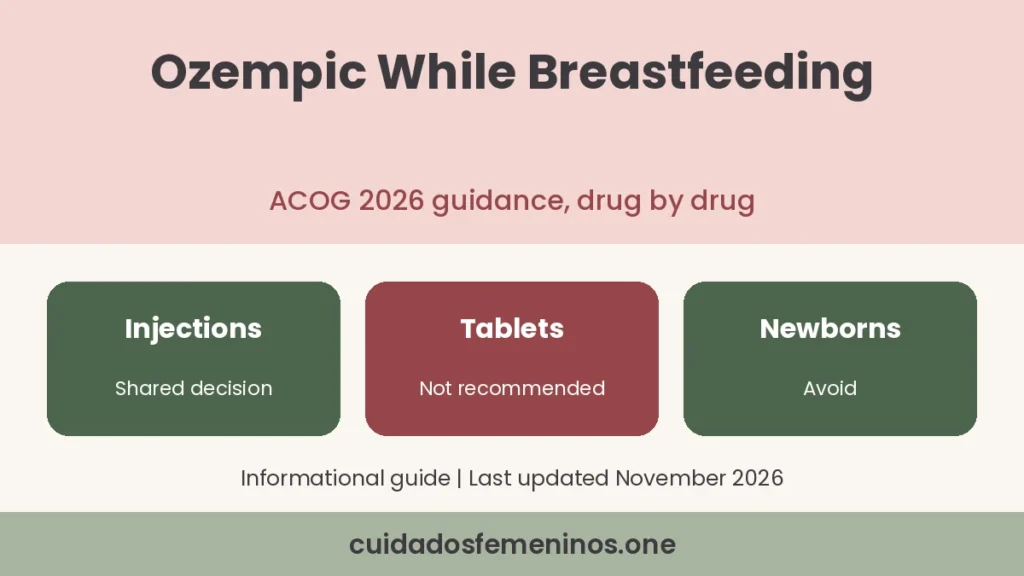
Ozempic while breastfeeding is no longer a question with zero guidance. In October 2026, ACOG said your doctor may work out a postpartum plan with you that includes a GLP-1 medicine, as long as your baby’s weight gain is watched closely. It also said no to these drugs if your baby was born preterm or is still a newborn, and no to the pill versions while you nurse.
For information only. This article does not replace your doctor, your baby’s pediatrician or a lactation consultant.
- Quick answer
- What ACOG said in October 2026
- Ozempic, Wegovy, Mounjaro, Zepbound: what is known, drug by drug
- Why the pill versions are a no while you nurse
- Does a GLP-1 pass into breast milk?
- Which GLP-1 is “best” while breastfeeding?
- The part nobody talks about: your own nutrition
- Your postpartum visit checklist
- What about compounded semaglutide or microdosing?
- Weight after the baby: setting expectations
- When to call your doctor
- Frequently asked questions
- Can you take Ozempic while breastfeeding?
- Can you take weight loss injections while breastfeeding?
- Has anyone breastfed while on semaglutide?
- Is Zepbound safe while breastfeeding?
- Does Mounjaro pass into breast milk?
- Can I take Wegovy pills or Rybelsus while breastfeeding?
- Will Ozempic lower my milk supply?
- How soon after giving birth can I start a GLP-1 if I am breastfeeding?
- Which GLP-1 is best while breastfeeding?
- Is compounded semaglutide okay while breastfeeding?
- Sources
Quick answer
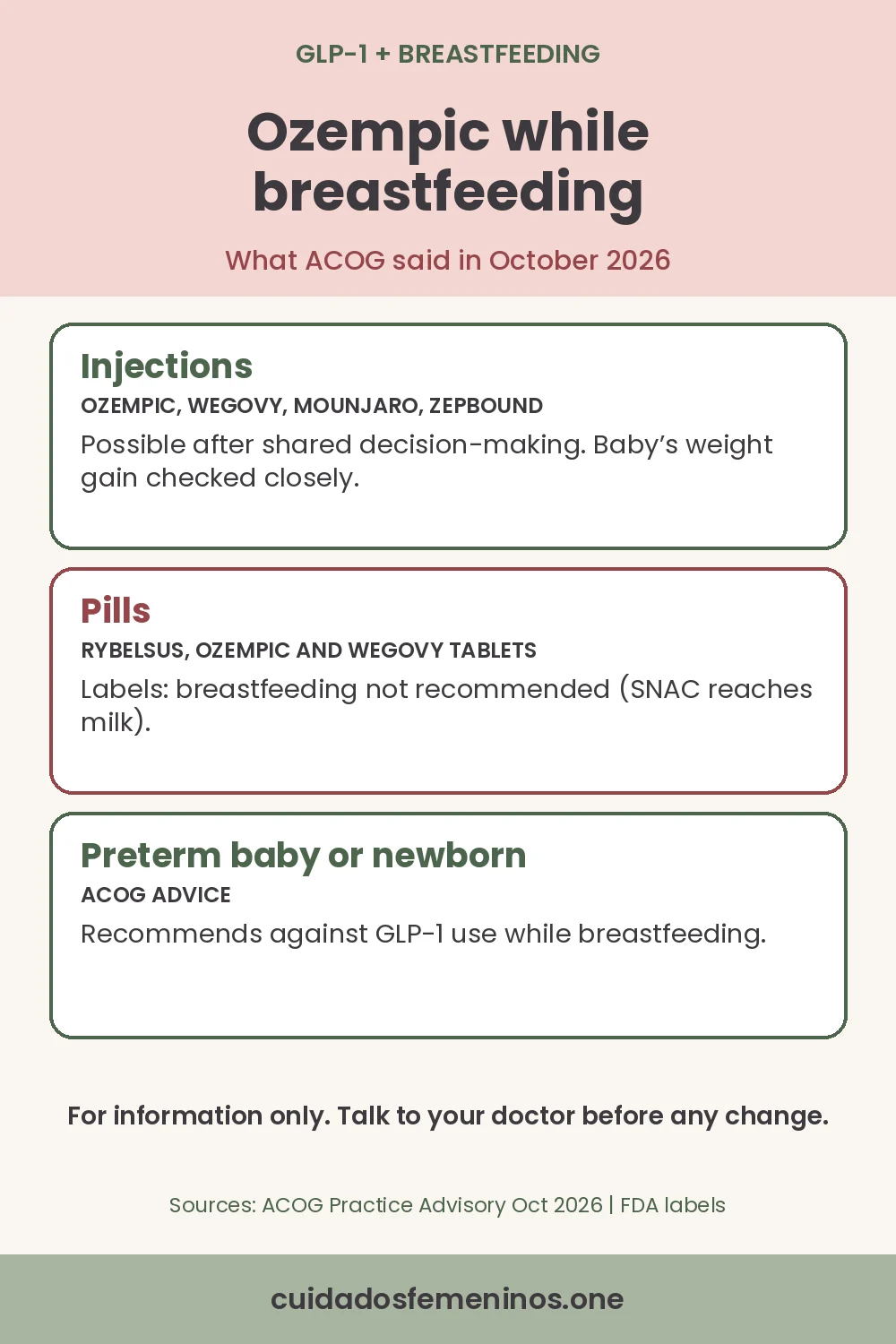
- Injections (Ozempic, Wegovy injection, Mounjaro, Zepbound): ACOG allows shared decision-making with your ob-gyn. If you go ahead, your baby’s weight gain should be followed closely with the pediatrician.
- Preterm babies and newborns: ACOG recommends against GLP-1 medicines while breastfeeding them.
- Pills (Rybelsus, Ozempic tablets, Wegovy tablets): the FDA labels say breastfeeding is not recommended, because the absorption enhancer SNAC reaches breast milk.
- What the milk studies show: very little or no drug was found in milk. Nobody has yet measured milk supply, milk composition or long-term effects on babies.
What ACOG said in October 2026
The ACOG Practice Advisory on GLP-1 receptor agonists in pregnancy and lactation came out on October 23, 2026. Its lactation advice has three parts, and they are worth reading word for word because they are softer than most people expect:
- Ob-gyns may engage breastfeeding or chestfeeding patients in shared decision-making to build a postpartum plan that potentially includes a GLP-1 medicine.
- If a GLP-1 is used while breastfeeding, close surveillance of the baby’s weight gain, together with the baby’s own clinician, is recommended.
- Ob-gyns should recommend against GLP-1 use for people breastfeeding preterm infants and neonates.
Notice what that is not. It is not a green light, and it is not a ban. ACOG is telling your doctor that this is a conversation to have with you, with your baby’s growth as the thing to watch. Pregnancy gets a much firmer line: ACOG advises against GLP-1 medicines during pregnancy and suggests stopping 1 to 2 months before trying to conceive.
Why the caution? In ACOG’s words, human milk studies so far only check whether the drug shows up in milk. They “still do not assess milk volume, density, composition, infant weight gain, or long-term outcomes.” A drug can be nearly absent from milk and still matter if it cuts your appetite so much that you eat too little.
Ozempic, Wegovy, Mounjaro, Zepbound: what is known, drug by drug
This table pulls together the lactation section (8.2) of each current FDA label on DailyMed and the one published human milk study of injected semaglutide. Half-lives come from the labels. A long half-life means the drug stays in your body for weeks after the last dose.
| Medicine | Active ingredient and form | What was found in breast milk | What the label says about breastfeeding | Half-life |
|---|---|---|---|---|
| Ozempic injection | Semaglutide, weekly injection | Small study (8 women, Diab et al., 2024): none detected at 0, 12 or 24 hours after a dose | Label (revised 7/2026): no human milk data; in rats, milk levels were 3 to 12 times lower than in the mother’s blood. Weigh benefits of breastfeeding against your need for the drug | About 1 week |
| Wegovy injection | Semaglutide, weekly injection | Same ingredient as Ozempic; no Wegovy-specific milk study | Label (revised 6/2026): no human milk data; the injection does not contain SNAC. Weigh benefits and risks | About 1 week |
| Wegovy tablets | Oral semaglutide with SNAC | Semaglutide below the lower limit of quantification, but SNAC and/or its metabolites present in milk | Breastfeeding not recommended during treatment | About 1 week |
| Rybelsus and Ozempic tablets | Oral semaglutide with SNAC | Same finding as Wegovy tablets | Breastfeeding not recommended during treatment | About 1 week |
| Mounjaro and Zepbound | Tirzepatide, weekly injection | Single 5 mg dose in 11 women: undetectable in 164 of 171 samples; the rest added up to less than 0.02% of the mother’s dose over 28 days | Labels (revised 7/2026 and 8/2026): no data on the breastfed baby or on milk production. Weigh benefits and risks | About 5 days |
Two things jump out. First, the injections look reassuring on drug transfer, and the tirzepatide study is the most detailed: the last measurable traces showed up 5 days after the dose. Second, the pills are a different story, and not because of the semaglutide itself.
Why the pill versions are a no while you nurse
Oral semaglutide needs a helper to get absorbed through the stomach. That helper is salcaprozate sodium, or SNAC. The Rybelsus, Ozempic tablets and Wegovy tablets labels all report that SNAC or its breakdown products are present in human milk. Babies may clear SNAC more slowly than adults, so levels could build up in them.
Because there are injectable semaglutide products without SNAC, the labels simply say breastfeeding is not recommended while taking the tablets. ACOG lands in the same place from a different angle: without safety data, breastfeeding parents should avoid oral GLP-1 medicines, even though the baby absorbing them is considered unlikely.
If you were on Rybelsus or Wegovy pills before pregnancy and plan to nurse, that is the first thing to raise at your postpartum visit.
Does a GLP-1 pass into breast milk?
Very little, as far as current studies can tell. These are large peptide molecules. LactMed, cited by ACOG, lists liraglutide at 3,751 daltons and exenatide at 4,187 daltons and expects very low amounts in milk.
The semaglutide study came from the InfantRisk Center milk biorepository. Researchers tested milk from eight women at 0, 12 and 24 hours after an injection and found no semaglutide in any sample. Using the lowest amount their test could have measured, they calculated a worst-case relative infant dose of 1.26%, well under the usual 10% threshold. The authors themselves flag open questions about milk nutrients and long-term outcomes.
Eight women and one dose timeline is a small base. It is good news, and it is also the reason ACOG still asks for weight checks on the baby.
Which GLP-1 is “best” while breastfeeding?
If a GLP-1 is truly needed, ACOG points to a general rule of lactation pharmacology: pick the drug with the shortest half-life. By that rule, ACOG says, exenatide would be preferred, because it has the shortest half-life of the class. Semaglutide (about a week) and tirzepatide (about 5 days) are long-acting.
That does not mean you should ask to switch for convenience. Exenatide is not one of the four brands most readers ask about, and whether any GLP-1 fits your situation depends on why you are taking it: type 2 diabetes, obesity, heart risk or something else. That is the core of the shared decision ACOG describes.
The part nobody talks about: your own nutrition
ACOG raises a quieter risk. A GLP-1 lowers appetite, and eating much less while making milk can leave you short on calories, protein, vitamins and minerals. ACOG also notes that obesity itself can change milk composition, so any effect on the baby is hard to pin on the drug alone.
In its perinatal care box for people who used GLP-1 medicines before pregnancy, ACOG suggests checking for deficiencies such as vitamin D, vitamin B12 and ferritin, eating a varied diet, and seeing a registered dietitian when needed. If you are nursing on a GLP-1 and eating less, those same checks are a fair thing to ask for.
- Iron: blood loss at birth plus a smaller appetite can add up to low iron. See low ferritin with normal hemoglobin and which iron supplement is gentler on the stomach.
- Choline and DHA: NIH sets the choline target higher while breastfeeding (550 mg a day) than in pregnancy (450 mg). Our guides on choline in pregnancy and breastfeeding and how much DHA you need cover food sources.
- Protein and fluids: nausea, vomiting and diarrhea are among the most common side effects on these labels, and fluid loss can follow.
Your postpartum visit checklist
Bring this to the appointment where you discuss restarting or starting a GLP-1. It turns ACOG’s “shared decision-making” into concrete questions.
| Ask your ob-gyn | Ask your baby’s pediatrician |
|---|---|
| Why do I need this medicine now: diabetes control, weight, heart risk? | How often should my baby be weighed once I start? |
| Is my baby still in the newborn period, or was my baby preterm? (ACOG advises against use in both cases) | What feeding or growth changes should make me call you? |
| Should I avoid tablets and use an injection instead, given the SNAC warning? | Is my baby’s weight gain on track right now, before I start? |
| What dose would we start with, and how slowly would we increase it? | Should we plan a check after each dose increase? |
| Should we check ferritin, vitamin D and B12 first? | Who do I contact if my milk supply seems to drop? |
| What contraception do I need, and how long before another pregnancy should I stop? |
On the last question: pregnancy is possible while breastfeeding. Semaglutide labels say to stop at least 2 months before a planned pregnancy, and the tirzepatide labels warn that oral birth control may work less well after starting and after each dose increase. Our sibling guide on Ozempic and birth control explains the 4-week backup rule.
What about compounded semaglutide or microdosing?
Every milk finding in this article comes from FDA-approved products. ACOG notes that unapproved compounded versions are widely sold online, in standard doses and in “microdoses.” None of the lactation data above applies to them, because nobody has studied what is actually in those vials or how they behave in milk. If you are breastfeeding, that alone is a strong reason to stay with an approved product prescribed by a clinician who knows you are nursing.
Weight after the baby: setting expectations
ACOG’s guidance is about safety, not about how fast you will lose weight postpartum, and it makes no promise there. It does point out that weight regain is common once a GLP-1 is stopped. If you start one while nursing, ask your doctor what the plan is for the day you stop, whether that is before another pregnancy or later.
When to call your doctor
Call promptly, or seek urgent care, in these situations:
- Your baby: seems to feed less, has fewer wet diapers than usual, or is not gaining weight as expected. Call the pediatrician; do not wait for the next routine visit.
- Severe stomach pain that does not go away, with or without vomiting, and sometimes felt in the back. The labels list this as a possible sign of pancreatitis and say to stop the medicine and call right away.
- Vomiting or diarrhea that will not stop, or signs of dehydration. Fluid loss also affects your milk.
- You cannot eat enough to feel steady, or you feel dizzy and weak.
- A positive pregnancy test. ACOG advises against GLP-1 medicines in pregnancy, so call your prescriber the same day.
Frequently asked questions
Can you take Ozempic while breastfeeding?
Possibly, after a shared decision with your doctor. ACOG’s October 2026 advisory lets ob-gyns include GLP-1 injections in a postpartum plan, with close checks of the baby’s weight gain. It recommends against them if you are breastfeeding a preterm baby or a newborn. The Ozempic label itself has no human milk data.
Can you take weight loss injections while breastfeeding?
ACOG says ob-gyns may discuss them with you through shared decision-making, but the evidence is thin. Studies show little or no drug in breast milk, yet nobody has measured milk supply, milk composition or long-term effects on babies. If you do use one, your baby’s weight should be followed closely with the pediatrician.
Has anyone breastfed while on semaglutide?
Yes. A 2024 study tested milk from eight women using injected semaglutide, collected at 0, 12 and 24 hours after a dose, and found no semaglutide in any sample. The worst-case infant dose was estimated at 1.26%. It was a small study, and it did not follow the babies over time.
Is Zepbound safe while breastfeeding?
Safety has not been established. In a single-dose study of 11 women given 5 mg of tirzepatide, the drug was undetectable in 164 of 171 milk samples, and the total amount found was under 0.02% of the dose. The label notes there are no data on the breastfed baby or on milk production.
Does Mounjaro pass into breast milk?
Only in tiny amounts, based on one study. After a single 5 mg dose in 11 lactating women, tirzepatide was undetectable in most samples, and the last measurable traces appeared 5 days after the dose. Mounjaro and Zepbound contain the same ingredient, so the same study appears on both labels.
Can I take Wegovy pills or Rybelsus while breastfeeding?
The FDA labels say breastfeeding is not recommended during treatment with Wegovy tablets, Rybelsus or Ozempic tablets. These pills contain SNAC, an absorption enhancer found in human milk, which babies may clear slowly. ACOG also advises avoiding oral GLP-1 medicines while breastfeeding. Ask about injectable options instead.
Will Ozempic lower my milk supply?
Nobody knows yet. The labels say there are no data on the effects on milk production, and ACOG notes that studies have not measured milk volume or composition. A GLP-1 can cut your appetite sharply, and eating too little is a concern while nursing. Tell your doctor if your supply seems to drop.
How soon after giving birth can I start a GLP-1 if I am breastfeeding?
ACOG does not give a set number of weeks. It recommends against GLP-1 medicines while breastfeeding newborns and preterm babies, which rules out the first weeks after birth. After that, the timing is part of the shared decision with your ob-gyn, based on your health and your baby’s growth.
Which GLP-1 is best while breastfeeding?
ACOG says that if a GLP-1 is needed, exenatide would be preferred, because it has the shortest half-life of the group. Semaglutide lasts about a week and tirzepatide about 5 days. The right choice still depends on why you need the medicine, so this is a question for your prescriber.
Is compounded semaglutide okay while breastfeeding?
The milk studies and FDA labels only cover approved products. ACOG notes that unapproved compounded GLP-1 versions are widely sold online, and none of the lactation data applies to them. While you are breastfeeding, stick with an approved medicine prescribed by a clinician who knows you are nursing.
Last updated: November 2026. This guide is for information only and does not replace your doctor or your baby’s pediatrician. It does not recommend any medicine for you.
Sources
- American College of Obstetricians and Gynecologists. Use of Glucagon-Like Peptide-1 Receptor Agonists in Pregnancy and Lactation. Practice Advisory, October 2026.
- ACOG. ACOG Releases New Guidance on the Use of GLP-1s in Pregnancy and Lactation. Press release, October 23, 2026.
- Diab H, et al. Subcutaneous Semaglutide during Breastfeeding: Infant Safety Regarding Drug Transfer into Human Milk. Nutrients, 2024;16(17):2886.
- Ozempic (semaglutide) injection prescribing information, section 8.2. DailyMed, revised 7/2026.
- Wegovy (semaglutide) injection and tablets prescribing information, section 8.2. DailyMed, revised 6/2026.
- Rybelsus and Ozempic (semaglutide) tablets prescribing information, section 8.2. DailyMed, revised 1/2026.
- Mounjaro (tirzepatide) prescribing information, section 8.2. DailyMed, revised 7/2026.
- Zepbound (tirzepatide) prescribing information, section 8.2. DailyMed, revised 8/2026.
Keep reading
- Ozempic and birth control The 4-week backup rule and when to stop before pregnancy.
- Choline in pregnancy and breastfeeding
- How much DHA in pregnancy
- Low ferritin, normal hemoglobin
 Progesterone Shortage 2026: Which Capsules Are Available and What to Use Instead
 Ferritin Level for Hair Loss: What Number Causes Shedding, and What Helps Regrowth
 How Long Before Pregnancy Should You Stop Ozempic, Wegovy or Zepbound? (2026 Labels + ACOG)
If you want to read more articles like Ozempic While Breastfeeding: What ACOG’s 2026 Guidance Says (Wegovy, Mounjaro, Zepbound), check out the Women's Health category.