
How Much DHA During Pregnancy? 200 mg vs 1,000 mg, and Who Needs More
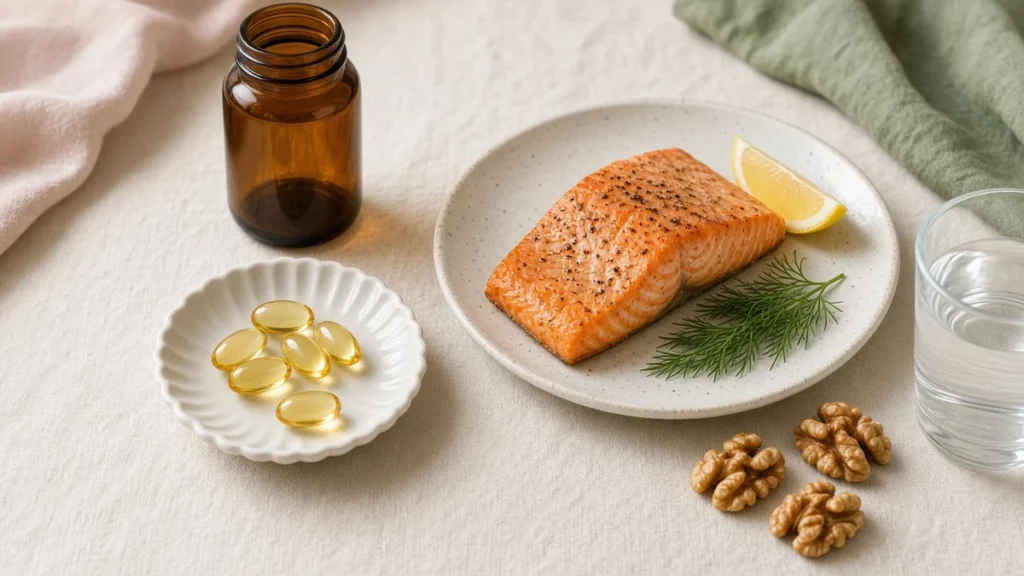
How much DHA during pregnancy? At least 200 mg a day for most women. If you rarely eat fish and don’t take a DHA supplement, a 2024 guideline suggests 600 to 1,000 mg a day from the second trimester to about 37 weeks, to lower the risk of early preterm birth. A new study from October 2026 suggests your genes may also matter.
Below you’ll find how to tell which group you’re in, how to add up the DHA in your prenatal and your meals, and what the new research does and doesn’t show. Everything here was checked against the original studies and guidelines on October 28, 2026.
- Quick answer
- How much DHA do you need during pregnancy?
- Who should consider 600 to 1,000 mg?
- The new 2026 study: why genes may change the answer
- How to check how much DHA your prenatal really has
- Can you get enough DHA from food?
- Can you take too much DHA while pregnant?
- When to start and when to stop DHA
- Is DHA linked to autism?
- When to talk to your doctor or midwife
- Frequently asked questions
- How much DHA do you need during pregnancy?
- Is 50 mg of DHA enough during pregnancy?
- Is 1000 mg of DHA too much?
- How much DHA is too much a day?
- Is too much DHA harmful during pregnancy?
- How do you know if you take too much omega-3?
- Is DHA linked to autism?
- What trimester is DHA most important?
- Is it too late to take prenatal vitamins at 20 weeks?
- When should you stop taking DHA in pregnancy?
- What happens if I don’t take DHA during pregnancy?
- Are 2 eggs enough omega-3?
- How much EPA do you need during pregnancy?
- Sources
Quick answer
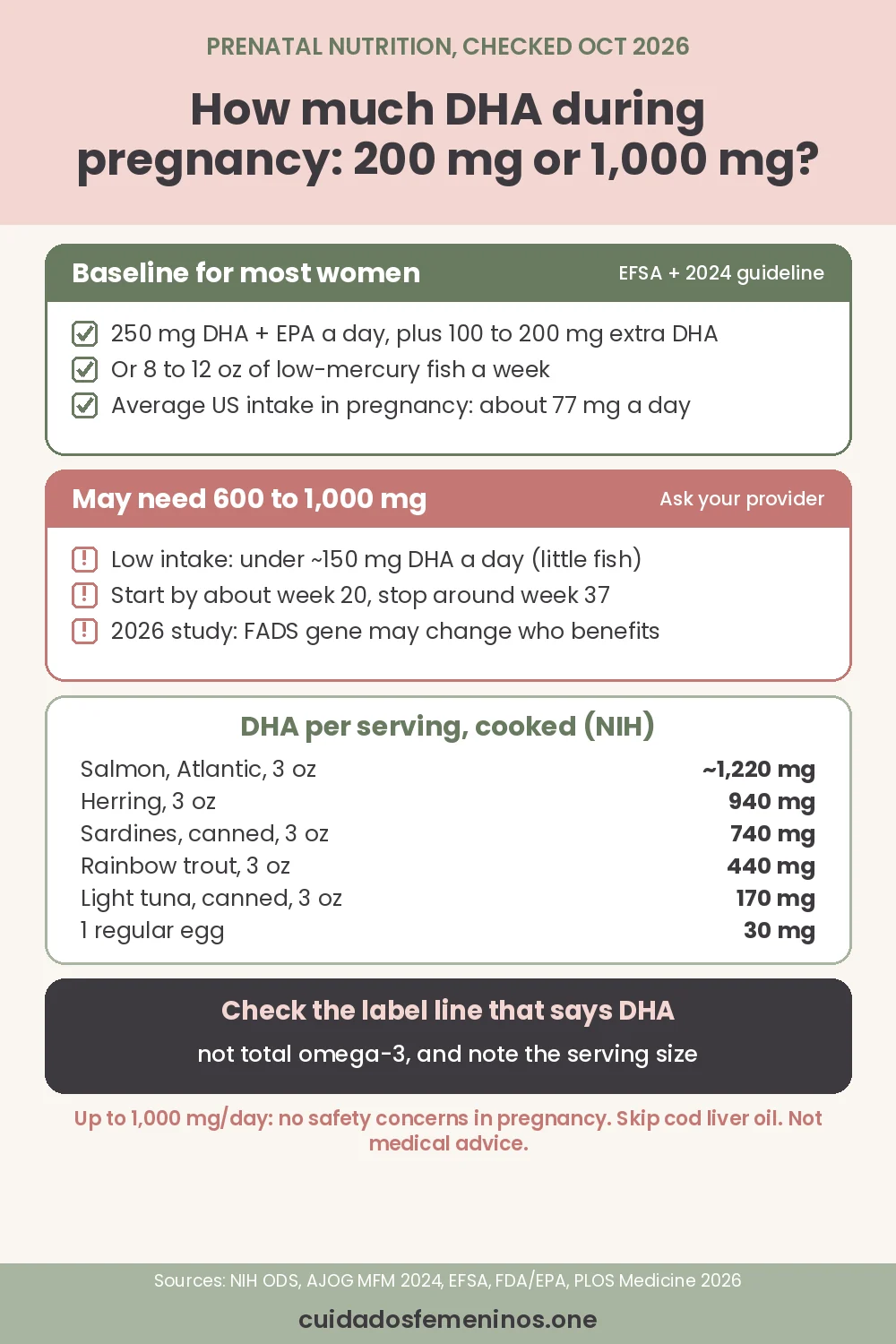
- Baseline for most women: about 250 mg of DHA plus EPA a day, plus an extra 100 to 200 mg of DHA in pregnancy. That’s the European (EFSA) advice and the 2024 clinical guideline.
- Who may need more: women with a low DHA intake (under about 150 mg a day) or low blood DHA. For them, the guideline suggests about 600 to 1,000 mg a day of DHA, or DHA plus EPA.
- When: start the higher dose in the second trimester, no later than about 20 weeks, and stop around 37 weeks or at birth.
- Is it safe? Up to 1,000 mg a day doesn’t raise safety concerns in pregnancy, according to the guideline authors. There’s no official upper limit, but the higher dose may slightly raise the chance of going past your due date.
- Fish counts: 3 ounces of cooked salmon has about 1,200 mg of DHA. The FDA suggests 2 to 3 servings a week of low-mercury fish in pregnancy.
How much DHA do you need during pregnancy?
There’s no official US recommended amount of DHA. The NIH says intake recommendations for DHA and EPA haven’t been established, and ACOG and the FDA frame their advice around fish: 8 to 12 ounces of lower-mercury seafood a week, which works out to roughly 250 mg a day of DHA plus EPA.
The numbers you see on prenatal labels come from other groups. Here’s how they line up:
| Who it applies to | Daily amount | Source |
|---|---|---|
| All adults, including women planning a pregnancy | At least 250 mg DHA plus EPA | EFSA; 2024 guideline in AJOG MFM |
| All pregnant women | An extra 100 to 200 mg DHA on top of that | EFSA; 2024 guideline; EBCOG |
| All pregnant women (alternative framing) | At least 300 mg DHA plus EPA, of which 200 mg DHA | Food and Agriculture Organization (as summarized by NIH) |
| Pregnant women with low DHA intake (under about 150 mg a day) or low blood DHA | About 600 to 1,000 mg DHA plus EPA, or DHA alone | 2024 guideline; endorsed by EBCOG |
| All pregnant women (food-based) | 8 to 12 oz of lower-mercury seafood a week | ACOG, FDA and EPA |
Most women are below even the baseline. The NIH reports that pregnant women aged 20 to 40 in the US get about 60 mg of DHA a day from food and about 77 mg from food and supplements combined. Black women are more likely than others to have a low intake. And only 35% to 39% of prenatal supplements contain any DHA at all.
Who should consider 600 to 1,000 mg?
The 2024 guideline, written by an international panel and endorsed by the European Board and College of Obstetrics and Gynaecology, says pregnant women with low DHA intake or low blood DHA have a higher risk of preterm and early preterm birth. That’s who the higher dose is for. It isn’t a blanket recommendation for everyone.
| Your situation | What the evidence suggests | Talk it over with your provider if |
|---|---|---|
| You rarely eat fish and your prenatal has no DHA | Your intake is probably under 150 mg a day, the group the guideline says should get about 600 to 1,000 mg | You’re already past 20 weeks |
| You eat fish now and then and take a 200 mg prenatal | You’re likely near the baseline; whether to add more depends on how much fish you really eat | You had a preterm birth before |
| You eat 2 to 3 servings of salmon, sardines or trout a week | You’re probably well above 200 mg a day from food | You also take a high-dose supplement |
| You’re vegetarian or vegan | You likely get almost no DHA from food; algae-based DHA works | You want to reach the higher range |
| You take a blood thinner, have a bleeding disorder or are carrying twins | Get a personal recommendation first; the guideline was written for single pregnancies | Always |
Doctors can estimate your intake with a short questionnaire. The NIH points to a validated seven-question tool for US pregnant women, and the 2024 guideline says a set of standard intake questions is enough to spot women with a low supply. Blood DHA tests exist, but the guideline notes that lab methods and cutoffs still need to be standardized.
The new 2026 study: why genes may change the answer
On October 8, 2026, PLOS Medicine published a new analysis of the ADORE trial, a US study that randomly assigned pregnant women at 12 to 20 weeks to 200 mg or 1,000 mg of DHA a day. The original trial, published in 2021, included 1,032 women in its main results. It found fewer early preterm births (before 34 weeks) on the higher dose, 1.7% versus 2.4%, and the gap was bigger in women who started with low DHA levels: 2.0% versus 4.1%.
The new paper looked at 761 of those women who agreed to genetic testing. The researchers checked one variant in the FADS gene, called the FADS Indel, which affects how much arachidonic acid the body makes. Arachidonic acid is an omega-6 fat that feeds the prostaglandins involved in starting labor. Women carry two copies, written as D/D, I/D or I/I.
| Group (FADS Indel) | Early preterm birth, 200 mg vs 1,000 mg | Preterm birth (before 37 weeks), 200 mg vs 1,000 mg | Birth at 40 weeks or later, 200 mg vs 1,000 mg |
|---|---|---|---|
| At least one I copy (I/D or I/I) | 4.3% vs 1.1% | 14.5% vs 9.3% | 17.8% vs 16.1% |
| D/D | 0.8% vs 2.7% | 8.7% vs 5.8% | 15.3% vs 25.7% |
In plain terms: women with at least one I copy seemed to get the most from 1,000 mg, while in D/D women the high dose didn’t lower early preterm birth and was linked to more pregnancies lasting 40 weeks or longer. Preterm birth before 37 weeks fell with the higher dose in both groups. The I copy was much more common in Black participants (85%) than in other participants (47%), and Black women benefited most from the higher dose.
Read this with care. The authors call it a post hoc analysis: comparing doses by genotype wasn’t one of the trial’s planned aims. Some groups had only a handful of early preterm births, as few as 1 to 3 per group, so the estimates are uncertain and need to be confirmed in a trial built to test genotype-based dosing. FADS testing isn’t part of routine prenatal care, so don’t change your dose based on this study alone.
How to check how much DHA your prenatal really has
Look at the Supplement Facts panel for a line that says “DHA” or “docosahexaenoic acid.” A line for total omega-3s or fish oil isn’t the same number. Then check the serving size, because some products need two softgels or capsules to reach the amount listed.
Affiliate disclosure: As an Amazon Associate, I earn from qualifying purchases. I may also earn from some brand partner links. If you buy through a product link on this page, the price is the same for you. Read the full disclosure.
| Product (label checked Oct 28, 2026) | DHA per daily serving | EPA | Serving | Source of DHA |
|---|---|---|---|---|
| One A Day Women’s Prenatal 1 (label) | 200 mg | 35 mg | 1 softgel | Fish oil |
| Ritual Essential Prenatal (label) | 350 mg | None listed | 2 capsules | Algae |
| Garden of Life Oceans Mom Prenatal DHA (label) | 350 mg | 15 mg | 1 softgel | Fish oil |
| Nordic Naturals Prenatal DHA (label) | 480 mg | 205 mg | 2 softgels | Fish oil |
| Nordic Naturals Vegan Prenatal DHA (label) | 500 mg | None listed | 2 softgels | Algae |
| Thorne Prenatal DHA (label) | 650 mg | 200 mg | 2 gelcaps | Fish oil |
| Thorne Basic Prenatal (label) | 0 mg | 0 mg | 3 capsules | Pair it with a separate DHA |
Formulas change, so trust the bottle in your hand over any list, including this one. If your prenatal has no DHA or only 200 mg and you eat little fish, a separate DHA softgel is the simplest way to fill the gap. A few that list their DHA clearly:
- Fish oil, 480 mg DHA per 2 softgels: Nordic Naturals Prenatal DHA on iHerb or on Amazon.
- Algae oil for vegetarians, 500 mg DHA per 2 softgels: Nordic Naturals Vegan Prenatal DHA on iHerb or on Amazon.
- One small softgel, 350 mg DHA: Garden of Life Oceans Mom on iHerb or on Amazon.
- Higher per serving, 650 mg DHA per 2 gelcaps: Thorne Prenatal DHA on Amazon.
None of these is “the best.” Pick by your diet, the dose your provider suggests and how many pills you’ll realistically take. Check the label for third-party purity testing, and skip cod liver oil as a DHA source: it also contains vitamin A, and too much preformed vitamin A in pregnancy can harm the baby.
While you have the label out, check the iodine line too. The 2026 thyroid guideline recommends 150 mcg a day, and many prenatals have none. Here's how to tell if your prenatal has iodine.
Can you get enough DHA from food?
Yes, if you eat fatty fish regularly. Salmon, herring, sardines and mackerel are the richest sources. The FDA counts a pregnancy serving as 4 ounces and suggests 2 to 3 servings a week from its “Best Choices” list, or 1 serving from the “Good Choices” list.
| Food (cooked, per NIH) | DHA | EPA |
|---|---|---|
| Salmon, Atlantic, farmed, 3 oz | 1,240 mg | 590 mg |
| Salmon, Atlantic, wild, 3 oz | 1,220 mg | 350 mg |
| Herring, Atlantic, 3 oz | 940 mg | 770 mg |
| Sardines, canned in tomato sauce, 3 oz | 740 mg | 450 mg |
| Salmon, pink, canned, 3 oz | 630 mg | 280 mg |
| Mackerel, Atlantic, 3 oz | 590 mg | 430 mg |
| Trout, rainbow, wild, 3 oz | 440 mg | 400 mg |
| Tuna, light, canned in water, 3 oz | 170 mg | 20 mg |
| Shrimp, 3 oz | 120 mg | 120 mg |
| Egg, 1 regular | 30 mg | 0 mg |
To estimate your daily DHA, add up your fish for the week, divide by 7, and add your supplement. For example, one 3-ounce serving of salmon a week works out to about 175 mg a day. Add a 200 mg prenatal and you’re near 375 mg a day. Skip the salmon and you’re back to roughly 200 mg plus whatever small amount comes from other food.
Avoid the fish the FDA lists as highest in mercury: king mackerel, marlin, orange roughy, shark, swordfish, tilefish from the Gulf of Mexico and bigeye tuna. Atlantic mackerel is on the “Best Choices” list. King mackerel isn’t.
Plant foods like walnuts, flaxseed and chia give you ALA, a different omega-3. The NIH says the body converts very little ALA into EPA and DHA, under 15%, so if you don’t eat fish, algae oil is the direct way to get DHA. Our guide to choline in pregnancy covers the other brain-building nutrient most prenatals come up short on.
Can you take too much DHA while pregnant?
It’s possible, but the amounts used in pregnancy studies are well within what experts consider safe. No official upper limit exists. EFSA said in 2012 that there wasn’t enough data to set one, and found that supplemental DHA alone up to about 1 g a day doesn’t raise safety concerns for the general population. For adults, EPA and DHA combined up to 5 g a day didn’t either. The 2024 guideline authors say up to 1,000 mg a day doesn’t raise safety concerns in pregnancy.
In the ADORE trial, the 1,000 mg group actually had fewer serious adverse events than the 200 mg group. The trade-off to know about is going past your due date. The 2018 Cochrane review of 70 trials found that omega-3s probably raise the rate of pregnancies lasting longer than 42 weeks, from 1.6% to 2.6%, and the 2026 analysis saw more births at 40 weeks or later in D/D women on the high dose.
Side effects are usually mild. The NIH lists an unpleasant taste, bad breath, heartburn, nausea, stomach discomfort, diarrhea, headache and smelly sweat. Most labels say to take softgels with food. Doses of 2 to 15 g a day may lengthen bleeding time, and fish oil can raise the INR in people on warfarin, so ask before adding DHA if you take a blood thinner, have a bleeding disorder or have surgery planned.
When to start and when to stop DHA
For the standard amount, there’s no wrong time to start: a prenatal with DHA works before conception, during pregnancy and after birth. For the higher 600 to 1,000 mg dose, timing matters more, because that’s what the trials tested.
| Dose | Start | Stop |
|---|---|---|
| Baseline (about 200 mg extra DHA) | Before or as soon as you’re pregnant | Usually continued; ask about breastfeeding |
| Higher (600 to 1,000 mg) | Second trimester, no later than about 20 weeks | Around 37 weeks, or at birth if earlier |
DHA builds up fastest in your baby’s brain and eyes during the third trimester, and it keeps accumulating in the brain for the first 2 years after birth, according to the NIH. So whether to keep taking DHA while breastfeeding is a fair question for your provider or lactation consultant.
Is DHA linked to autism?
There’s no good evidence that DHA supplements cause or prevent autism. The 2018 Cochrane review found very few differences in cognition, behavior or other development outcomes between children whose mothers took omega-3s in pregnancy and those whose mothers didn’t, and most of that evidence was low quality.
The largest recent look comes from the US ECHO cohorts, published in 2024. Eating any fish during pregnancy was linked to 16% lower odds of an autism diagnosis. Omega-3 supplements weren’t linked to diagnosis, but they were tied to slightly higher scores on a questionnaire about autism-related traits, the opposite of what the researchers expected. Because these were observational studies, none of it proves cause and effect. What it does support is the advice you’ll hear anyway: eat low-mercury fish if you can.
When to talk to your doctor or midwife
Bring up DHA at your next prenatal visit, especially if any of these apply:
- You rarely eat fish and your prenatal has no DHA, or you’re not sure.
- You had a preterm birth before, or you’ve been told you’re at higher risk.
- You’re close to 20 weeks and want to know whether the higher dose makes sense for you.
- You take a blood thinner or aspirin, have a bleeding disorder, or are carrying twins.
- You went past 41 or 42 weeks in an earlier pregnancy.
Don’t wait if you notice signs of preterm labor before 37 weeks. ACOG lists regular or frequent contractions or tightening (often painless), mild cramps with or without diarrhea, watery, bloody or mucus-like discharge or more discharge than usual, pelvic pressure, a constant low dull backache, and your water breaking. Call your ob-gyn right away or go to the hospital. Also call about unusual bruising or nosebleeds after starting a supplement.
If cost is what’s holding you back, our guide for anyone pregnant with no health insurance explains how Medicaid and WIC can help with prenatal care and vitamins. If you have an FSA, prenatal vitamins are a gray area, and our list of FSA eligible items for women explains when they count. And if you’re tired all the time, ask about iron too: low ferritin with normal hemoglobin is common in pregnancy.
Frequently asked questions
How much DHA do you need during pregnancy?
Most guidance lands on at least 200 mg of DHA a day during pregnancy, on top of about 250 mg of DHA plus EPA for adults. A 2024 guideline adds that if you get less than about 150 mg a day from food, 600 to 1,000 mg a day may lower your risk of early preterm birth.
Is 50 mg of DHA enough during pregnancy?
No. Fifty milligrams is well below the extra 100 to 200 mg of DHA a day that European guidance and the 2024 clinical guideline suggest for pregnancy. It’s also close to what the average pregnant woman in the US already gets from food alone, which NIH puts at about 60 mg a day.
Is 1000 mg of DHA too much?
Not for most pregnant women. The authors of the 2024 guideline say intakes up to 1,000 mg a day of DHA, or DHA plus EPA, don’t raise safety concerns in pregnancy, and EFSA reached a similar view for DHA alone. It’s more than most women need, though, so it makes sense mainly when your intake is low.
How much DHA is too much a day?
No official upper limit exists. EFSA found that up to about 1 g a day of supplemental DHA alone, or up to 5 g a day of EPA plus DHA for adults, didn’t raise safety concerns. In pregnancy, the studied range tops out at 1,000 mg a day, so going above that without a doctor’s advice isn’t a good idea.
Is too much DHA harmful during pregnancy?
At doses up to 1,000 mg a day, trials haven’t found safety problems, and in the ADORE trial the higher dose had fewer serious adverse events. The main trade-off is a slightly higher chance of going past your due date, which the 2018 Cochrane review and the 2026 PLOS Medicine analysis both point to.
How do you know if you take too much omega-3?
Common signs are mild and digestive: a fishy taste or burps, bad breath, heartburn, nausea, loose stools, headache or odd-smelling sweat, according to NIH. Very high doses can lengthen bleeding time. If you bruise easily, have nosebleeds or take a blood thinner, stop adding extra omega-3 and call your provider.
Is DHA linked to autism?
No study shows that DHA supplements cause or prevent autism. In a large 2024 analysis of US cohorts, eating fish during pregnancy was linked to 16% lower odds of an autism diagnosis, while omega-3 supplements showed no link to diagnosis. These were observational findings, so they can’t prove cause and effect either way.
What trimester is DHA most important?
The third trimester, when DHA builds up fastest in your baby’s brain and eyes, according to NIH. That’s why guidelines say to start a higher dose early, in the second trimester and no later than about 20 weeks, so your levels are already up when your baby’s demand peaks.
Is it too late to take prenatal vitamins at 20 weeks?
No. A prenatal vitamin still helps at 20 weeks and beyond, so start now and tell your provider. For the higher 600 to 1,000 mg DHA dose, the 2024 guideline says to begin no later than about 20 weeks, because that’s the window the preterm birth trials tested. Ask your provider if you’re past it.
When should you stop taking DHA in pregnancy?
If you’re on the higher 600 to 1,000 mg dose, the 2024 guideline and EBCOG say to stop around 37 weeks, or at birth if your baby comes earlier. A standard 200 mg prenatal is usually continued. Whether to keep a DHA supplement while breastfeeding is worth asking your provider.
What happens if I don’t take DHA during pregnancy?
Most babies do fine, and you can get DHA from fish instead of pills. But low DHA intake is linked to a higher risk of preterm and early preterm birth, and the 2018 Cochrane review found omega-3s cut early preterm birth by 42%. If you rarely eat fish, a supplement is an easy fix.
Are 2 eggs enough omega-3?
Not for DHA. A regular cooked egg has about 30 mg of DHA, according to NIH, so two eggs give you about 60 mg, well under 200 mg. Omega-3 enriched eggs have more, but amounts vary by brand, so check the carton. Eggs are still a great source of choline.
How much EPA do you need during pregnancy?
There’s no separate EPA target. Guidelines count DHA and EPA together, about 250 mg a day for adults, then ask for 100 to 200 mg of extra DHA in pregnancy. The 2024 guideline’s higher range can be DHA alone or DHA plus EPA, so a little EPA in your softgel is fine.
This article is general information, was last updated on October 28, 2026, and isn’t medical advice. Talk with your OB, midwife or pharmacist before you change your DHA dose or add a supplement, especially if you take blood thinners or have a bleeding disorder.
Sources
- Li YN, Kothapalli KSD, Carlson SE, et al. Genotype-informed DHA dosing based on the FADS Indel to reduce preterm and prolonged gestation: a secondary analysis of the ADORE randomized trial. PLOS Medicine, October 8, 2026
- Carlson SE, et al. Higher dose DHA supplementation during pregnancy and early preterm birth (ADORE trial). EClinicalMedicine, 2021
- Cetin I, Carlson SE, et al. Omega-3 fatty acid supply in pregnancy for risk reduction of preterm and early preterm birth (clinical practice guideline). Am J Obstet Gynecol MFM, 2024
- European Board and College of Obstetrics and Gynaecology (EBCOG). Omega-3 fatty acid supply in pregnancy: position statement. Eur J Obstet Gynecol Reprod Biol, 2024
- NIH Office of Dietary Supplements: Omega-3 fatty acids, fact sheet for health professionals (food values, recommendations table, safety)
- NIH Office of Dietary Supplements: Nutrition during pregnancy, fact sheet for health professionals (omega-3s and seafood)
- EFSA Panel on Dietetic Products, Nutrition and Allergies. Scientific opinion on the tolerable upper intake level of EPA, DHA and DPA. EFSA Journal, 2012
- FDA and EPA: Advice about eating fish (pregnancy and breastfeeding)
- Middleton P, et al. Omega-3 fatty acid addition during pregnancy. Cochrane Database of Systematic Reviews, 2018 (CD003402)
- Lyall K, et al. Maternal fish consumption and omega-3 supplement use during pregnancy and child autism-related outcomes (ECHO). Am J Clin Nutr, 2024
- ACOG: Preterm labor and birth, patient FAQ (signs and symptoms)
- NIH Dietary Supplement Label Database: Nordic Naturals Prenatal DHA label
- NIH Dietary Supplement Label Database: Nordic Naturals Prenatal DHA Vegan label
Keep reading
- Choline in pregnancy · 450 vs 900 mg and the new IQ study.
- Low ferritin with normal hemoglobin · Why iron needs jump in pregnancy.
- Pregnant with no health insurance? · Medicaid, CHIP and open enrollment.
- Abrysvo vs Beyfortus · RSV protection for your newborn.
- FSA eligible items for women · Including when prenatal vitamins count.
- More fertility, pregnancy and baby guides
- Iron infusion in pregnancy: when you need it
If you want to read more articles like How Much DHA During Pregnancy? 200 mg vs 1,000 mg, and Who Needs More, check out the Fertility, Pregnancy & Baby category.