How Long Before Pregnancy Should You Stop Ozempic, Wegovy or Zepbound? (2026 Labels + ACOG)
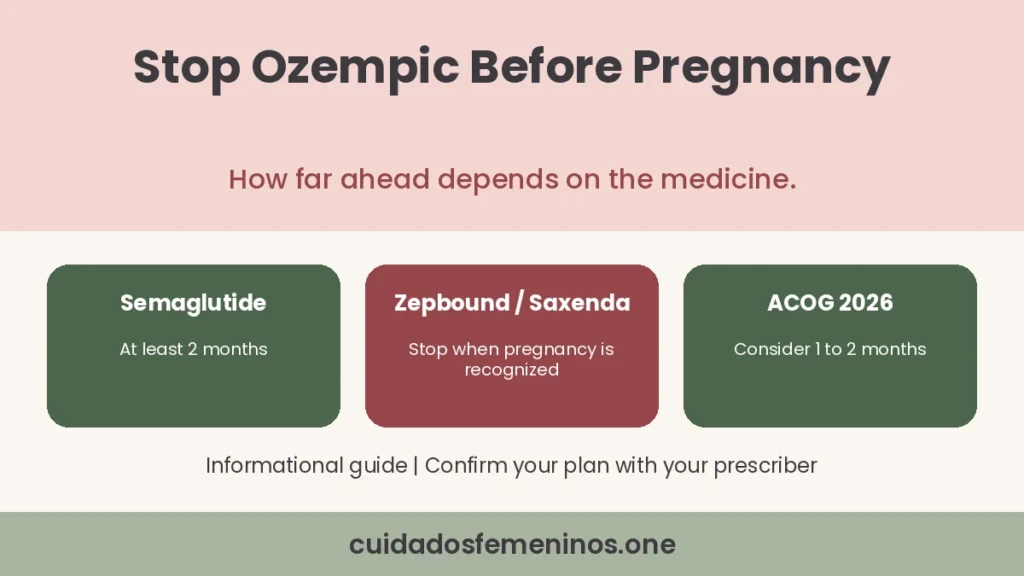
How long to stop Ozempic before pregnancy is at least 2 months if you take Wegovy, Ozempic or Rybelsus, because semaglutide stays in the body a long time. Zepbound and Saxenda labels have no fixed washout and say to stop when pregnancy is recognized. Mounjaro and Victoza also have no fixed washout; those labels say to use the medicine in pregnancy only if the potential benefit justifies the potential risk to the fetus. ACOG (October 2026) suggests considering stopping 1 to 2 months before trying.
This article is for information only and does not replace advice from your doctor or pharmacist.
Last updated: November 2026.
- Stop times by drug (2026 FDA labels)
- Why semaglutide needs 2 months and tirzepatide doesn't
- What ACOG's 2026 guidance adds
- Diabetes vs weight loss: two different plans
- What happens after you stop (weight, appetite, blood sugar)
- A sample timeline for trying to conceive
- Birth control until your stop date
- Got pregnant while on Ozempic or Zepbound? What to do
- When to call your doctor
- Frequently asked questions
- Is it harder to get pregnant while on Ozempic?
- Can I take Ozempic for 3 months and then stop before trying?
- What happens if I accidentally get pregnant on Ozempic?
- How long does Ozempic stay in your system after you stop?
- How long before pregnancy should I stop Zepbound or Mounjaro?
- Can I use Ozempic while trying to conceive with IVF?
- Will I gain the weight back when I stop for pregnancy?
- Can I go back on Ozempic after giving birth or while breastfeeding?
- Sources
Stop times by drug (2026 FDA labels)
Plan every stop date with the person who prescribes your medicine. The table below uses only the current U.S. labels on DailyMed. If a detail is missing from the label, the cell says "not stated in the label."
| Brand | Active ingredient | Used for | What the current FDA label says about planning a pregnancy | What the label says if she gets pregnant | Half-life (section 12.3) |
|---|---|---|---|---|---|
| Ozempic | semaglutide | Type 2 diabetes (also CV and kidney risk reduction) | Discontinue in women at least 2 months before a planned pregnancy due to the long washout period for semaglutide | Use during pregnancy only if the potential benefit justifies the potential risk to the fetus | Approximately 1 week; present in the circulation for about 5 weeks after the last dose |
| Wegovy (injection and tablet) | semaglutide | Weight reduction / CV risk reduction (also MASH) | Discontinue at least 2 months before a planned pregnancy because of the long half-life of semaglutide | For weight reduction or CV risk reduction, discontinue when pregnancy is recognized. For MASH, use only if the potential benefit justifies the potential risk to the fetus. Registry available | Approximately 1 week; present in the circulation for about 5 to 7 weeks after the last injectable dose of 2.4 mg or 7.2 mg or oral dose of 25 mg |
| Rybelsus (oral) | semaglutide | Type 2 diabetes (also CV risk reduction) | Discontinue in women at least 2 months before a planned pregnancy due to the long washout period for semaglutide | Use during pregnancy only if the potential benefit justifies the potential risk to the fetus | Approximately 1 week; present in the circulation for about 5 weeks after the last tablet dose |
| Zepbound | tirzepatide | Weight reduction (also OSA) | Not stated in the label (no fixed washout) | Discontinue when pregnancy is recognized. Weight loss offers no benefit to a pregnant patient and may cause fetal harm. Registry available | Approximately 5 to 6 days |
| Mounjaro | tirzepatide | Type 2 diabetes | Not stated in the label (no fixed washout) | Available data are insufficient to evaluate risk; use only if the potential benefit justifies the potential risk to the fetus | Approximately 5 days |
| Saxenda | liraglutide | Weight management | Not stated in the label (no fixed washout) | Discontinue when pregnancy is recognized. Weight loss offers no benefit to a pregnant patient and may cause fetal harm | Approximately 13 hours |
| Victoza | liraglutide | Type 2 diabetes (also CV risk reduction) | Not stated in the label (no fixed washout) | Use during pregnancy only if the potential benefit justifies the potential risk to the fetus | Approximately 13 hours |
Links to the current labels, with listing update dates, are in the Sources list at the end.
Why semaglutide needs 2 months and tirzepatide doesn't
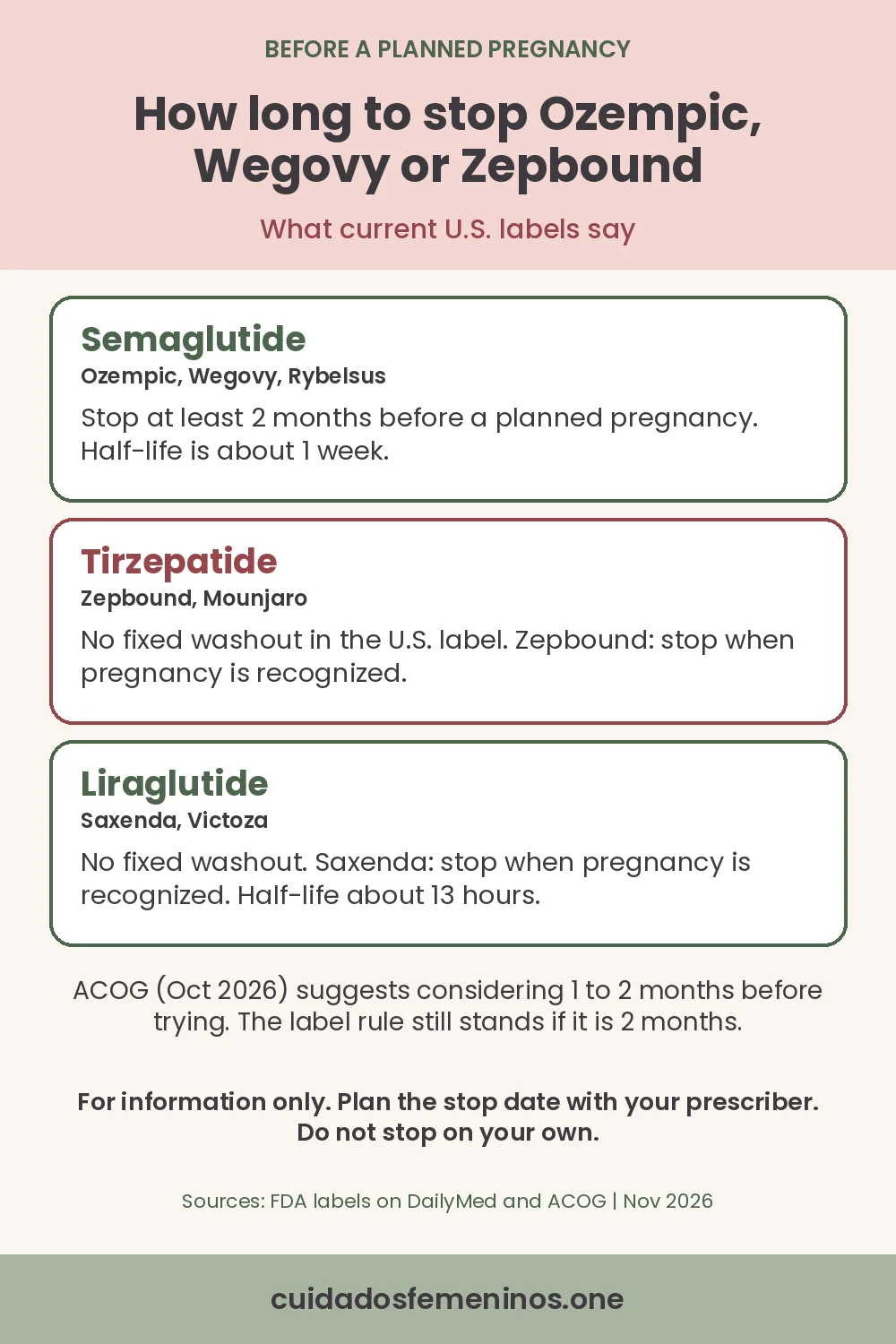
Semaglutide labels list an elimination half-life of approximately 1 week. After the last dose, Ozempic and Rybelsus say the drug can still be present in the circulation for about 5 weeks. The Wegovy label says about 5 to 7 weeks after the last listed dose. A simple rule of thumb is that most of a drug is gone after roughly 5 half-lives. For a 1-week half-life that lands near 5 to 7 weeks, which is why those labels chose a 2-month window before a planned pregnancy.
Tirzepatide labels list an elimination half-life of approximately 5 days (Mounjaro) or 5 to 6 days (Zepbound). Using the same rough 5-half-life idea, most of the drug is expected to clear in about 25 to 30 days. Because clearance is faster, the U.S. labels do not set a fixed multi-month washout. Zepbound says to stop when pregnancy is recognized. Mounjaro does not give a fixed pre-pregnancy interval and uses benefit-versus-risk wording if you are already pregnant. Individual clearance still varies, so the stop date is still decided with your prescriber.
What ACOG's 2026 guidance adds
ACOG's October 2026 Practice Advisory states that safety data on GLP-1 receptor agonists in pregnancy are still limited. It recommends advising patients about that gap and considering discontinuation 1 to 2 months before conception. It advises against use during pregnancy. It also notes that effective contraception should be used while taking these drugs, because weight loss can improve fertility. Prescribing in the perinatal period rose more than 30-fold from 2019 to 2024. Four recent meta-analyses cited by ACOG did not find a statistically significant increase in major congenital malformations. ACOG does not shorten the FDA label. If your label says 2 months for semaglutide, that label rule still stands.
ACOG also cites Maya et al. (JAMA 2025). In a large retrospective cohort, people with GLP-1 exposure from 3 years before conception through 90 days after had more preterm delivery (17% vs 13%), gestational diabetes (20% vs 15%) and hypertensive disorders of pregnancy (46% vs 36%) than propensity-matched controls. ACOG says the absolute differences were modest and notes a limitation: matching used prepregnancy BMI, not BMI when the medicine was started. ACOG discusses rebound after stopping as one possible explanation, also drawing on Yu et al. Take this as a reason to have a plan for weight and blood sugar after you stop, not as a reason to panic.
Diabetes vs weight loss: two different plans
If you take the medicine for type 2 diabetes, blood-sugar control still matters before and during pregnancy. The labels note that poorly controlled diabetes raises risks for both you and the baby. The plan is a medication switch that your doctor arranges before you stop the GLP-1. Never stop on your own.
If you take it only for weight, the main goals are to stop on the schedule your label and prescriber recommend, keep contraception until the stop date, and have a plan for appetite and weight once the drug is gone. Neither situation is a judgment about why you started the medicine.
What happens after you stop (weight, appetite, blood sugar)
Appetite often returns after the drug leaves your system, and weight can rise. ACOG notes that regaining lost weight is common after stopping, and it encourages lifestyle support and weight checks. The labels reviewed here do not give regain percentages.
For diabetes, the switch plan is made with your doctor before you stop so blood sugar stays controlled. After stopping, your care team will usually want regular checks until the new plan is stable.
A sample timeline for trying to conceive
This is an example only, not a prescription. Adjust every date with your prescriber and OB.
| When | What to do |
|---|---|
| 3 to 4 months before trying | Talk with the person who prescribes the GLP-1 and with your OB. Start a prenatal vitamin that contains folic acid. Plan contraception that you will continue until the stop date. You can also review nutrition topics such as choline and DHA. |
| Stop date | 2 months before trying for any semaglutide product (Ozempic, Wegovy, Rybelsus) per the label. For tirzepatide (Zepbound, Mounjaro) or liraglutide (Saxenda, Victoza), the date is set by your prescriber. |
| Months after stopping | Appetite often returns. Watch weight and energy. Keep nutrition and movement steady. If you have diabetes, continue the blood-sugar checks your doctor ordered. |
| First positive test | Call your prescriber and OB the same day. See the next section. |
More on prenatal nutrition: choline in pregnancy and how much DHA in pregnancy.
Birth control until your stop date
Keep using reliable contraception until you reach the agreed stop date. Zepbound and Mounjaro labels state that oral birth-control pills may work less well. Use a backup method or switch to a non-oral method for 4 weeks after starting and for 4 weeks after each dose increase. Full details are in our guide on Ozempic and birth control.
Got pregnant while on Ozempic or Zepbound? What to do
Call your prescriber and OB the same day. Do not try to manage this alone, and do not panic. Weight-loss labels for Wegovy, Zepbound and Saxenda say to discontinue when pregnancy is recognized. Diabetes labels for Ozempic, Rybelsus, Mounjaro and Victoza say to use the medicine only if the potential benefit justifies the potential risk to the fetus, so the next step is a same-day plan with your clinicians, especially if you need a diabetes substitute. The 2026 and other recent meta-analyses cited by ACOG did not find a significant increase in major malformations. You can also call MotherToBaby (free, U.S.) at mothertobaby.org and ask about the manufacturer's pregnancy registry listed in your specific label (Wegovy and Zepbound labels describe a registry).
When to call your doctor
- You decide you want to start trying in the next few months.
- You have a positive pregnancy test while still taking the drug. See also how soon you can take a pregnancy test.
- Appetite or blood sugar changes sharply after stopping.
- You have diabetes and need to discuss the switch plan.
- You have questions about contraception while still on the medicine.
Frequently asked questions
Is it harder to get pregnant while on Ozempic?
Weight loss from these drugs can improve fertility for some people, which is why labels and ACOG recommend effective contraception while you are taking them. The medicines themselves are not fertility treatments. Nothing in the sources used here says Ozempic makes it harder to conceive. Discuss your timeline with your prescriber before you change anything.
Can I take Ozempic for 3 months and then stop before trying?
Yes, as long as the stop date meets the 2-month label rule for semaglutide and is planned with your prescriber. The total time on the drug is less important than the washout before conception. If you have diabetes, arrange the blood-sugar plan before you stop. Do not set a stop date on your own.
What happens if I accidentally get pregnant on Ozempic?
Call your prescriber and OB the same day. Recent meta-analyses cited by ACOG are reassuring on major malformations, but you still need medical follow-up, especially if you take the medicine for diabetes. MotherToBaby can also answer questions. Your label may list a pregnancy registry; Wegovy and Zepbound labels do.
How long does Ozempic stay in your system after you stop?
The Ozempic label states an elimination half-life of approximately 1 week, with the drug present in the circulation for about 5 weeks after the last dose. That is why the label uses a 2-month pre-pregnancy window. Wegovy uses the same 2-month rule and says about 5 to 7 weeks after the last listed dose.
How long before pregnancy should I stop Zepbound or Mounjaro?
U.S. labels do not set a fixed washout. Zepbound says to stop when pregnancy is recognized. Mounjaro says to use it in pregnancy only if the potential benefit justifies the potential risk to the fetus. ACOG suggests considering 1 to 2 months before trying. Decide the exact date with your prescriber.
Can I use Ozempic while trying to conceive with IVF?
Ask the fertility clinic. ACOG's general advice still applies: safety data are limited, consider stopping 1 to 2 months before conception, and do not use these medicines in pregnancy. Clinic policies vary and are not stated in the sources here. Insurance coverage for IVF is a separate topic: does insurance cover IVF.
Will I gain the weight back when I stop for pregnancy?
Appetite and weight often return after stopping. ACOG says regain is common and encourages nutrition, movement and weight checks. Having those plans ready before the stop date can make the change less abrupt. Exact regain percentages are not given in the labels or the ACOG advisory used here.
Can I go back on Ozempic after giving birth or while breastfeeding?
Labels and ACOG address lactation separately. ACOG recommends against use while breastfeeding preterm infants and neonates, and supports shared decision-making afterward, with close watch on the baby's weight gain if a medicine is used. See the full discussion in Ozempic while breastfeeding.
Last updated: November 2026. This is a source-based informational guide, not individualized medical advice.
Sources
- ACOG Practice Advisory, Use of Glucagon-Like Peptide-1 Receptor Agonists in Pregnancy and Lactation, October 2026
- ACOG news release, October 23, 2026
- Maya J, et al. Gestational weight gain and pregnancy outcomes after GLP-1 receptor agonist discontinuation. JAMA 2025;334:2186-96. doi: 10.1001/jama.2025.20951 (figures quoted as reported by ACOG)
- Wegovy label (DailyMed listing updated June 18, 2026)
- Ozempic label (DailyMed listing updated July 30, 2026)
- Rybelsus / oral semaglutide label (DailyMed listing updated January 30, 2026)
- Zepbound label (DailyMed listing updated August 28, 2026)
- Mounjaro label (DailyMed listing updated July 29, 2026)
- Saxenda label (DailyMed listing updated February 25, 2026)
- Victoza label (DailyMed listing updated October 14, 2025)
- MotherToBaby
- MotherToBaby fact sheet on NCBI Bookshelf
Keep reading
- Ozempic, Zepbound and birth control
- Ozempic while breastfeeding
- Choline during pregnancy
- How much DHA in pregnancy
- When to take a pregnancy test
- IVF insurance coverage
 How Long Should You Use a Heating Pad for Period Cramps? Safe Times, Settings and What Works
 When to Take an Ovulation Test: The Right Cycle Day and Time of Day
 Does At-Home IPL Actually Work? Who It's For, How Long It Takes and Who Should Skip It
If you want to read more articles like How Long Before Pregnancy Should You Stop Ozempic, Wegovy or Zepbound? (2026 Labels + ACOG), check out the Women's Health category.