
Does Insurance Cover IVF? How to Pick a 2027 Plan That Does

Does insurance cover IVF? Sometimes, and for 2027, the answer is mostly being decided right now. The plan you pick during open enrollment this November is usually the plan you’re stuck with all next year, and two plans that look alike on the premium page can treat IVF completely differently. Here’s how to tell them apart before you click “enter.”
This isn’t insurance or legal advice. It’s a plain-English guide built from federal rules, state law summaries and KFF data, checked on October 27, 2026. Your own plan documents always win, so use this to know what to ask.
- Quick answer
- Why this November matters so much
- In what states is IVF covered by insurance?
- The self-funded plan trap
- Employer fertility benefits: Progyny, Carrot, Kindbody and Maven
- How do I know if my insurance covers IVF? A 10-minute check
- What changes in 2027: the proposed federal fertility rule
- How much does IVF cost with and without insurance?
- Does insurance cover IVF for single women and same-sex couples?
- If your plan won’t cover it: IVF financing options
- Your open enrollment action plan
- When to see a doctor (and why it helps with coverage)
- Frequently asked questions
- Is it common for insurance to cover IVF?
- How much does IVF cost in the US with insurance?
- How do I know if my insurance covers IVF?
- Are IVF meds covered by insurance?
- Will IVF be covered in 2026?
- How much is IVF in Texas with insurance?
- Can I buy my own IVF insurance?
- What insurances have IVF coverage?
- Does insurance cover egg freezing?
- Will insurance pay for IVF after tubal ligation?
- Is IVF cheaper under Trump?
- How can I get IVF if I can’t afford it?
- Can IVF be paid in installments?
- Can I switch plans outside open enrollment to get IVF coverage?
- Sources
Quick answer
- There’s no federal IVF mandate. The Affordable Care Act doesn’t require it, and KFF confirms there’s currently no federal requirement to cover fertility services.
- Fifteen states plus D.C. require some IVF coverage, according to RESOLVE and federal regulators. Those laws only reach fully insured plans.
- About two-thirds of workers with job-based coverage are in self-funded plans (67% in KFF’s 2025 survey). State mandates don’t apply to them; the employer decides.
- The federal “excepted fertility benefits” rule is only proposed. It was published May 13, 2026 and still isn’t final, so don’t pick a plan counting on it.
- If you do one thing this week: ask HR “Is our medical plan fully insured or self-funded?” and find the “infertility treatment” line in each plan’s Summary of Benefits and Coverage.
Why this November matters so much
Outside open enrollment, you can usually change plans only after a qualifying life event, like getting married, having a baby, moving or losing other coverage. Starting IVF isn’t one of them. So the choice you make in the next few weeks tends to lock in your fertility coverage until next fall.
- Job-based plans: most employers hold open enrollment in November, but each company sets its own dates, and the window can be short. Check your HR portal today.
- HealthCare.gov: open enrollment for 2027 runs November 1, 2026 to January 15, 2027.
- December 15, 2026 is the last day to pick a plan for coverage that starts January 1, 2027 (you also have to pay the first premium).
- December 16 to January 15: plans you pick in this window start February 1, 2027.
- State-run marketplaces can set different deadlines, so check yours if you don’t use HealthCare.gov.
Already in treatment? Ask both your current plan and any new plan how a switch on January 1 would affect prior authorizations, your deductible and your clinic’s network status. A new plan year usually means a new deductible.
In what states is IVF covered by insurance?
As of 2026, RESOLVE counts 15 states with laws requiring IVF coverage, plus D.C.; KFF lists 23 states that require private plans to cover at least some infertility services. The table shows the laws that reach private, fully insured plans and include IVF or broad fertility treatment, with the limits people trip over most.
| State | Who has to cover it | IVF and key limits |
|---|---|---|
| Arkansas | Individual and group policies with maternity benefits (HMOs exempt) | Yes; $15,000 lifetime maximum; eggs must be fertilized with the spouse’s sperm |
| California | Large-group plans (more than 100 employees) from January 2026 | Yes; up to 3 egg retrievals, unlimited transfers. Small-group plans must only offer infertility coverage, without IVF |
| Colorado | Large-group plans (more than 100 employees) | Yes; 3 egg retrievals, unlimited transfers |
| Connecticut | Fully insured plans; you must be on the plan 12 months | Yes; lifetime max of 2 IVF cycles |
| Delaware | Individual and group plans; employers with 50+ workers | Yes; retrievals before 45, transfers before 50 |
| District of Columbia | Individual, small- and large-group plans | Yes; at least 3 egg retrievals, unlimited transfers |
| Hawaii | Individual and group plans | One IVF cycle; strict history rules, spouse’s sperm |
| Illinois | Group plans and HMOs with pregnancy benefits | Yes; up to 4 retrievals, 6 lifetime if you have a live birth |
| Maine | Plans sold in Maine (from 2024) | Fertility diagnosis, treatment and preservation; ask how your plan applies it to IVF |
| Maryland | Plans with pregnancy benefits; employers with 50+ workers | Yes; 3 tries per live birth, $100,000 lifetime cap |
| Massachusetts | Insurers and HMOs with pregnancy benefits | Yes; no cycle or dollar cap in the law |
| New Hampshire | Group plans | Medically necessary fertility treatment |
| New Jersey | Group plans and HMOs; employers with 50+ workers | Yes; 4 completed retrievals, unlimited transfers |
| New York | Large-group plans (100+ employees) | Yes; up to 3 IVF cycles; fertility drugs in plans with drug coverage |
| Rhode Island | Insurers and HMOs with pregnancy benefits | Yes; ages 25 to 42, $100,000 cap, up to 20% copay |
Texas is the one that confuses people: insurers there only have to offer IVF coverage to employers, who can say no. Several other states, including Georgia, Kentucky, Louisiana and Oklahoma, require coverage only for fertility preservation before cancer treatment and similar care. Ohio and West Virginia require HMOs to cover basic infertility services; Ohio’s law says IVF isn’t required. Every one of these laws exempts self-funded employer plans.
The self-funded plan trap
This is the part most articles skip, and it’s the reason two coworkers in the same state can get completely different answers. State insurance laws apply to plans where an insurance company carries the risk. When an employer pays claims out of its own money, the plan is self-funded (or self-insured). A federal law, ERISA, keeps state mandates from applying to those plans.
And self-funding is the norm, not the exception. In KFF’s 2025 survey, 67% of covered workers were in self-funded plans, including 80% at firms with 200 or more workers. The insurer’s name on your card doesn’t tell you which kind you have: big carriers often just process claims for self-funded employers.
How to find out in five minutes:
- Email HR: “Is our medical plan fully insured or self-funded for 2027?” Ask for the answer in writing.
- Search your Summary Plan Description for “self-funded,” “self-insured” or “administrative services only.” If the insurer is described as a claims administrator, that’s a strong hint the plan is self-funded.
- If you’re choosing between two employer plans, ask about each one separately. Don’t assume they’re funded the same way.
If your plan is self-funded, a state mandate won’t help you, but don’t give up yet. Your employer may have chosen to cover IVF anyway, or may add a separate fertility benefit.
Employer fertility benefits: Progyny, Carrot, Kindbody and Maven
A lot of employers that cover IVF do it through a specialty fertility company rather than the regular medical plan. The proposed federal rule says the same thing: many employers already run fertility benefits under a separate contract. These benefits come with their own network, care advocates and rules, so read them as carefully as the medical plan.
Designs vary a lot. Some set a lifetime dollar maximum. Progyny uses a “Smart Cycle,” a bundle in which each treatment uses a fraction of your balance; in its own examples, a fresh IVF cycle uses 3/4 of a Smart Cycle and egg freezing uses 1/2. We don’t rank these companies; the details your employer bought matter more than the brand.
Ask HR before your enrollment window closes:
- Is there a fertility benefit for 2027, and who runs it?
- Do I have to enroll in a specific medical plan to get it?
- What’s the lifetime maximum, in dollars or cycles, and is it per person or per family?
- Are medications included, or billed through the pharmacy plan?
- Does it cover egg freezing, donor eggs or sperm, and single people or same-sex couples?
- Which clinics are in network near me?
How do I know if my insurance covers IVF? A 10-minute check
Do this for every plan you’re offered, including a spouse’s or partner’s plan.
- Download the Summary of Benefits and Coverage (SBC) for each plan. Every plan has to give you one.
- Scroll to the boxes near the end called “Services Your Plan Generally Does NOT Cover” and “Other Covered Services.” Federal SBC instructions require “Infertility treatment” to appear in one of them. If it’s in the first box, that plan most likely won’t pay for IVF.
- If it’s covered, open the full plan document and search “infertility,” “assisted reproductive technology,” “IVF” and “fertility preservation.”
- Note the definition of infertility, any age limits, cycle or dollar caps and whether you must try cheaper treatments first.
- Check how fertility drugs are covered: medical benefit, pharmacy benefit or a specialty pharmacy.
- Ask HR whether the plan is self-funded and whether a separate fertility benefit applies.
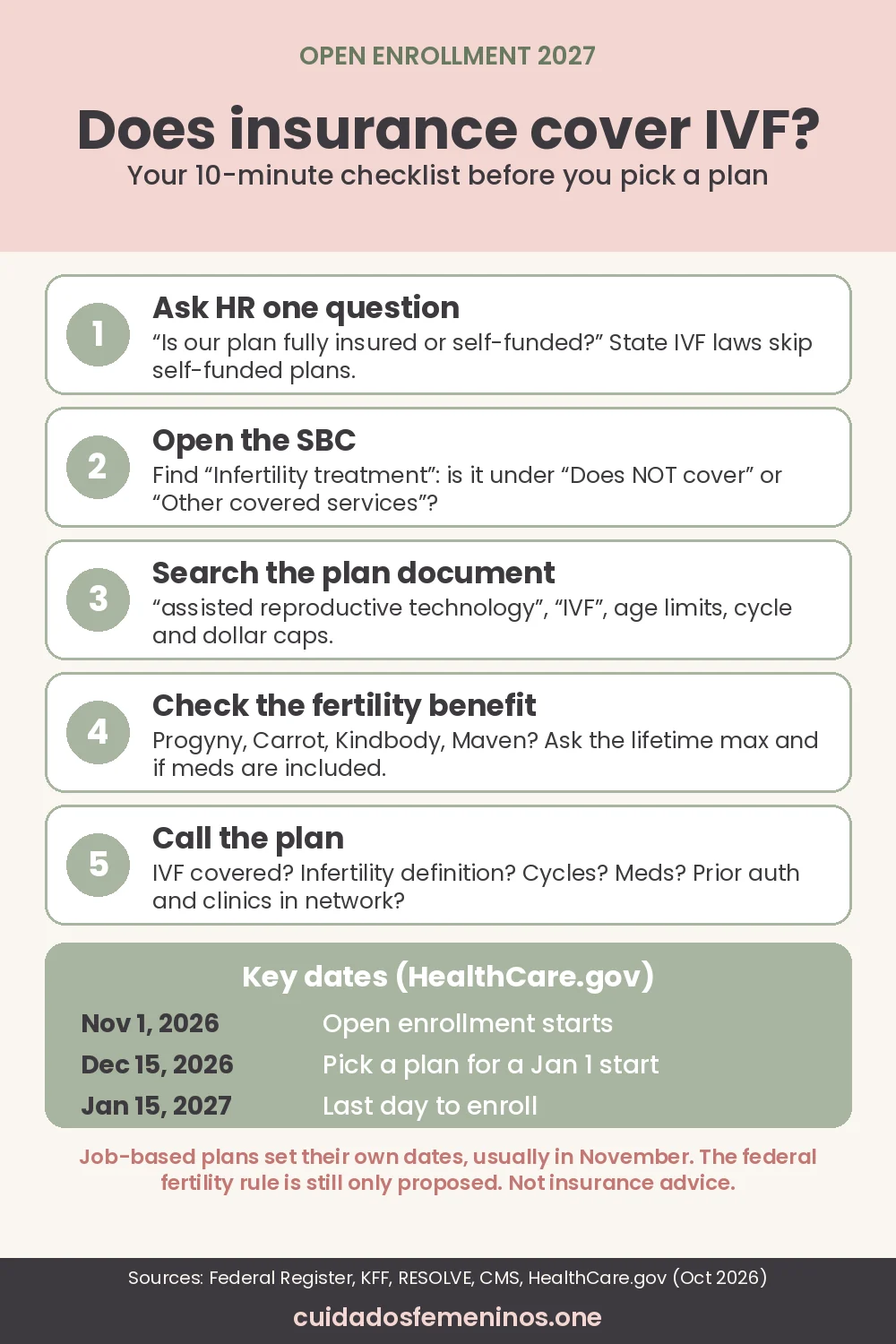
Five questions to ask when you call the plan
Call the member services number on the plan’s website (or the number HR gives you for next year’s plans). Write down the date, the representative’s name and the call reference number.
- “Does this plan cover in vitro fertilization for the 2027 plan year? Where is that written?”
- “How does the plan define infertility, and does that definition include single people or same-sex couples?”
- “How many cycles or egg retrievals are covered, and is there a lifetime dollar limit?”
- “Are fertility medications covered, under which benefit, and do they need a specialty pharmacy?”
- “What prior authorization is required, and which clinics near me are in network?”
If a claim gets denied later, those notes are gold. The same appeal habits that work for other procedures apply here; our guide to appealing an insurance denial walks through the paperwork.
What changes in 2027: the proposed federal fertility rule
On May 13, 2026, the IRS, the Department of Labor and HHS published proposed rules creating a new category called “excepted fertility benefits.” In plain terms, employers could offer fertility coverage as a separate benefit with fewer federal strings attached, a bit like stand-alone dental or vision.
- Lifetime cap: up to $120,000 per participant (together with covered family members), indexed for medical inflation after 2027.
- Scope: substantially all benefits must be for diagnosing, mitigating or treating infertility, by licensed professionals. IVF can be included.
- Access: the employer must offer a regular medical plan too, but you wouldn’t have to enroll in it to get the fertility benefit.
- Notice: plans would have to give you a plain-language summary when you can first enroll and every year after.
- Timing: proposed for plan years starting on or after January 1, 2027.
Here’s the catch. The comment period closed July 13, 2026, and as of October 27, 2026 the Federal Register shows no final rule. It doesn’t require any employer to cover anything, either. If it’s finalized, it may simply make it easier for your employer to add a benefit, possibly mid-year. Choose your 2027 plan based on what’s in writing today.
How much does IVF cost with and without insurance?
Without coverage, one IVF cycle commonly costs $15,000 to $20,000, the estimate federal regulators cite in the 2026 proposal, and KFF notes a cycle can run upward of $25,000. Medications alone for one cycle can top $5,000. The same federal document says an average of 2.5 cycles is needed for a successful pregnancy, which is how total costs pass $40,000.
With insurance, there’s no honest national average, because plans differ so much. What you’ll pay depends on your deductible, coinsurance, out-of-pocket maximum, cycle caps and whether drugs are included. Ask the plan or clinic for a written estimate before you start. And if you’ve already hit your 2026 out-of-pocket maximum, ask whether any step can reasonably happen before the plan year resets.
Cost is the barrier that keeps coming up. In KFF’s survey published October 8, 2026, 15% of women ages 18 to 49 said they or a partner had ever needed fertility services, and among those who didn’t get the care they needed, cost was the leading reason.
Does insurance cover IVF for single women and same-sex couples?
It depends heavily on how the plan defines infertility. Older definitions are built around a couple having unprotected sex for a year, which can shut out single women and same-sex couples. Arkansas and Hawaii, for example, still require that the patient’s eggs be fertilized with her spouse’s sperm.
Newer definitions are broader. ASRM’s 2023 definition includes needing medical help, such as donor sperm or eggs, to get pregnant as an individual or with a partner. California, Colorado, Illinois, New Jersey and D.C. use similar language in their laws, and Maryland has a separate path for unmarried patients. Many employer fertility benefits are written to include single parents by choice. Ask the plan directly (it’s question 2 on the call list above).
If your plan won’t cover it: IVF financing options
- FSA or HSA money: the IRS counts IVF, including temporary egg or sperm storage, as a medical expense. With a health FSA, your full annual election is available from the start of the plan year, so if you’re planning IVF in 2027, the amount you elect this November matters.
- Clinic payment plans and packages: many clinics spread costs over months or sell multi-cycle packages, some with partial refunds if treatment doesn’t work. They usually cost more if you succeed on the first try, so compare the math.
- Fertility loans: they exist, but read the interest rate, fees and what happens if a cycle is canceled. Treat them like any other loan.
- Grants: the Baby Quest Foundation awards grants twice a year for IVF and related treatment (its next deadline is March 4, 2027). The Cade Foundation’s Family Building Grant gives up to $10,000 to families with diagnosed infertility; it charges a $50 application fee.
- Cash-price medications: KFF notes the administration offers discounts on some IVF drugs through TrumpRx for people without coverage. Compare that price with your clinic’s pharmacy before you buy.
If you’re still early, tracking your cycle can help you and your doctor time things and spot problems sooner. Here’s how to read ovulation test strips, and our comparison of Inito vs Mira if you’re thinking about a hormone monitor.
Your open enrollment action plan
| If this is you… | Do this before your window closes |
|---|---|
| Your employer offers only one plan | Get the SBC, ask whether it’s self-funded, and ask HR about a separate fertility benefit for 2027. |
| You can choose between two or more employer plans | Compare the “infertility treatment” line and drug coverage side by side. Ask which plans are fully insured; a fully insured plan in a mandate state may have to cover IVF. |
| You could join a spouse’s or partner’s plan | Run the same check on their employer’s plans. A better fertility benefit there can be worth a higher premium; do the math with your likely IVF costs. |
| You buy coverage on HealthCare.gov | Most Marketplace plans don’t cover IVF unless your state’s law reaches individual plans. Open each SBC, and pick by December 15 for a January 1 start. |
| Your plan is self-funded with no fertility benefit | Ask HR in writing whether one will be added for 2027. Then plan around FSA money, grants and clinic financing. |
| You’re already in the middle of treatment | Before switching, ask the new plan about prior authorization, your clinic’s network status and how a new deductible changes your next cycle. |
If you’re pregnant or might be soon, also check what each plan charges for prenatal care and delivery. Our guide for anyone pregnant with no health insurance covers Marketplace choices for a 2027 due date.
Still have a 2026 FSA balance? Use it on fertility costs you already have, like ovulation tests, pregnancy tests or clinic copays. Here’s our list of FSA eligible items for women to buy before December 31.
When to see a doctor (and why it helps with coverage)
Many plans won’t approve IVF without a documented infertility diagnosis, so getting evaluated has a practical upside too. ACOG suggests seeing an ob-gyn or fertility specialist if:
- You’re under 35 and have been trying for 12 months.
- You’re 35 or older and have been trying for 6 months.
- You’re over 40, in which case it’s reasonable to get checked sooner.
- Your periods are irregular or missing, you have known endometriosis or a past pelvic infection, or your partner has known sperm problems. Don’t wait the full year in these cases.
If your cycles are unpredictable, here’s what works for ovulation testing with irregular periods and when to take an ovulation test. Bring any charts or test results to your first appointment.
Frequently asked questions
Is it common for insurance to cover IVF?
Not yet. KFF’s 2024 employer survey found that only about 27% of large firms offering health benefits covered IVF. Fifteen states plus D.C. require some IVF coverage, but only for fully insured plans. Most people with job-based coverage are in self-funded plans those laws don’t reach.
How much does IVF cost in the US with insurance?
It ranges from a few hundred dollars in copays to most of the bill, depending on your deductible, coinsurance, cycle limits and whether medications are included. There’s no reliable national average. Without coverage, a federal estimate puts one cycle at $15,000 to $20,000, so ask your plan for an estimate in writing.
How do I know if my insurance covers IVF?
Open your Summary of Benefits and Coverage and find the line “infertility treatment.” Federal instructions require every SBC to list it as either excluded or covered. Then search your plan document for “assisted reproductive technology,” ask HR whether the plan is self-funded, and call the plan with specific questions about cycles, medications and prior authorization.
Are IVF meds covered by insurance?
Sometimes, and often under a different benefit than the procedure. Fertility drugs may run through your pharmacy benefit, with their own prior authorization and specialty pharmacy. New York requires plans with drug coverage to include infertility drugs. Ask the plan separately about the medications, because a single cycle’s drugs can cost more than $5,000.
Will IVF be covered in 2026?
Only if your plan already covers it. Nothing changed federally in 2026: there’s still no national IVF mandate. A proposed rule published May 13, 2026 would let employers offer separate fertility benefits from 2027, but it isn’t final. State mandates still apply only to fully insured plans, so check your own plan.
How much is IVF in Texas with insurance?
It depends on your employer’s choice. Texas only requires group insurers to offer IVF coverage, so employers decide whether to buy it, and self-funded plans are exempt. Where it’s included, Texas rules can require a five-year infertility history or certain diagnoses. Without coverage, expect self-pay prices in the $15,000 to $20,000 range per cycle.
Can I buy my own IVF insurance?
Not in most states. There’s no widely sold stand-alone IVF policy for individuals, and Marketplace plans cover IVF only where state law reaches individual plans, as in Arkansas or Maryland. The 2026 federal proposal asks whether separate fertility policies should be allowed in the individual market, but that’s still under consideration, not available.
What insurances have IVF coverage?
Coverage depends on the plan, not the company. Blue Cross Blue Shield, Aetna, Cigna and UnitedHealthcare all run plans with and without IVF, because self-funded employers choose their own benefits and state mandates vary. Compare the specific plans offered to you by reading each Summary of Benefits and Coverage line by line.
Does insurance cover egg freezing?
Medical egg freezing often is covered. RESOLVE counts 22 states that require fully insured plans to cover fertility preservation before treatments like chemotherapy. Freezing eggs for future plans, without a medical reason, usually isn’t covered by regular health plans. Some employer fertility benefits do include it, so ask HR before enrollment closes.
Will insurance pay for IVF after tubal ligation?
Often not. Many plans define infertility in a way that excludes sterilization you chose, and some state laws allow that. New Jersey’s law, for example, lets plans exclude infertility caused by voluntary sterilization unless it was reversed. Look for “sterilization” in your plan document and ask the plan before you start treatment.
Is IVF cheaper under Trump?
A little, for some people. The administration offered discounts on some IVF drugs through TrumpRx for people paying cash, and proposed a rule to make employer fertility benefits easier to offer. There’s no federal coverage mandate, though, and KFF says these steps will likely give limited help to people with gaps in coverage.
How can I get IVF if I can’t afford it?
Start with what you already have: check whether your plan covers testing, medications or a fertility benefit, and set aside pre-tax FSA or HSA money. Then look at grants such as Baby Quest or the Cade Foundation, clinic payment plans and multi-cycle packages. Compare total costs in writing before signing any loan.
Can IVF be paid in installments?
Yes, at many clinics. Options include in-house payment plans, fertility loans from specialty lenders and multi-cycle packages paid up front. Ask whether a plan charges interest or fees, what happens if a cycle is canceled, and whether a package refunds money if treatment doesn’t work. Get every term in writing.
Can I switch plans outside open enrollment to get IVF coverage?
Usually not. Outside open enrollment you need a qualifying life event, like marriage, a new baby, a move or losing other coverage. Deciding to start IVF or getting an infertility diagnosis isn’t on HealthCare.gov’s list. That’s why the plan you choose this November likely decides your IVF coverage for all of 2027.
This article is general information, was last updated on October 27, 2026, and isn’t insurance, legal, tax or medical advice. Plan designs change every year, so confirm what your own plan covers in writing with HR, the plan or the Marketplace before you enroll.
Sources
- Federal Register: Excepted Fertility Benefits, proposed rules (IRS, EBSA, CMS), May 13, 2026
- U.S. Department of Labor: Proposed rule on excepted fertility benefits, fact sheet (2026)
- KFF State Health Facts: Mandated coverage of infertility treatment (as of November 2025)
- RESOLVE: The National Infertility Association, insurance coverage by state
- KFF: Women’s access to fertility care, findings from the 2026 KFF Women’s Health Survey (October 8, 2026)
- KFF: 2025 Employer Health Benefits Survey (self-funded plans)
- HealthCare.gov: Dates and deadlines for 2027 open enrollment
- HealthCare.gov: Qualifying life event (glossary)
- CMS: Summary of Benefits and Coverage instructions (infertility treatment line)
- American Society for Reproductive Medicine: Definition of infertility, committee opinion (2023)
- ACOG: Evaluating infertility (patient FAQ)
- IRS Publication 502: Medical and dental expenses, fertility enhancement
- IRS Publication 969: Health savings accounts and other tax-favored health plans (health FSAs)
- Progyny: What is a Smart Cycle?
- Baby Quest Foundation: fertility grants
- Tinina Q. Cade Foundation: Family Building Grant
Keep reading
- Inito vs Mira Which fertility monitor is worth it while you try.
- Ovulation tests with irregular periods What actually works.
- Pregnant with no health insurance? Medicaid, CHIP and 2027 open enrollment.
- Breast reduction covered by insurance How to document a claim and appeal a denial.
- Choline in pregnancy What to take once you’re pregnant.
- More fertility, pregnancy and baby guides
If you want to read more articles like Does Insurance Cover IVF? How to Pick a 2027 Plan That Does, check out the Fertility, Pregnancy & Baby category.