
Life Insurance for Stay at Home Mom: How Much You Need (2026)
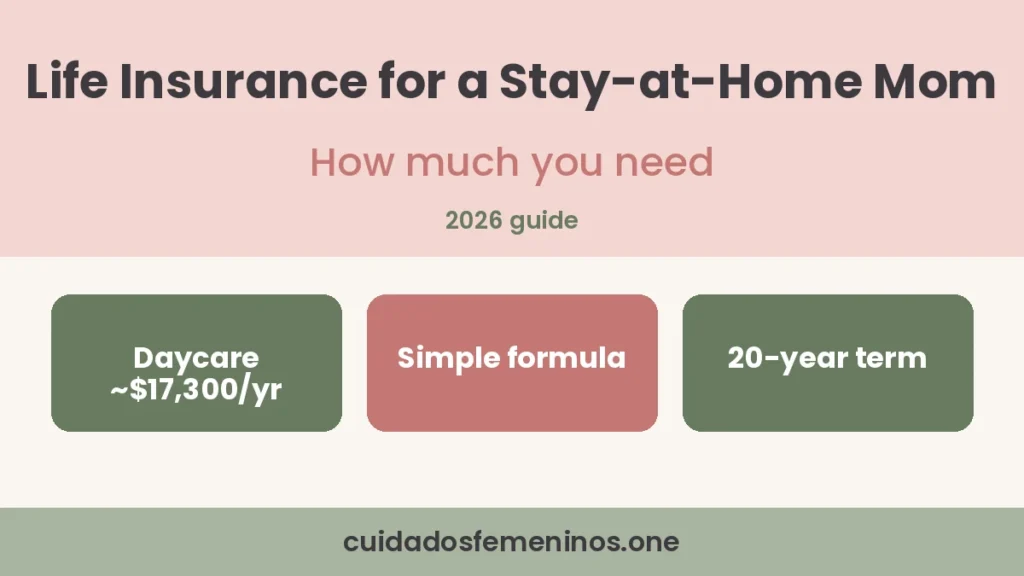
Wondering whether you need life insurance for stay at home mom years? Most families with kids should have it on the stay-at-home parent too. You don't earn a paycheck, but if you weren't there, your family would have to pay for childcare, housework and a lot of driving. Full-time infant daycare alone averages about $17,300 a year. A 20-year term policy is usually the simplest fit, and it often costs less than people think.
- What would it cost to replace what you do?
- How much coverage do you need? A simple formula
- Term vs. whole life for a stay-at-home mom
- What does it cost?
- Can you get life insurance while pregnant?
- Is life insurance through your partner's job enough?
- How to buy it: 6 steps
- Mistakes to avoid
- When to talk to a licensed agent or planner
- Frequently asked questions
- Does a stay-at-home mom really need life insurance?
- How much life insurance should a stay-at-home mom have?
- Can you get life insurance with no income?
- Can I get life insurance while pregnant?
- Is term or whole life better for a stay-at-home mom?
- Can my husband buy life insurance on me?
- What happens to my policy if I go back to work?
- Should I name my kids as beneficiaries?
- How much is a stay-at-home mom worth in salary?
- Sources
What would it cost to replace what you do?
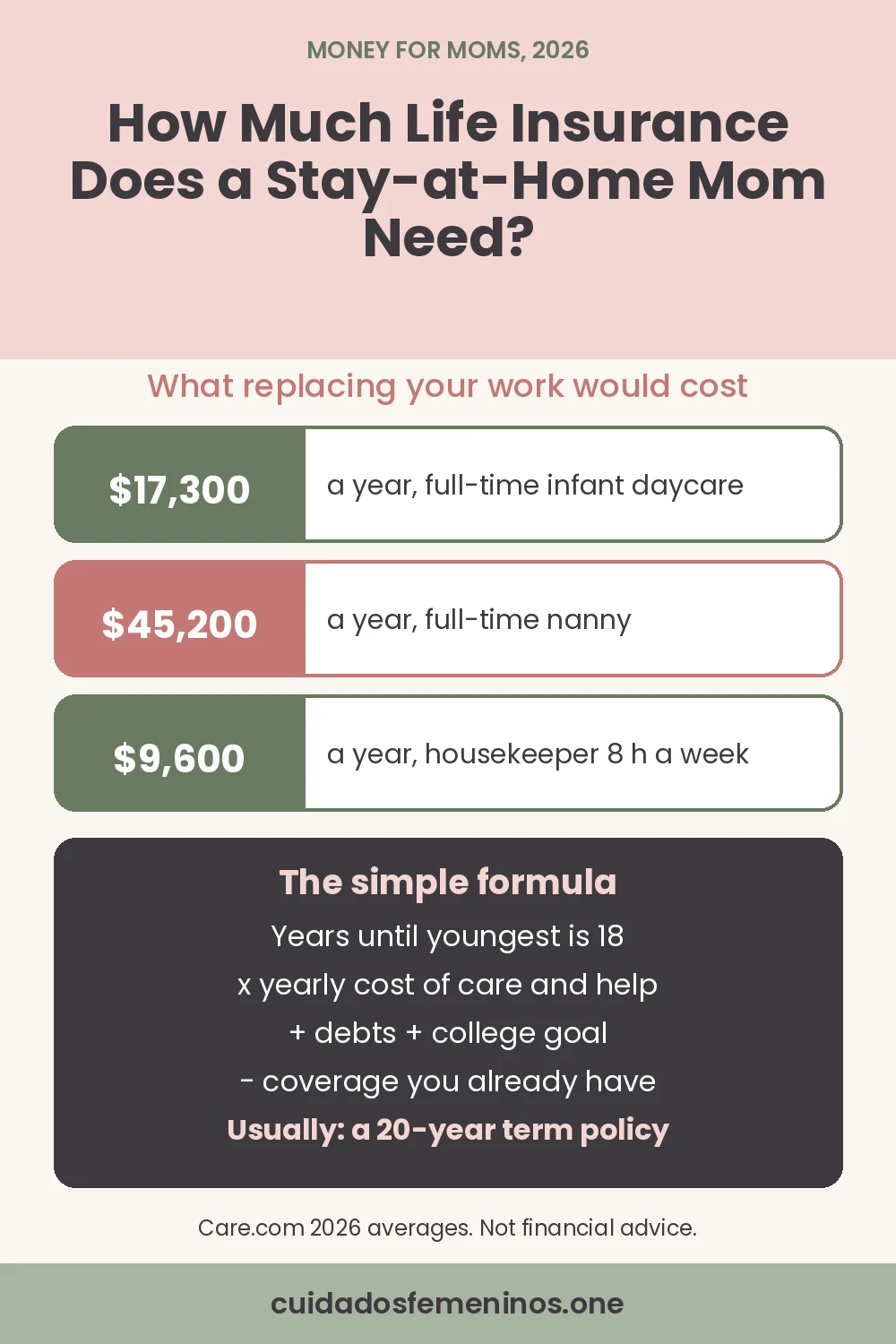
More than most of us would guess. Here's what the big pieces cost, using Care.com's 2026 Cost of Care Report (national averages, one child):
| What you'd need to pay for | Weekly average | About per year |
|---|---|---|
| Full-time infant daycare | $332 | $17,300 |
| Full-time nanny (40 hours a week) | $870 | $45,200 |
| Housekeeper (8 hours a week) | $184 | $9,600 |
| Meals, driving, errands, after-school care | Your own estimate | Add your local numbers |
Your area could be much cheaper or much pricier, so swap in local rates if you know them.
You've probably seen headlines putting a salary on moms. Insure.com's 2025 Mother's Day Index adds up 19 roles (cook, driver, tutor, nurse and so on) over about 183 hours a week and gets $145,235 a year. That isn't what your family would actually spend, but it shows how much ground you cover. For life insurance, the useful number is what your family would really pay for help, and that's what the formula below uses.
How much coverage do you need? A simple formula
Add up five numbers:
- Years of care: years until your youngest turns 18.
- Yearly replacement cost: childcare plus the household help your family would actually hire.
- Debts you'd want covered: your share of the mortgage, a car loan, anything else.
- College goal: optional, whatever starting amount feels right.
- Minus coverage you already have, like a work policy.
Coverage = (years × yearly cost) + debts + college − existing coverage
An example (round numbers, not a recommendation): your kids are 3 and 7, so the youngest has 15 years to 18. The first 5 years cost more because of daycare: 5 × $30,000 = $150,000. The next 10 are cheaper, mostly after-school care and help around the house: 10 × $15,000 = $150,000. Add $50,000 toward the mortgage and $40,000 for college. With no coverage today, that's $390,000, so this family might look at a $400,000 policy for 20 years.
Your number could be half that or double. That's fine. The point is to pick an amount you can explain.
Term vs. whole life for a stay-at-home mom
For most moms, term is enough. What you're covering is temporary: the years your kids need daily care. Term covers exactly that window and costs far less.
| Term life | Whole life | |
|---|---|---|
| How long it lasts | A set period (10, 20 or 30 years) | Your whole life, if you keep paying |
| Cost for the same payout | Much lower | Many times higher |
| Cash value | None | Builds slowly |
| Best for | Covering the child-raising years | Lifelong needs, like a child with a disability who'll always depend on you |
Whole life can make sense if someone will depend on you for life, or if you've already maxed out other savings and want what it offers. For replacing childcare, it's rarely needed.
What does it cost?
Probably less than you think. In LIMRA and Life Happens' 2025 Insurance Barometer Study, adults 30 and younger guessed that a $250,000, 20-year term policy cost 10 to 12 times what it really does.
For a real reference, Policygenius' price index (August 2024) put a $500,000, 20-year term policy for a healthy 35-year-old woman who doesn't smoke at about $26.59 a month. That's the healthiest rate class, so your price will be different.
What moves your premium:
- Age: every year you wait costs a bit more.
- Health: blood pressure, weight, conditions and medications.
- Nicotine: smokers often pay several times more.
- Term length and amount: longer and bigger cost more.
The only way to know your price is to compare quotes from several insurers.
Can you get life insurance while pregnant?
Yes. A healthy pregnancy alone doesn't usually rule you out. Complications are what change things. According to Policygenius, gestational diabetes or preeclampsia can delay approval or raise your rate, and some insurers postpone applications made in the third trimester until 4 to 8 weeks after you give birth.
So if you're planning a pregnancy, applying before is often easiest. If you're already pregnant, applying earlier beats applying later. Always disclose the pregnancy and any complications, because leaving something out can cause problems if your family ever files a claim. If you're pregnant and uninsured for health care, our guide for anyone pregnant with no health insurance covers Medicaid and Marketplace options.
Is life insurance through your partner's job enough?
Usually not. Spouse coverage through an employer is often $10,000 to $25,000, and many plans cap it at half of the employee's own coverage, according to a Brown & Brown group life guide. Compare that with the $17,300 a year that daycare costs.
It's also tied to the job. The NAIC's buyer's guide notes that work coverage is usually less than you need and may not go with you when the employee leaves. A policy you own stays in place as long as you pay. Many families keep the work benefit as a small extra on top.
How to buy it: 6 steps
- Pick the amount with the formula above.
- Pick the term. Long enough for your youngest to reach adulthood, often 20 years (30 if you have a baby or plan more kids).
- Compare quotes from several insurers, and read what each policy covers.
- Check financial strength. In AM Best's scale, A++ and A+ mean "superior" and A and A- mean "excellent."
- Set up beneficiaries carefully. Usually your partner first, then a trust or a custodian for the kids (see below).
- Review after big changes: a new baby, a move, going back to work or a new mortgage.
If you and your partner are sorting out money in general, our guide to a joint bank account for couples shows how to split shared costs, including premiums, by income.
Mistakes to avoid
- Naming your kids directly as beneficiaries. Insurers won't pay a minor, the NAIC says. Without a trust or custodian, a court may have to appoint someone to manage the money, which takes time and money, as Munich Re explains. Ask about naming a trust or a custodian under your state's transfers-to-minors law.
- Buying too little because "I don't earn anything." Run the numbers anyway.
- Relying only on work coverage. It's small and can end with the job.
- Letting it lapse. Turn on autopay so a missed bill doesn't cancel your coverage.
When to talk to a licensed agent or planner
A licensed independent agent or a fee-only financial planner is worth a call if you have a health condition that could affect your rate, a child with special needs, a blended family, or assets you want to leave in a trust. An estate attorney can set up the trust or name a guardian for your kids. You can also check an agent's license with your state insurance department.
Frequently asked questions
Does a stay-at-home mom really need life insurance?
If you have young kids, usually yes. Your partner would suddenly need to pay for childcare and household help on one income. Full-time infant daycare alone averages about $17,300 a year in Care.com's 2026 report, and a full-time nanny about $45,200, before cooking, driving or after-school care.
How much life insurance should a stay-at-home mom have?
Multiply the years until your youngest turns 18 by what care and help would cost each year. Add debts you'd want paid and any college goal, then subtract coverage you already have. There's no standard amount. It depends on your kids' ages, your local prices and what your family would actually hire.
Can you get life insurance with no income?
Yes. Insurers recognize that a stay-at-home parent has real economic value to the family. Some may ask about your partner's coverage or household income to keep the amounts in proportion, but having no paycheck of your own doesn't disqualify you from buying a policy in your own name.
Can I get life insurance while pregnant?
Yes. A healthy pregnancy usually isn't a problem. Complications like gestational diabetes or preeclampsia can delay a decision or raise your rate, and some insurers postpone third-trimester applications until a few weeks after birth. Always disclose the pregnancy, since leaving it out can cause trouble with a claim later.
Is term or whole life better for a stay-at-home mom?
For most moms, term. It covers the years your kids depend on you for daily care, and it costs far less for the same payout. Whole life fits narrower situations, like a child with a disability who'll need support for life, or families who have already maxed out other savings.
Can my husband buy life insurance on me?
Yes. A spouse has what insurers call an insurable interest in you, so your husband can own a policy on your life. You'll still need to agree, sign the application and answer the health questions yourself. Many couples simply each own a policy and name the other as beneficiary.
What happens to my policy if I go back to work?
Nothing changes. A policy you own keeps going as long as you pay the premiums, whatever your job situation. Going back to work is a good moment to check whether you need more coverage, since your paycheck now matters to the family budget too, alongside the care you still provide.
Should I name my kids as beneficiaries?
Usually not directly. Insurers won't pay a minor, so a court may have to appoint someone to manage the money, which takes time and costs money. Naming a trust, or a custodian under your state's transfers-to-minors law, is the cleaner way to leave money to your children.
How much is a stay-at-home mom worth in salary?
It depends on who's counting. Insure.com's 2025 Mother's Day Index adds up 19 roles over about 183 hours a week and lands on $145,235 a year. For life insurance, though, use what your family would actually pay for childcare and help, which is usually far less than that headline number.
This article is general information, was last updated on October 30, 2026, and isn't financial, insurance or legal advice. Prices and underwriting rules vary by insurer, state and your health. Talk with a licensed insurance professional about your situation.
Sources
- Care.com: 2026 Cost of Care Report (national weekly averages for daycare, nannies and housekeepers)
- Insure.com: 2025 Mother's Day Index ($145,235 for 19 roles)
- LIMRA and Life Happens: 2025 Insurance Barometer Study, adults 30 and younger overestimate life insurance cost by 10 to 12 times
- Policygenius: Life Insurance Price Index, August 2024
- Policygenius: Life insurance while pregnant
- Brown & Brown: Group term life insurance guide (spouse coverage limits)
- AM Best: Guide to Best's Financial Strength Ratings
- Munich Re: The challenge of minor beneficiaries
- NAIC: Life Insurance Buyer's Guide (2026)
Keep reading
- Joint bank account for couples · Yours, mine and ours, and a fair split by income.
- Pregnant with no health insurance? · Medicaid, CHIP and open enrollment.
- Does insurance cover IVF? · What to check before open enrollment.
- Cord blood banking costs · The real price over 20 years.
- More rights and money guides
If you want to read more articles like Life Insurance for Stay at Home Mom: How Much You Need (2026), check out the Rights & Money category.