Does Your Prenatal Have Iodine? The 150 mcg Rule (2026)
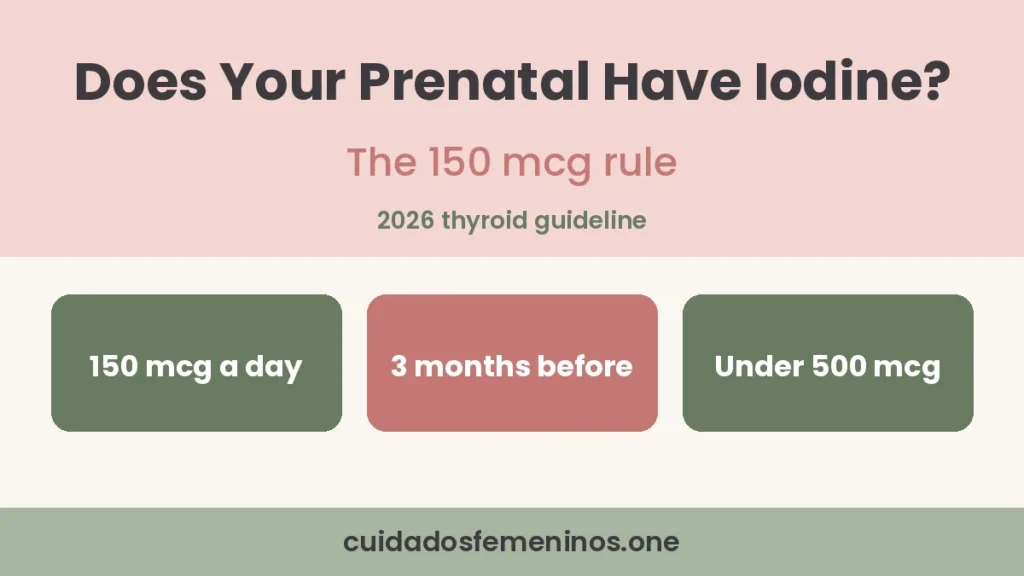
Does your prenatal have iodine? Flip the bottle over and look for an iodine line on the Supplement Facts panel. You want about 150 mcg, ideally as potassium iodide. That's what the American Thyroid Association's 2026 guideline recommends every day from at least 3 months before conception through pregnancy and breastfeeding. Plenty of prenatals still skip it.
Below: what the new guideline says, how to read the label in 30 seconds, which popular prenatals have iodine (we checked the labels), how much you get from food, and how much is too much. Everything was checked against the guideline and the NIH on October 30, 2026.
- Quick answer
- What the 2026 thyroid guideline says about iodine
- Why iodine matters in pregnancy
- How to check your prenatal for iodine in 30 seconds
- Do pregnancy multivitamins have iodine?
- Iodine in food: how much you get
- How much iodine is too much in pregnancy?
- Iodine with hypothyroidism, Hashimoto's or Graves' disease
- When to talk to your doctor or midwife
- Frequently asked questions
- Is iodine necessary in prenatal vitamins?
- Do pregnancy multivitamins have iodine?
- Are iodine supplements safe during pregnancy?
- What happens if you don't take iodine during pregnancy?
- How long do you take iodine for during pregnancy?
- Can I take folic acid and iodine together?
- Is there a connection between autism and iodine deficiency?
- What is the best prenatal supplement for hypothyroidism?
- I forgot to take iodine for weeks, is my baby OK?
- Sources
Quick answer
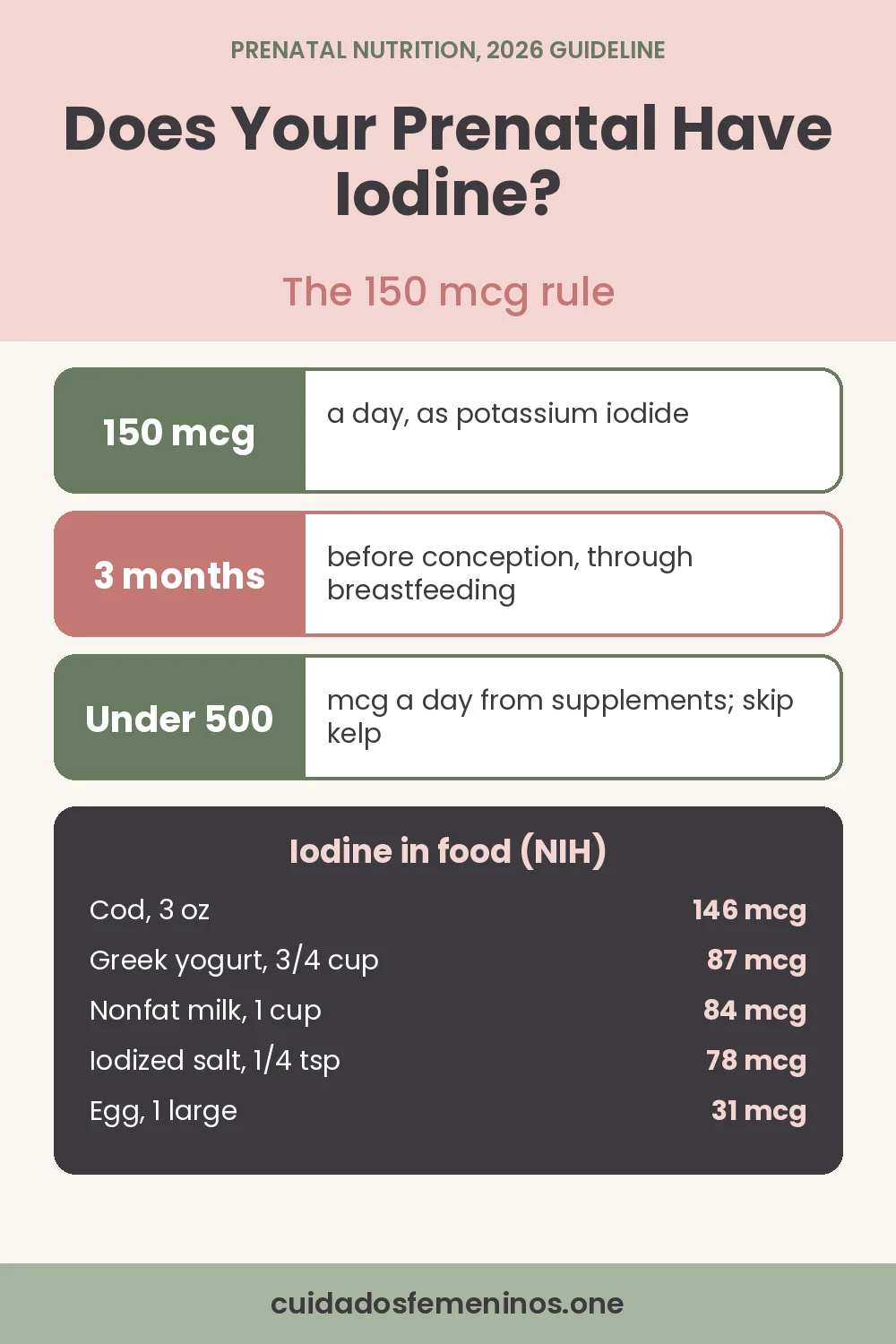
- How much: a 150 mcg iodine supplement a day, so that diet plus supplement reaches about 250 mcg, per the 2026 ATA guideline. The US RDA is 220 mcg in pregnancy and 290 mcg while breastfeeding, per the NIH.
- When: ideally starting at least 3 months before you try to conceive, and continuing until you finish breastfeeding.
- Which form: potassium iodide. Kelp and seaweed vary too much from batch to batch.
- How much is too much: avoid more than 500 mcg a day over time from supplements and high-iodine foods. The adult upper limit from all sources is 1,100 mcg a day.
- Thyroid condition? Ask your endocrinologist before you add iodine, and never change your levothyroxine dose on your own.
What the 2026 thyroid guideline says about iodine
The American Thyroid Association published its first full update on thyroid disease in pregnancy since 2017 in Thyroid in May 2026, and ACOG endorsed it. On iodine, it says pregnant and breastfeeding women should get about 250 mcg a day from food plus supplements, and that a 150 mcg supplement should be advised for all women before conception, in pregnancy and during lactation, unless their usual diet is already very high in iodine.
It also says some women may need more, for example if you don't use iodized salt, don't eat dairy or follow a vegan diet. And it warns against sustained intake above 500 mcg a day because too much can upset thyroid function in both you and your baby.
One open question, as co-author Angela Leung told Healio: researchers know a lot about severe iodine deficiency but much less about how much risk mild or moderate shortfalls carry. Those are the ones that affect far more women.
Why iodine matters in pregnancy
Your thyroid uses iodine to make thyroid hormone, and your baby depends on your thyroid hormone for brain development, especially early in pregnancy before their own thyroid is working. Pregnancy also raises your iodine needs, because you make more thyroid hormone and pass some iodine to the baby.
Severe deficiency is rare in the US, but intake is uneven. The NIH notes that from 2011 to 2014, 72% of pregnant women took a supplement, yet only about 18% of them took one with iodine.
How to check your prenatal for iodine in 30 seconds
- Find the Supplement Facts panel on the back of the bottle.
- Look for a line that says Iodine. No line means no iodine.
- Check the amount. 150 mcg is the usual dose. Check the serving size too: some prenatals need 2 or 3 pills to reach it.
- Check the form. "As potassium iodide" is what you want. If it says kelp, seaweed or a "food blend," the actual amount is less predictable.
- Add up anything else you take, like a separate iodine pill or a multivitamin, so you stay well under 500 mcg a day.
If your prenatal has none, you don't necessarily need a new one. A separate 150 mcg potassium iodide tablet does the same job. Ask your provider which is easier for you.
Do pregnancy multivitamins have iodine?
Many do, but not all. Researchers at Boston University looked at the 59 best-selling US prenatal vitamins from July 2016 to July 2017 and found that only 34 (57.6%) contained iodine, according to the 2019 study in Thyroid. About 24% of all prenatal doses sold had no iodine at all. Among those with iodine, most had 150 mcg, but the range was 25 to 290 mcg, and almost a quarter used kelp as the source.
Affiliate disclosure: As an Amazon Associate, I earn from qualifying purchases. I may also earn from some brand partner links. If you buy through a product link on this page, the price is the same for you. Read the full disclosure.
Here's what current labels show for several popular prenatals. Formulas change, so check the bottle you buy.
| Prenatal | Iodine per daily serving | Form | Where to buy |
|---|---|---|---|
| Thorne Basic Prenatal | 150 mcg (3 capsules) | Potassium iodide (brand label) | Check price on Amazon |
| Nature Made Prenatal Multi + DHA | 150 mcg (1 softgel) | Potassium iodide (brand label, DSLD) | Check price on Amazon |
| Ritual Essential Prenatal | 150 mcg (2 capsules) | Potassium iodide (brand label) | Check price on Amazon |
| MegaFood Baby & Me 2 | 150 mcg (2 tablets) | DSLD label; check the bottle for the form | See it on iHerb |
| Garden of Life mykind Organics Prenatal Once Daily | 145 mcg (1 tablet) | From an organic food blend, not potassium iodide (DSLD) | See it on iHerb |
| SmartyPants Prenatal Formula | 290 mcg (4 gummies) | Potassium iodide (DSLD) | See it on iHerb |
| Nordic Naturals Prenatal DHA | None | DHA softgel, not a multivitamin (DSLD) | Check price on Amazon |
Two notes. SmartyPants is above 150 mcg but still well under the 500 mcg caution line. And if you take a DHA-only "prenatal" like Nordic Naturals on its own, you aren't getting iodine, folic acid or iron from it.
Iodine-only option
If you like your current prenatal and it has no iodine, a plain potassium iodide tablet fills the gap. NaturesPlus Potassium Iodide 150 mcg lists 150 mcg as potassium iodide per tablet in the NIH label database (also on iHerb). Skip iodine-only products with much higher doses: the NIH warns that many exceed the upper limit.
Iodine in food: how much you get
Food matters too, especially dairy, seafood, eggs and iodized salt. Amounts below are from the NIH Office of Dietary Supplements.
| Food | Serving | Iodine (mcg) |
|---|---|---|
| Cod, baked | 3 ounces | 146 |
| Greek yogurt, plain, nonfat | 3/4 cup | 87 |
| Milk, nonfat | 1 cup | 84 |
| Iodized table salt | 1/4 teaspoon | 78 |
| Egg, hard boiled | 1 large | 31 |
| Cheddar cheese | 1 ounce | 14 |
| Tuna, canned in water, drained | 3 ounces | 7 |
Sea salt, kosher salt and the salt in most processed foods usually aren't iodized, so restaurant and packaged food won't do much for you. Seaweed can contain a lot of iodine, and kelp supplements vary widely, which is why both the NIH and the 2026 guideline steer you toward measured doses instead.
How much iodine is too much in pregnancy?
The 2026 guideline says to avoid sustained intake above 500 mcg a day from supplements and high-iodine foods during pregnancy. The NIH sets the adult upper limit at 1,100 mcg a day from all sources. A 150 mcg prenatal plus a normal diet with dairy, eggs and some iodized salt stays well under both.
The usual ways women go over are kelp or seaweed supplements, stacking a prenatal with a separate iodine pill and a multivitamin, or large amounts of seaweed snacks every day. Iodine-containing medicines like amiodarone and iodine contrast for scans are a separate issue your doctor will weigh.
Iodine with hypothyroidism, Hashimoto's or Graves' disease
If you take levothyroxine, a standard prenatal with 150 mcg of iodine is usually fine, but tell your endocrinologist what you take. Take your thyroid pill on an empty stomach and keep it at least 4 hours away from your prenatal, because iron and calcium can block absorption. Most women on levothyroxine need a higher dose in pregnancy, and your doctor will adjust it, so never change it yourself.
If you have Graves' disease or take antithyroid medicine, ask before adding any iodine supplement. The guideline has separate advice for you.
The guideline also clarifies TSH in pregnancy. It prefers your lab's pregnancy-specific reference range. When a lab doesn't have one, it says a first-trimester range of about 0.1 to 4.0 mU/L is acceptable, rather than the old 2.5 cutoff many women heard about. Your provider will read your TSH alongside free T4, your symptoms and your history.
When to talk to your doctor or midwife
- Your prenatal has no iodine, or lists kelp or seaweed as the source.
- You have hypothyroidism, Hashimoto's, Graves' disease or any thyroid history.
- You don't use iodized salt, avoid dairy or eggs, or eat vegan.
- You take kelp supplements or eat a lot of seaweed.
- You take more than one product with iodine.
- Your TSH has been outside the range your lab uses for pregnancy.
Iodine isn't the only gap in many prenatals. Choline and DHA are often low too: see our guides to choline in pregnancy and how much DHA during pregnancy. If you're tired all the time, ask about iron, since low ferritin with normal hemoglobin is common. And if cost is a worry, our guide for anyone pregnant with no health insurance explains how Medicaid and WIC can help with prenatal care and vitamins.
Frequently asked questions
Is iodine necessary in prenatal vitamins?
For most women in the US, yes. The American Thyroid Association's 2026 guideline advises 150 mcg of iodine a day before conception, during pregnancy and while breastfeeding, unless your usual diet is already very high in iodine. If your prenatal has none, ask your provider about switching or adding a separate iodine supplement.
Do pregnancy multivitamins have iodine?
Not all of them. In a study of 59 best-selling US prenatal vitamins sold in 2016 and 2017, only 34 contained iodine, and about a quarter of the doses sold had none. Most that did used 150 mcg. Check the Supplement Facts panel for an iodine line and the amount in mcg.
Are iodine supplements safe during pregnancy?
At the usual 150 mcg a day, yes, for most women. The 2026 guideline warns against sustained intake above 500 mcg a day from supplements and high-iodine foods, and the adult upper limit from all sources is 1,100 mcg. If you have Graves' disease or Hashimoto's, ask your doctor first.
What happens if you don't take iodine during pregnancy?
Many women get enough from iodized salt, dairy and eggs, and nothing happens. Others fall short. Severe deficiency can harm a baby's thyroid, growth and brain development. Mild shortfalls are less clear, which the guideline authors call a key research gap, so a 150 mcg supplement is the simple way to cover it.
How long do you take iodine for during pregnancy?
Ideally from at least 3 months before you try to conceive, every day through pregnancy, and for as long as you breastfeed, according to the 2026 ATA guideline. If you're already pregnant and haven't started, start now. There's no need to wait for your next appointment to begin a standard prenatal.
Can I take folic acid and iodine together?
Yes. Most prenatal vitamins already combine folic acid or folate with iodine, and the two don't interfere with each other. If you take a separate folic acid tablet plus a prenatal, add up the totals on both labels so you don't double up on iodine or go well past the folic acid your provider suggested.
Is there a connection between autism and iodine deficiency?
Severe iodine deficiency can affect a baby's brain development, but there's no good evidence that mild shortfalls cause autism or that a 150 mcg supplement prevents it. Research on milder deficiency is still limited. The practical takeaway is the same: take a prenatal with 150 mcg of iodine and skip high-dose kelp.
What is the best prenatal supplement for hypothyroidism?
There isn't one best brand. A prenatal with 150 mcg of iodine as potassium iodide fits most women on levothyroxine. Take it at least 4 hours apart from your thyroid pill, since iron and calcium can block absorption. Your endocrinologist will adjust your dose and track your TSH during pregnancy.
I forgot to take iodine for weeks, is my baby OK?
Most likely, yes. Many women get a fair amount of iodine from food, and a few missed weeks rarely cause problems on their own. Restart your prenatal today, don't double up to catch up, and mention it at your next visit so your provider can decide whether any testing makes sense.
This article is general information, was last updated on October 30, 2026, and isn't medical advice. Talk with your OB, midwife or endocrinologist before you start, stop or change an iodine supplement, especially if you have a thyroid condition or take levothyroxine.
Sources
- Korevaar TIM, Leung AM, Alexander EK, et al. American Thyroid Association 2026 guidelines for thyroid disease in preconception, pregnancy, and postpartum. Thyroid. 2026;36(5):481-544
- Healio | Endocrine Today: New thyroid disease in pregnancy guideline addresses drug regimens, screening for dysfunction (October 2026)
- NIH Office of Dietary Supplements: Iodine, fact sheet for health professionals (RDA, UL, food values, supplements)
- Patel A, Lee SY, Stagnaro-Green A, et al. Iodine content of the best-selling United States adult and prenatal multivitamin preparations. Thyroid. 2019;29(1):124-127
- Lee SY, Stagnaro-Green A, MacKay D, et al. Iodine contents in prenatal vitamins in the United States. Thyroid. 2017;27(8):1101-1102
- Thorne: Basic Prenatal, Supplement Facts (iodine as potassium iodide 150 mcg)
- Nature Made: Prenatal Multi + DHA, Supplement Facts (150 mcg iodine)
- Ritual: Essential Prenatal Multivitamin, Supplement Facts (iodine as potassium iodide 150 mcg)
- NIH Dietary Supplement Label Database: MegaFood Baby & Me 2 label
- NIH Dietary Supplement Label Database: Garden of Life mykind Organics Prenatal Once Daily label
- NIH Dietary Supplement Label Database: SmartyPants Prenatal Formula label
- NIH Dietary Supplement Label Database: Nordic Naturals Prenatal DHA label
- NIH Dietary Supplement Label Database: NaturesPlus Potassium Iodide 150 mcg label
Keep reading
- Choline in pregnancy · 450 vs 900 mg and the new IQ study.
- How much DHA during pregnancy · 200 mg vs 1,000 mg, and who needs more.
- Low ferritin with normal hemoglobin · Why iron needs jump in pregnancy.
- Pregnant with no health insurance? · Medicaid, CHIP and open enrollment.
- More fertility, pregnancy and baby guides
- Iron infusion in pregnancy: when you need it
If you want to read more articles like Does Your Prenatal Have Iodine? The 150 mcg Rule (2026), check out the Fertility, Pregnancy & Baby category.