
Iron Infusion in Pregnancy: When You Need It (2026)
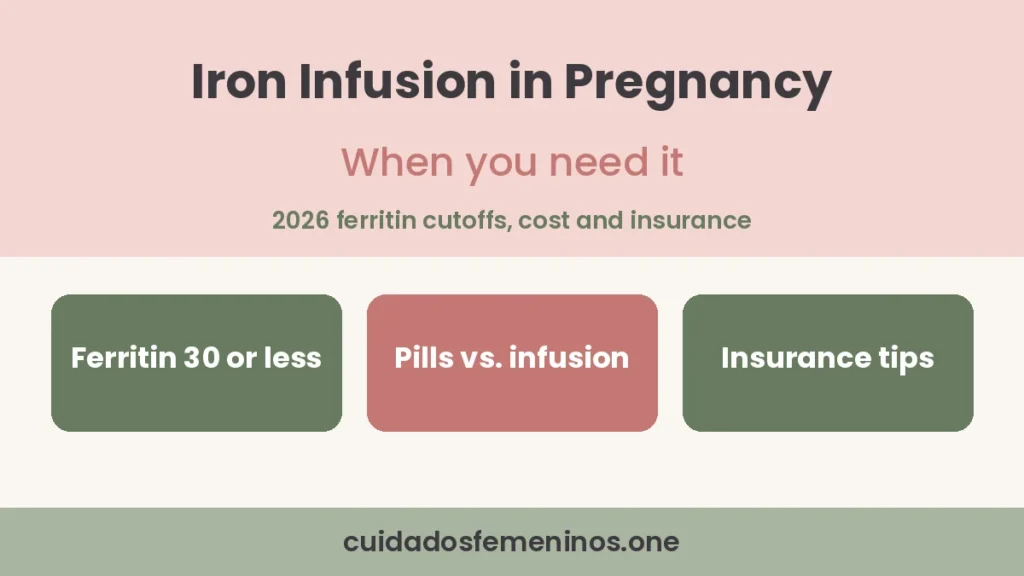
An iron infusion in pregnancy is usually considered when iron pills aren't working, when you can't keep them down, when your anemia is severe, or when you're far enough along that pills won't catch up in time. It's given after the first trimester. And under the 2026 American Society of Hematology (ASH) guideline, "low" starts sooner than many labs say: a ferritin of 30 ng/mL or less.
Affiliate disclosure: As an Amazon Associate, I earn from qualifying purchases. I may also earn from some brand partner links. If you buy through a product link on this page, the price is the same for you. Read the full disclosure.
If your ferritin came back low and you're wiped out, this guide walks you through the numbers, the guidelines, what an infusion is actually like, and how to deal with insurance. If your hemoglobin is normal but your ferritin is low, start with our guide to low ferritin with normal hemoglobin.
- Ferritin cutoffs in pregnancy: old vs. 2026
- When an infusion is considered
- Iron pills vs. an iron infusion
- Daily or every other day?
- What an infusion feels like and how long it takes
- Questions to ask your OB
- Cost and insurance in the US
- What to do if insurance denies it
- When to call your doctor or go to the ER
- Other nutrients that matter now
- Frequently asked questions
- How long does an iron infusion take to work in pregnancy?
- What does an iron infusion feel like?
- How low does ferritin have to be for an infusion in pregnancy?
- Is an iron infusion safe during pregnancy?
- Can an iron infusion trigger labor?
- Can low iron in pregnancy harm the baby?
- How much does an iron infusion cost in the US?
- Is it worth getting an infusion in the third trimester?
- Should I take iron every day or every other day?
- Why didn't my doctor check my ferritin?
- Sources
Ferritin cutoffs in pregnancy: old vs. 2026
Ferritin shows how much iron you have stored. The cutoff for "too low" has been moving up.
| Source | Ferritin cutoff for iron deficiency in pregnancy | What it means |
|---|---|---|
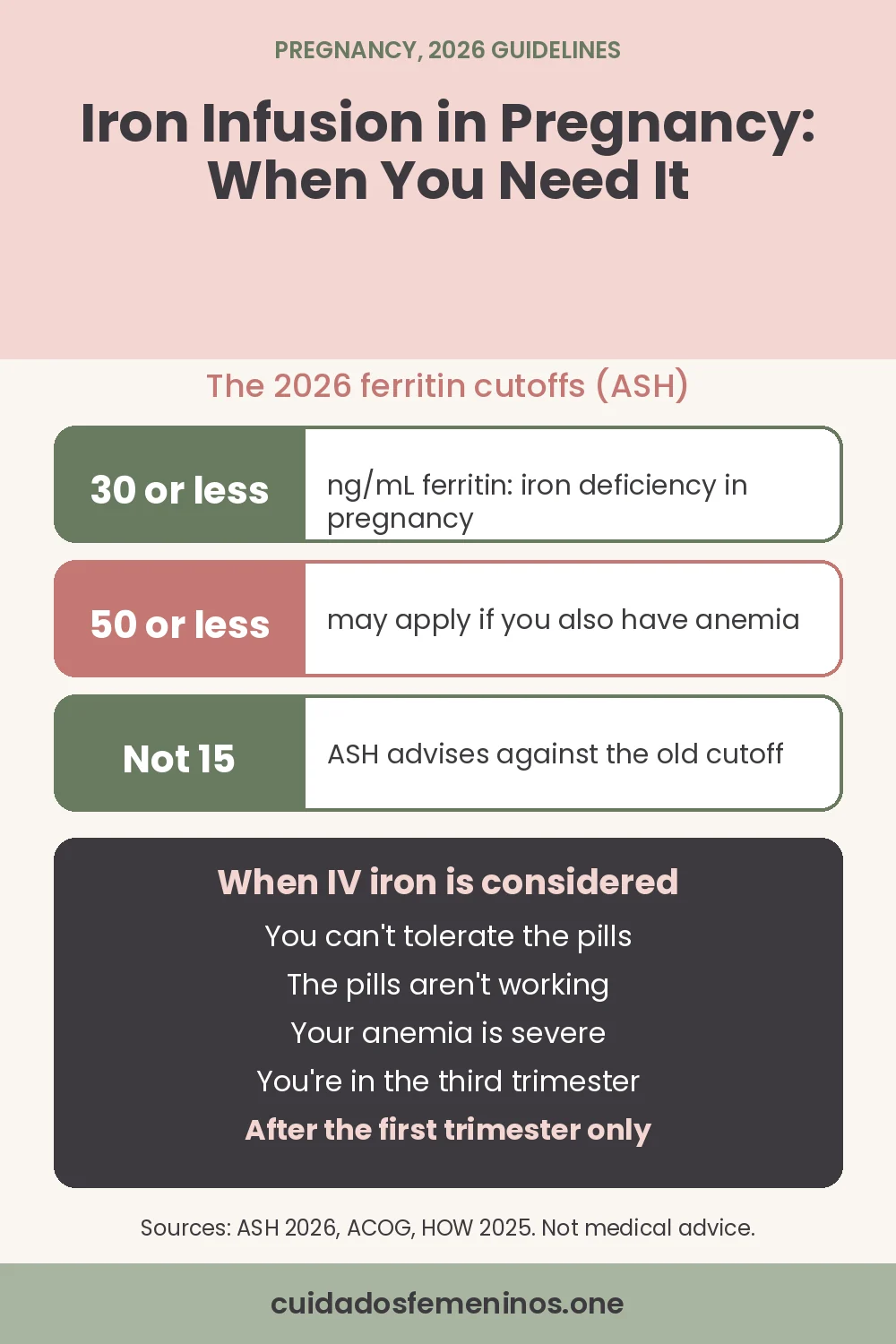
| ASH 2026 guideline | 30 ng/mL or lower; 50 ng/mL or lower may be appropriate if you also have anemia | Recommends against using 15 ng/mL in pregnancy |
| Older WHO cutoff | Below 15 µg/L | Still printed on many lab reports |
| NHANES study of US pregnant women | Below 25.8 (1st trimester), 18.3 (2nd), 19.0 (3rd) µg/L | Where red blood cell production starts to suffer from lack of iron |
(1 ng/mL equals 1 µg/L, so the numbers compare directly.)
On 15, ASH's wording is unusually firm. The panel "recommends against" it for diagnosing iron deficiency in pregnancy, and calls that a strong recommendation even though the evidence behind it is low certainty. The 30 cutoff is a softer "suggestion." The panel also admits nobody has tied a specific ferritin number to outcomes for you or your baby. Still, the takeaway is practical: a ferritin of 22 isn't "fine" just because it clears 15.
Ferritin also tends to fall as pregnancy goes on. The Australian and New Zealand HOW consensus (2025) recommends checking it at your first prenatal visit and again at 24 to 28 weeks.
On the other side, the US Preventive Services Task Force (2024) says there isn't enough evidence to know whether routine screening or routine iron for pregnant women without symptoms improves outcomes. That's not a "no." It means the decision falls to you and your OB.
When an infusion is considered
Pills come first. ACOG's Practice Bulletin 233 says IV iron "may be considered for those who cannot tolerate or do not respond to oral iron or for those with severe iron deficiency later in pregnancy," and places it after the first trimester. The HOW 2025 consensus goes a bit further: IV iron should be offered if you can't tolerate oral iron, it isn't working, or you're already in the third trimester.
So the usual triggers are:
- You can't take the pills. Nausea, vomiting or constipation won't let up.
- The pills aren't working. Your numbers barely move after a fair trial.
- Your anemia is severe.
- Time is short. You're in the third trimester and want good iron stores before delivery and the blood loss that comes with it.
What the big 2025 trial actually showed
You may see headlines about a "large study" presented at the Society for Maternal-Fetal Medicine's 2025 meeting. Here's what it was. The trial ran in India with 4,368 women who had moderate anemia and iron deficiency before 17 weeks. They got either daily iron pills or a single early IV dose (ferric carboxymaltose or ferric derisomaltose).
By delivery, about the same share of women in each group were no longer anemic. The IV groups less often needed extra IV iron or a blood transfusion before birth. Babies were less often low birth weight only in the ferric carboxymaltose group. It was a conference abstract from a country with high anemia rates. It's promising, but it isn't a US guideline and doesn't mean everyone should skip pills.
Iron pills vs. an iron infusion
| Iron pills | Iron infusion | |
|---|---|---|
| Speed | Slow; stores take weeks to months to fill | Stores fill fast; hemoglobin climbs over the following weeks |
| Visits | None, you take them at home | One visit or several, depending on the product |
| Common side effects | Constipation, nausea, stomach upset | Mild infusion reactions; serious reactions are rare |
| Cost | Low | Much higher |
| Insurance | Usually simple | Usually needs prior authorization with labs and a failed pill trial |
Daily or every other day?
If you're still on pills, timing matters. The PANDA trial (Blood Advances, 2026) gave non-anemic pregnant women 200 mg of ferrous sulfate daily, every other day, or three times a week. Daily dosing kept up with pregnancy's demand better. Even so, 69% to 72% of women still had ferritin under 30 at 26 to 30 weeks, whatever the schedule.
It was a small trial that tracked blood markers, not birth outcomes. But it explains why so many women end up talking about infusions in the third trimester: pills alone often can't keep up. HOW does say every-other-day dosing is a reasonable option if daily pills upset your stomach.
Getting more out of your pills
- Extra vitamin C isn't required: a 2020 randomized trial found iron alone worked as well (see our ferritin guide). Some people still take iron with orange juice or food, which is fine.
- Keep it at least two hours away from calcium, dairy, coffee, tea and your prenatal.
- Ask your OB which form and dose to use.
Common options, if your OB is fine with them:
- Gentle iron bisglycinate: Check price on Amazon · See it on iHerb
- Ferrous sulfate 325 mg: Check price on Amazon · See it on iHerb
Don't start, stop or double up on iron without checking with your provider. Too much iron has its own risks.
What an infusion feels like and how long it takes
How long you're in the chair depends on the product:
- Ferric carboxymaltose (Injectafer): the label allows a single infusion over at least 15 minutes, and a full course is usually one or two doses.
- Iron sucrose (Venofer): smaller doses, often 200 mg at a time, so you usually come back several times.
Either way, you'll be watched for at least 30 minutes afterward.
Most people feel little. A small number, around 1 in 100 in older data, get what's called a Fishbane reaction: sudden flushing, aches in the chest or back, or joint pain. It isn't a true allergy, and there's no drop in blood pressure or trouble breathing. The nurse pauses the drip, it usually fades within minutes, and it doesn't usually come back once they restart at a slower rate. Serious allergic reactions are rare.
Iron stores fill quickly, but hemoglobin rises over a few weeks while your body makes new red blood cells. How soon you feel better depends on how low you started. Your OB will usually recheck your labs a few weeks later, or sooner if delivery is close.
Questions to ask your OB
- What's my ferritin, and is my hemoglobin low too?
- Am I getting enough from pills? When will we recheck?
- Would daily, or every-other-day, dosing work better for me?
- If I need IV iron, which product, how many visits and where?
- Can it be done at your office or an infusion center rather than a hospital outpatient department? (Hospital outpatient departments are often pricier.)
- Will your office handle prior authorization?
- What's the plan if I'm still low closer to delivery?
Cost and insurance in the US
Prices vary a lot by product and setting. In 2017, according to Health Care Cost Institute data, private plans paid an average of $412 per visit for Ferrlecit, $825 for Venofer, $1,502 for INFeD, $3,087 for Feraheme and $4,316 for Injectafer. Your share depends on your deductible, coinsurance and whether the place is in network.
Most insurers want proof first. Aetna's policy (CPB 0575) is a typical example. For people without kidney disease, it defines iron deficiency anemia as "serum ferritin less than 30 ng/mL or a transferrin saturation (TSAT) less than 20 percent." It also requires an "unsatisfactory response, intolerance or contraindication to oral iron." Your own plan's policy is what counts, so ask your insurer for it.
If you don't have insurance, see our guide to being pregnant with no health insurance.
What to do if insurance denies it
- Get the denial in writing and find the exact reason (missing labs, no pill trial, wrong site of care).
- Ask your OB's office to file a peer-to-peer review. Your doctor talks directly with the insurer's reviewer. This often fixes things quickly.
- Send a letter of medical necessity with your ferritin, hemoglobin and TSAT, what pills you took, for how long and why you stopped, your symptoms and how far along you are.
- Quote the guidelines: ACOG PB 233, HOW 2025 for the third trimester, ASH 2026 for the ferritin cutoff.
- Ask whether an infusion center or office would be approved if a hospital outpatient department was the problem.
- File an internal appeal before the deadline in your letter. Mark it urgent if your due date is close.
- Request an external review if the internal appeal fails.
- Get a written cost estimate before you book.
When to call your doctor or go to the ER
Call your doctor promptly if you have worsening shortness of breath, a racing or irregular heartbeat, or feel faint. Go to the ER for chest pain, fainting or sudden severe symptoms. In pregnancy, these can have causes besides anemia, so don't wait.
Other nutrients that matter now
Iron isn't the only gap. See how much DHA you need in pregnancy, why choline in pregnancy matters, and how to check whether your prenatal has iodine.
Frequently asked questions
How long does an iron infusion take to work in pregnancy?
Iron stores fill quickly, but hemoglobin rises gradually over a few weeks as your body makes new red blood cells. How fast you feel better depends on how low you started. Your OB will usually recheck your labs a few weeks later, or sooner if you're close to delivery.
What does an iron infusion feel like?
Most people feel very little beyond the needle. A small number get a brief Fishbane reaction, with flushing or aches in the chest, back or joints. The nurse pauses the drip and it usually fades within minutes. You'll be watched for at least 30 minutes after the dose.
How low does ferritin have to be for an infusion in pregnancy?
There isn't one magic number. ASH 2026 calls a ferritin of 30 ng/mL or less iron deficiency, and up to 50 may apply if you're anemic. Insurers like Aetna look for ferritin under 30 or TSAT under 20%, plus pills that didn't work or that you couldn't tolerate.
Is an iron infusion safe during pregnancy?
ACOG and the HOW 2025 consensus support IV iron after the first trimester when pills aren't enough or can't be tolerated. Serious reactions are rare with current products, and you're monitored during and after the dose. It's generally avoided in the first trimester because data there are limited.
Can an iron infusion trigger labor?
The guidelines we reviewed don't list starting labor as a known effect of IV iron. Infusions are given with monitoring in the second and third trimesters. If you're close to your due date or have a history of preterm labor, ask your OB about timing before you book.
Can low iron in pregnancy harm the baby?
Iron deficiency anemia has been linked to preterm birth and bleeding problems, and very severe anemia can affect a baby's oxygen supply. Treating it protects you and helps build your baby's iron stores. Your OB will look at your actual numbers and history, not just one lab value.
How much does an iron infusion cost in the US?
It depends on the product and setting. In 2017, private plans paid an average of about $400 to over $4,000 per visit depending on the drug. Your share depends on your deductible, coinsurance and network. Always get a written estimate and confirm prior authorization first.
Is it worth getting an infusion in the third trimester?
Often, yes, if pills aren't working or you can't take them. HOW 2025 specifically says IV iron should be offered in the third trimester. Better stores going into delivery can help you handle blood loss at birth and recover afterward. Ask how many weeks you have left for it to work.
Should I take iron every day or every other day?
In the PANDA trial (2026), daily dosing kept up with pregnancy's needs better than less frequent schedules. Every other day may be gentler on your stomach. Either way, many women still ended up low by 26 to 30 weeks. Ask your OB which schedule fits you.
Why didn't my doctor check my ferritin?
Many practices still screen only hemoglobin. The USPSTF says evidence is insufficient to recommend routine screening for women without symptoms. HOW 2025 recommends checking ferritin at the first visit and at 24 to 28 weeks. If you're tired or at higher risk, it's reasonable to ask for the test.
This article is general information, was last updated on October 31, 2026, and isn't medical advice. Decisions about testing, iron pills or an infusion belong with the clinician who knows your labs, history and pregnancy. Talk with your OB or midwife before starting or changing any treatment.
Sources
- American Society of Hematology 2026 guidelines for diagnosis of iron deficiency (Blood Advances)
- Li N et al. Comparison of oral iron supplement with and without vitamin C for iron deficiency anemia. JAMA Network Open, 2020
- PANDA trial, oral iron dosing regimens in pregnancy (Blood Advances, 2026)
- ACOG Practice Bulletin 233, Anemia in Pregnancy (2021)
- HOW Collaborative consensus, Iron optimisation in pregnancy (Intern Med J, 2025)
- USPSTF 2024, Iron deficiency in pregnancy: screening and supplementation
- Trimester-specific ferritin thresholds in US pregnant women (NHANES)
- SMFM 2025 news release on early IV iron trial in India
- Injectafer prescribing information (FDA, 2025)
- Venofer prescribing information
- Hypersensitivity reactions to intravenous iron (Haematologica, 2014)
- Aetna Clinical Policy Bulletin 0575, Intravenous Iron Therapy
- Advisory Board summary of HCCI 2017 IV iron prices
Keep reading
- Low ferritin with normal hemoglobin · The 2026 cutoffs and what to ask for.
- Pregnant with no health insurance? · Medicaid, CHIP and open enrollment.
- How much DHA in pregnancy · And how to read your label.
- Does your prenatal have iodine? · The 150 mcg rule.
- More pregnancy guides
If you want to read more articles like Iron Infusion in Pregnancy: When You Need It (2026), check out the Fertility, Pregnancy & Baby category.