
Sucrosomial Iron vs Ferrous Sulfate (and Bisglycinate): What Low-Ferritin Women Need to Know
You know your ferritin is low. Maybe your hemoglobin is normal, maybe it isn’t. Ferrous sulfate made you queasy or badly constipated, so you quit, and now a pricier sucrosomial bottle keeps showing up in your feed. This sucrosomial iron vs ferrous sulfate comparison is something you can bring to your clinician. It is not a treatment plan, and it won’t tell you which product to start or how much to take.
This article is for information only and does not replace advice from your doctor. Too much iron is dangerous. Have your ferritin, hemoglobin and iron studies interpreted by a clinician before you change anything.
- Quick answer
- What sucrosomial iron actually is
- The comparison table: sulfate, bisglycinate, sucrosomial and liposomal
- Why some papers sound enthusiastic and others say “not so fast”
- Stomach side effects and why so many women quit ferrous sulfate
- When sucrosomial is not the first step
- The non-dialysis kidney disease trial
- Pregnancy, and when an infusion is the better conversation
- Lactoferrin in pregnancy: what the 2026 LEAP1 trial found
- How to bring this up with your clinician
- Product examples, if your clinician agrees
- When to call your doctor
- Frequently asked questions
- Is sucrosomial iron better than ferrous sulfate?
- Is sucrosomial iron available in the US?
- What are sucrosomial iron side effects?
- Which iron is best absorbed?
- Sucrosomial vs liposomal vs bisglycinate: what is the difference?
- Can I take it if ferrous sulfate upset my stomach?
- Does sucrosomial iron replace an iron infusion?
- Is sucrosomial iron safe in pregnancy?
- How long until ferritin rises?
- Can I take vitamin C with iron?
- Is lactoferrin better than iron pills in pregnancy?
- Can you take lactoferrin with iron?
- Sources
Quick answer
Ferrous sulfate is still the usual first oral iron: cheap and well studied. Sucrosomial iron is ferric pyrophosphate in a phospholipid and sucrester matrix. Some studies report similar hemoglobin gains with fewer stomach problems, but a 2025 letter says better head-to-head trials are needed first. Bisglycinate is another gentler option. IV iron is used when pills fail or time is short. Lactoferrin is sometimes pitched as a gentler swap; a 2026 phase 3 trial found it worked worse than ferrous sulfate for pregnancy anemia.
What sucrosomial iron actually is
Start with the number that matters on any label: elemental iron, the actual iron content. A common 325 mg ferrous sulfate tablet gives you 65 mg of elemental iron, per the SABM clinician guide, which fits the roughly 20% elemental iron that NIH ODS describes for ferrous sulfate.
Ferrous sulfate is the least expensive and most commonly used oral iron. Its weak spot is your gut. SABM says to expect discontinuation or non-compliance in as many as 30–40% of patients on common ferrous salts, largely because of nausea, constipation and stomach pain.
Ferrous bisglycinate is an iron amino-acid chelate. SABM lists an over-the-counter example with 25 mg of elemental iron (an example, not a recommended dose) and notes some data suggesting higher bioavailability than iron salts in otherwise healthy, iron-deficient patients, with less gastrointestinal intolerance. It costs more than sulfate.
Sucrosomial iron is ferric pyrophosphate carried in a phospholipid and sucrester matrix called a sucrosome. SABM describes a phospholipid bilayer made mostly of sunflower lecithin, and says preclinical data show the iron stays inside the sucrosome in stomach acid so intact particles reach the small intestine. The 2023 updated review adds that absorption runs through enterocytes and M cells, by paracellular and transcellular routes, mostly as intact particles. Keep the evidence type in mind: these are pharmacokinetic and preclinical findings, not proof that it works better in women with low ferritin.
You will also see “liposomal” or “microencapsulated” iron. SABM covers microencapsulated iron pyrophosphate in liposomal form as a related newer category, and the 2023 review itself cites some older studies labeled “liposomal” while discussing sucrosomial iron. So the terms overlap in the literature, but they are not automatically interchangeable, and these sources don’t give one technical line that separates every product.
The comparison table: sulfate, bisglycinate, sucrosomial and liposomal
| Form | What it is | How the sources describe its use | Stomach tolerance, as reported | Evidence notes |
|---|---|---|---|---|
| Ferrous sulfate | Ferrous salt; a 325 mg tablet has 65 mg elemental iron (SABM) | The least expensive, most commonly used oral iron | GI side effects are common; SABM warns discontinuation or non-compliance can run as high as 30–40% with common ferrous salts | Most studied; works when tolerated; absorption is limited when inflammation raises hepcidin |
| Ferrous bisglycinate | Iron amino-acid chelate; SABM lists a 25 mg elemental iron example | An alternative after sulfate intolerance | Less likely to cause GI intolerance than iron salts (SABM) | Some data suggest higher bioavailability in otherwise healthy iron-deficient patients; smaller evidence base; more expensive |
| Sucrosomial iron | Ferric pyrophosphate in a phospholipid and sucrester matrix (sunflower lecithin per SABM) | Studied in iron deficiency and anemia, pregnancy, IBD, celiac disease, cancer, bleeding and non-dialysis CKD | Usually reported as better tolerated than ferrous salts in summarized studies; GI symptoms can still happen | 2023 review is supportive; the 2025 letter says high-quality trials against low-dose ferrous salts are lacking |
| Liposomal / microencapsulated iron | Microencapsulated iron pyrophosphate in liposomal form (SABM) | A newer oral option described by SABM | SABM reports claims of fewer unwanted effects; that is not a promise of zero symptoms | GRAS status applies to iron pyrophosphate as a food ingredient, not drug approval; fewer direct comparisons |
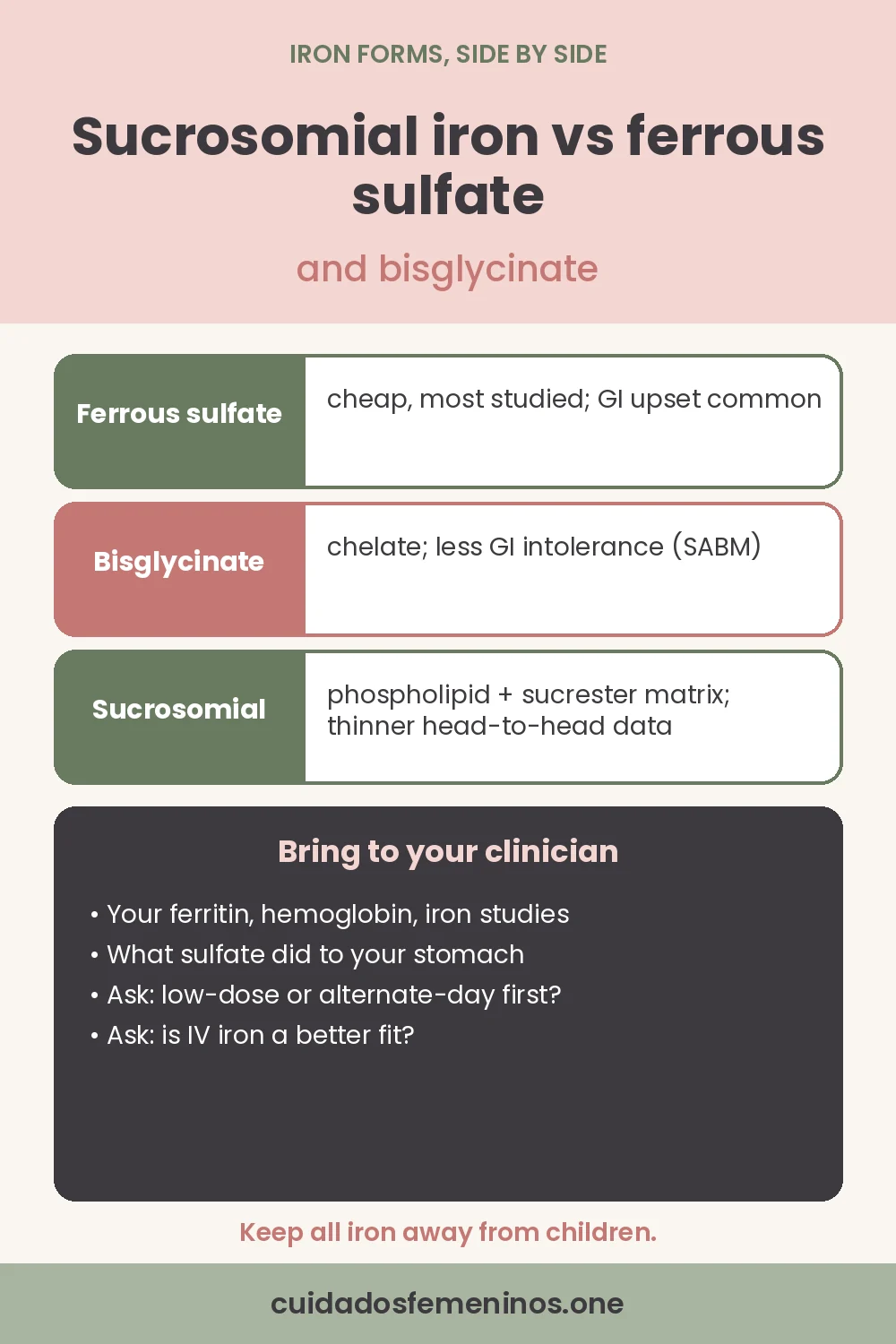
Prices move constantly, so none are listed here. Check the current listing before you buy.
Why some papers sound enthusiastic and others say “not so fast”
The 2023 review by Gómez-Ramírez and colleagues concludes that sucrosomial iron has higher intestinal absorption and excellent gastrointestinal tolerance compared with conventional oral iron salts. It summarizes studies of hemoglobin recovery and iron stores at lower elemental doses, including in inflammatory conditions, and calls for larger, methodologically robust randomized controlled trials. Worth knowing: two coauthors work for Alesco/Pharmanutra, other authors disclose industry relationships, and the funding statement says the review received no external funding. None of that makes the data wrong, but enthusiastic language plus preclinical uptake data does not show superiority over modern low-dose ferrous sulfate in women with low ferritin and no anemia.
The 2025 letter by Salvador Payán-Pernía and colleagues pushes back on a cardiac-surgery guideline that favored sucrosomial iron before surgery. Their points:
- The guideline recommendation rested on a single-centre study.
- Sucrosomial iron is not recognized by the European Medicines Agency or national medicines agencies as a medication; it is considered a nutritional supplement.
- Lower single daily doses of ferrous salts (40–80 mg), even on alternate days, improve fractional absorption and cause fewer gut side effects.
- High-quality studies comparing sucrosomial iron with ferrous salts at that low-dose standard are lacking.
- In an observational study of 50 patients with iron-deficiency anemia after percutaneous coronary intervention, three months of either sucrosomial iron or ferrous sulfate raised hemoglobin by a similar 2 g/dL.
- When oral iron fails or time to surgery is short, intravenous iron should be preferred.
The letter also gives a European cost example: about €25–30 for 30 tablets in countries such as Spain or Italy, paid by the patient, while the criticized study used two capsules a day. That is a preoperative, European example, not a US shelf price.
Stomach side effects and why so many women quit ferrous sulfate
According to NIH ODS, iron supplements can cause constipation, nausea, vomiting, diarrhea and abdominal pain, especially at high doses. If you stopped sulfate because you felt awful, you are in large company, and that is exactly the adherence problem SABM describes.
Sucrosomial studies summarized in the 2023 review and the SABM guide generally report fewer gastrointestinal complaints than ferrous salts. Fewer is not none. Bisglycinate is also described by SABM as less likely to upset your stomach. Whether a different form works for you is something to test with a clinician who is following your labs.
When sucrosomial is not the first step
Don’t reach for it as an automatic first choice if nobody has looked at recent labs with you. If your hemoglobin is very low, your doctor is already considering intravenous iron, or you need a fast correction, oral iron of any kind may not be the right next move. Extra iron can also be harmful in some conditions, so never start a supplement without knowing why your stores are low.
Commercial sucrosomial products are sold in various markets, but the clinical sources here do not confirm current US stock or any product’s regulatory status. Read the actual label and ask a pharmacist.
The non-dialysis kidney disease trial
SABM summarizes a randomized open-label trial in non-dialysis-dependent CKD patients with iron-deficiency anemia. Patients were randomized 2:1 to oral sucrosomial iron 30 mg/day for three months or IV ferrous gluconate 125 mg/week to a total of 1,000 mg, with four months of follow-up. Short-term oral sucrosomial iron was as effective as IV ferrous gluconate at correcting anemia, with a favorable tolerability profile. These are study doses, not advice.
The 2023 review adds detail on the same trial (Pisani et al.): 99 patients, hemoglobin after three months that did not differ between groups (11.4 g/dL oral vs 11.7 g/dL IV), but higher ferritin with IV iron (86 ng/mL oral vs 239 ng/mL IV). That gap matters. Similar short-term hemoglobin is not the same as equally refilled iron stores, and it does not mean a pill replaces an infusion your clinician recommended. This was also a narrow kidney-disease population with short follow-up.
Pregnancy, and when an infusion is the better conversation
SABM notes sucrosomial iron has been evaluated in pregnancy, inflammatory bowel disease, celiac disease, cancer and bleeding, and the 2023 review includes pregnancy and postpartum data. That evidence is still thinner than the long record for standard ferrous salts. If you are pregnant, take the iron your obstetric clinician recommended and don’t switch on your own.
If oral iron has already failed or you can’t tolerate it, the conversation often turns to an infusion. Our guide to iron infusion in pregnancy walks through that. Related reads: choline in pregnancy and whether your prenatal has iodine.
Lactoferrin in pregnancy: what the 2026 LEAP1 trial found
In LEAP1, a large phase 3 trial published in November 2026, pregnant women given lactoferrin did worse than those given ferrous sulfate: 57% were still anemic or needed IV iron, compared with 39% on ferrous sulfate. Lactoferrin is not a replacement for the iron your OB prescribed.
Lactoferrin is an iron-binding protein found in milk, including human breast milk and cow's milk. Supplement forms are usually made from cow's milk. Check the label if you have a milk allergy.
It became popular because older, smaller studies suggested it could raise hemoglobin about as well as regular iron pills while causing fewer stomach problems. A 2017 meta-analysis of four randomized trials (600 pregnant women) found lactoferrin produced a similar or slightly better rise in hemoglobin at four weeks than ferrous iron, with significantly fewer gastrointestinal side effects. A 2023 review said lactoferrin could be recommended for prevention and treatment of anemia in pregnancy and noted its safety, after discussing earlier trials that compared it with ferrous sulfate.
LEAP1 updates that picture. This phase 3 trial, published in November 2026, compared bovine lactoferrin with ferrous sulfate in pregnant women who had iron deficiency or anemia. The main maternal result showed 57% of the lactoferrin group were still anemic or needed intravenous iron between 34 weeks and delivery, versus 39% of the ferrous sulfate group. Birth weight was similar between the groups. A newer, larger trial carries more weight than those earlier small ones. Being easier on the stomach does not help if your anemia does not improve and you still need stronger treatment later.
Do not swap your prescribed iron for lactoferrin on your own. If ferrous sulfate upsets your stomach, ask your OB about alternate-day dosing, a different oral form, or whether an iron infusion in pregnancy is a better next step. If you want to take lactoferrin in addition to the iron your clinician prescribed, ask your OB or pharmacist first. You can also review what low ferritin with normal hemoglobin can mean.
| Option | What it is | Evidence in pregnancy (as of November 2026) | Stomach tolerance as reported | Bottom line |
|---|---|---|---|---|
| Lactoferrin | Iron-binding protein from milk | Older small trials suggested similar hemoglobin gains with better tolerance; LEAP1 (phase 3, 2026) showed worse anemia outcomes than ferrous sulfate on the primary maternal endpoint | Generally better tolerated in older studies | Not a replacement for prescribed iron |
| Ferrous sulfate | Standard oral iron salt | Strongest evidence base; better than lactoferrin on LEAP1's primary maternal outcome (still anemic or needed IV iron between 34 weeks and delivery) | Common gastrointestinal side effects | Usual first-line choice |
| Sucrosomial iron | Iron protected in a phospholipid matrix | Smaller and more limited than for ferrous salts | Often reported as better tolerated than ferrous sulfate | Discuss with your clinician; not an automatic first choice |
If your clinician says it is fine to add lactoferrin, here are search links (affiliate; the same disclosure as in the product section below applies): lactoferrin on Amazon; lactoferrin on iHerb.
How to bring this up with your clinician
- Bring your latest ferritin, hemoglobin and iron studies.
- Say plainly that ferrous sulfate caused nausea or constipation, and how long you lasted on it.
- Ask whether bisglycinate or a low-dose or alternate-day ferrous regimen makes sense first, or whether sucrosomial iron is reasonable given the evidence.
- Ask how soon ferritin should rise and when you will be retested.
- If time is short or earlier oral trials failed, ask whether intravenous iron fits.
If your numbers are the confusing kind, start with what low ferritin with normal hemoglobin means (in Spanish: ferritina baja sin anemia).
Product examples, if your clinician agrees
Affiliate disclosure: As an Amazon Associate, I earn from qualifying purchases. I may also earn from some brand partner links. If you buy through a product link on this page, the price is the same for you. Read the full disclosure.
If you and your clinician settle on a form, these search links show what is currently listed. They are examples of the categories above, not confirmed stock and not a recommendation over your clinician’s pick: ferrous sulfate on Amazon; ferrous bisglycinate on Amazon or iHerb; sucrosomial iron on Amazon or iHerb. The case for the newer forms is better tolerance and convenience; the case against is higher cost and thinner high-quality evidence versus modern low-dose sulfate. Check the current price and the elemental iron per dose on the label. No product is guaranteed to raise ferritin.
When to call your doctor
Call promptly if you get severe abdominal pain, vomiting, or signs of an allergic reaction after starting any iron. Keep every iron product away from children: NIH ODS warns that accidental overdose of iron-containing products is a leading cause of fatal poisoning in children under 6. If you suspect an overdose, call a doctor or Poison Control right away. And mention any change in your stools to your clinician rather than guessing what it means.
Frequently asked questions
Is sucrosomial iron better than ferrous sulfate?
Some summarized studies report similar hemoglobin gains with fewer stomach complaints, and the 2023 review supports it when standard salts are not tolerated. The 2025 Payán-Pernía letter says high-quality trials against today’s low-dose ferrous regimens are missing and it should not replace them as standard yet. Your clinician can weigh both against your labs.
Is sucrosomial iron available in the US?
The clinical sources behind this article do not confirm current US stock or product-specific FDA status for any sucrosomial product. Listings do exist in various markets, so check the actual US product page and label, and ask a pharmacist, rather than relying on general descriptions or marketing claims you see online.
What are sucrosomial iron side effects?
Stomach symptoms can still happen, although summarized studies generally report fewer than with ferrous salts. NIH ODS lists common iron supplement effects such as constipation, nausea, vomiting, diarrhea and abdominal pain. No iron formulation is free of side effects, and how you tolerate one product does not predict the next one.
Which iron is best absorbed?
Sucrosomial iron is described as having absorption properties that may beat conventional salts, based largely on preclinical and review data. Bisglycinate has some data suggesting higher bioavailability than simple salts. Real absorption depends on inflammation, dose and other factors, so your follow-up labs, not the label claims, show what is working for you.
Sucrosomial vs liposomal vs bisglycinate: what is the difference?
Sucrosomial iron uses a phospholipid and sucrester matrix; SABM describes a sunflower-lecithin bilayer. Liposomal or microencapsulated iron is a related but not automatically identical category. Bisglycinate is a chelated form that SABM says is less likely to cause stomach intolerance than iron salts. The strength of evidence differs for each one.
Can I take it if ferrous sulfate upset my stomach?
Many women who quit sulfate because of nausea or constipation try bisglycinate or sucrosomial iron with their clinician’s guidance. Another option to ask about is a lower or alternate-day ferrous dose. Tolerance is individual, so do not assume any form will be problem-free, and do not start a new product without reviewing your labs.
Does sucrosomial iron replace an iron infusion?
No. It does not replace intravenous iron when your clinician recommended an infusion because pills failed, were not tolerated, or a fast correction is needed. In one kidney disease trial, hemoglobin was similar after three months, but ferritin was much higher with IV iron, so similar hemoglobin did not mean equal iron stores.
Is sucrosomial iron safe in pregnancy?
It has been studied in pregnancy, but that evidence is more limited than the long record for standard ferrous salts. Follow the iron plan your obstetric clinician gave you. If oral iron has failed, ask about intravenous options rather than switching products on your own, and do not change your dose without guidance.
How long until ferritin rises?
In the studies discussed here, hemoglobin and ferritin were measured over weeks up to about three months. Your own timeline depends on the dose, how well you absorb it, ongoing blood losses and inflammation. Ask your clinician when you will be retested, and do not judge the result on how you feel alone.
Can I take vitamin C with iron?
NIH ODS notes that vitamin C (ascorbic acid) enhances absorption of nonheme iron. Whether adding it makes sense with your specific product and dose is a question for your clinician or pharmacist. Do not assume one rule fits every formulation, and do not raise your iron dose to compensate for anything.
Is lactoferrin better than iron pills in pregnancy?
No. In the 2026 LEAP1 phase 3 trial, 57% of pregnant women given lactoferrin were still anemic or needed IV iron, compared with 39% given ferrous sulfate. Birth weight was similar. The larger trial does not support lactoferrin as a better option.
Can you take lactoferrin with iron?
The sources reviewed here do not clearly support taking lactoferrin with iron as a routine step. LEAP1 compared lactoferrin against ferrous sulfate, not the combination. Ask your OB or pharmacist before adding it, and do not stop the iron your clinician prescribed.
This article is general information, last updated November 19, 2026. It is not medical advice. Talk to your doctor before you start, stop or change any iron supplement.
Sources
- Gómez-Ramírez S, et al. Sucrosomial® Iron: An Updated Review of Its Clinical Efficacy for the Treatment of Iron Deficiency. Pharmaceuticals, 2023
- Payán-Pernía S, et al. Sucrosomial iron? Not so fast. European Journal of Cardio-Thoracic Surgery, 2025
- Society for the Advancement of Patient Blood Management: Clinician’s Guide to Oral Iron
- NIH Office of Dietary Supplements: Iron, fact sheet for health professionals
- NIH Office of Dietary Supplements: Iron, consumer fact sheet
- Said JM, O'Connell RL, Reynolds RM, et al. Effects of oral bovine lactoferrin versus oral iron sulphate in iron-deficiency anaemia in pregnancy (LEAP1): a multicentre, double-blind, randomised, phase 3 trial. Lancet Obstet Gynaecol Womens Health. 2026;2(11):e959-e972.
- Abu Hashim H, Foda O, Ghayaty E. Lactoferrin or ferrous salts for iron deficiency anemia in pregnancy: A meta-analysis of randomized trials. Eur J Obstet Gynecol Reprod Biol. 2017;219:45-52.
- Gawel P, Krolak-Olejnik B. Lactoferrin supplementation during pregnancy: a review of the literature and current recommendations. Ginekologia Polska. 2023;94(7):570-580.
Keep reading
- Low ferritin, normal hemoglobin What it means and what to ask.
- Iron infusion in pregnancy When pills are not enough.
- Choline in pregnancy
- Does your prenatal have iodine?
- Ferritin level for hair loss: which number causes shedding
 Oral Minoxidil for Women: What Studies Used and What Side Effects to Expect
 Ozempic While Breastfeeding: What ACOG’s 2026 Guidance Says (Wegovy, Mounjaro, Zepbound)
 Progesterone Shortage 2026: Which Capsules Are Available and What to Use Instead
If you want to read more articles like Sucrosomial Iron vs Ferrous Sulfate (and Bisglycinate): What Low-Ferritin Women Need to Know, check out the Women's Health category.