
Abrysvo vs Beyfortus vs Enflonsia (2026-27): Which One Your Baby Needs, What It Costs and What to Do If Insurance Won't Pay

Abrysvo vs Beyfortus isn't really a contest: they're two routes to the same goal, keeping your newborn out of the hospital with RSV this winter. Abrysvo is a single vaccine you get late in pregnancy. Beyfortus (nirsevimab), or the newer Enflonsia (clesrovimab), is an antibody shot your baby gets after birth. Most babies need one route, not both. For 2026-27, two things changed that most pages haven't caught up with: ACOG stretched the Abrysvo window to September 1 through March 1, and many families are learning that their insurer won't pay for the baby's shot while you're still in the hospital.
Below you'll find a side-by-side comparison, a due-date table to see which option fits you, the real list prices, and a script for your hospital, pediatrician and insurer so your baby doesn't leave unprotected. Everything comes from ACOG, AAP, AAFP, CDC and FDA documents, linked at the end.
- The short answer
- Abrysvo vs Beyfortus vs Enflonsia: side-by-side comparison
- Which option fits your due date?
- Why ACOG extended the Abrysvo window to March 1
- Is the RSV vaccine safe in pregnancy?
- Beyfortus vs Enflonsia: is one better?
- How much does Abrysvo cost? How much is Beyfortus?
- What to do if insurance won't pay for the RSV shot in the hospital
- Packing your hospital bag for RSV season
- When to call the doctor about RSV symptoms
- Frequently asked questions
- Can baby get Beyfortus if mom got Abrysvo?
- Which RSV vaccine is most effective?
- Is Beyfortus the same as the RSV vaccine?
- Why avoid the RSV vaccine?
- How much is Beyfortus without insurance?
- Can a baby get Beyfortus twice?
- What is the maximum age for a child to take Beyfortus?
- Is Abrysvo covered by insurance during pregnancy?
- When should I get Abrysvo in pregnancy for 2026-27?
- Sources
The short answer
- Pregnant and between 32 and 36 weeks from September 1 to March 1? You can get one dose of Abrysvo. If your baby is born at least 14 days later, they usually don't need an antibody shot.
- Skipped the vaccine, got it less than 14 days before delivery, or got it in a past pregnancy? Your baby should get Beyfortus or Enflonsia, ideally before leaving the hospital and within the first week of life.
- Beyfortus or Enflonsia? AAP and AAFP don't prefer either one for the first season. ACOG advises choosing whichever is "most readily available and easily accessible."
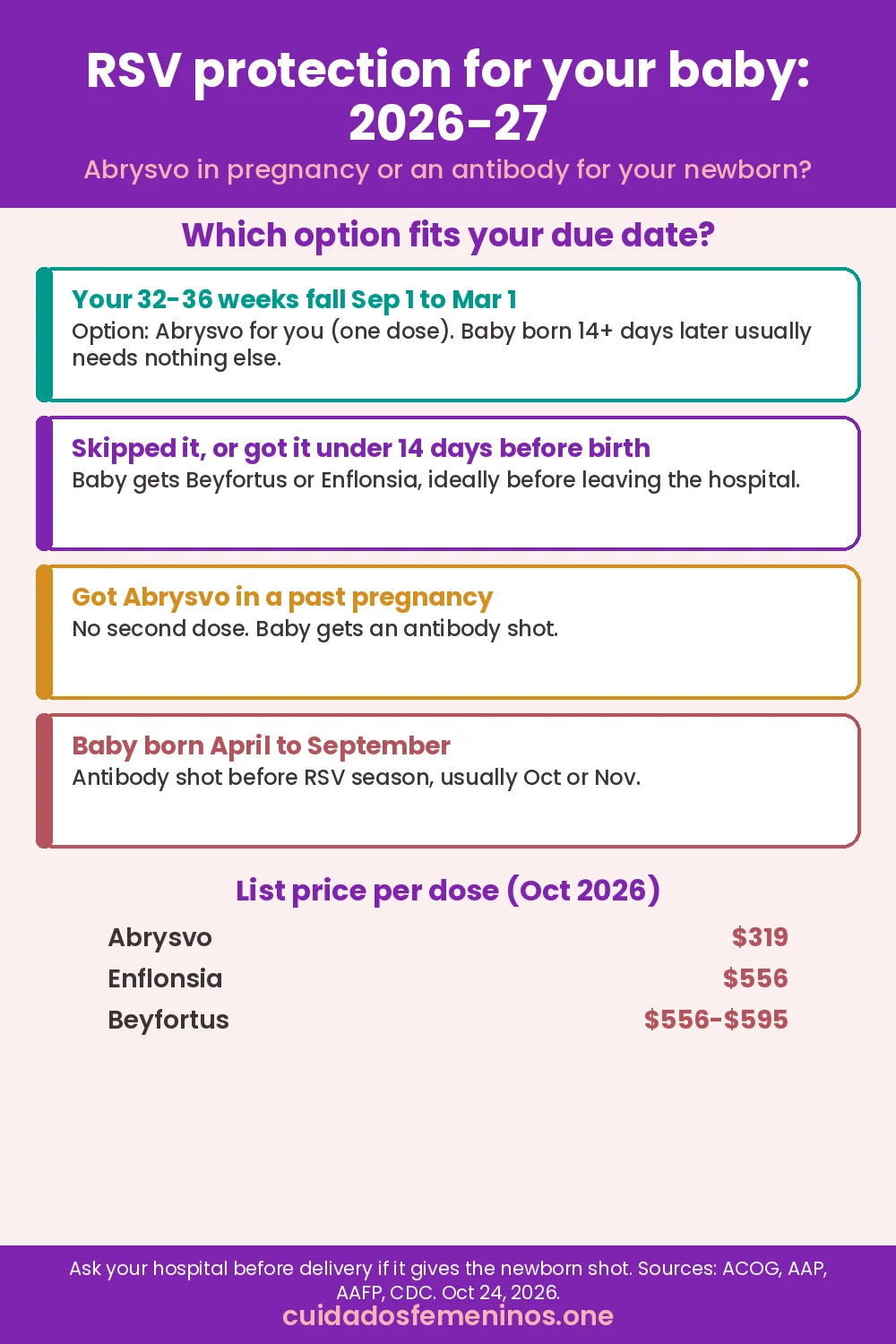
- List prices (October 2026): Abrysvo $319.07; Enflonsia $556; Beyfortus $556.13 to $595.06 per dose, depending on the source.
- Biggest 2026 trap: many insurers don't pay hospitals for the antibody during the birth stay, even though they pay for it at the pediatrician's office days later. Ask before you deliver.
Abrysvo vs Beyfortus vs Enflonsia: side-by-side comparison
Here's how the three options compare on the details parents ask about most. Efficacy numbers come from each product's own trials, which used different designs, so they can't be ranked against each other directly.
| Abrysvo | Beyfortus (nirsevimab) | Enflonsia (clesrovimab) | |
|---|---|---|---|
| What it is | Vaccine for the pregnant parent | Monoclonal antibody for the baby | Monoclonal antibody for the baby |
| Maker | Pfizer | Sanofi and AstraZeneca | Merck |
| Who gets the shot | You, at 32 weeks 0 days to 36 weeks 6 days | Baby under 8 months, first RSV season | Baby under 8 months, first RSV season |
| 2026-27 timing | September 1 to March 1 (most of the continental U.S.) | October to March, within a week of birth; before the season for babies born April to September | Same as Beyfortus |
| Dose | One dose, once in a lifetime for now | 50 mg under 5 kg (11 lb), 100 mg at 5 kg or more | 105 mg for every baby, no weighing needed |
| How fast it protects | Antibodies need about 2 weeks to reach the baby | Right away | Right away |
| Trial results | 81.8% less severe RSV illness in the first 90 days; 69.4% through 6 months | 74.5% fewer medically attended RSV infections (MELODY trial, through 150 days) | 60.5% fewer medically attended RSV infections; 84.3% fewer RSV hospitalizations (through 150 days) |
| Second season | No | Yes, 200 mg for high-risk children 8 to 19 months | No, first season only |
| List price per dose | $319.07 | $556.13 (AAP) to $595.06 (CDC list) | $556 |
Sources for the table: ACOG 2026-27 guidance, AAFP 2026-27 RSV recommendations, the FDA Abrysvo approval, the FDA Enflonsia trial snapshot and the CDC price list. Synagis (palivizumab), the old monthly shot, has been discontinued; Beyfortus now covers the high-risk babies who used to get it.
Which option fits your due date?
The deciding factor is where your 32-to-36-week stretch lands. If any day of it falls between September 1, 2026, and March 1, 2027, Abrysvo is an option. If not, plan on the antibody for your baby. Use this table, then confirm with your OB.
| Your situation | What ACOG, AAP and AAFP recommend |
|---|---|
| Your 32 to 36 weeks fall between Sep 1, 2026, and Mar 1, 2027 | Either Abrysvo for you, or an antibody for the baby at birth. Most babies need only one. |
| You got Abrysvo and the baby is born 14 or more days later | Usually no antibody needed. |
| The baby is born less than 14 days after your Abrysvo shot | Antibody for the baby (Beyfortus or Enflonsia). |
| You got Abrysvo in a previous pregnancy | No second Abrysvo dose. The baby gets an antibody. |
| You're already past 36 weeks 6 days | Skip Abrysvo; there may not be time for antibodies to cross the placenta. Antibody for the baby. |
| Baby born October through March without your vaccine | Antibody within the first week, ideally before hospital discharge. |
| Baby born April through September | Antibody shortly before RSV season starts, usually October or November. |
| Your vaccine status is unknown (for example, records lost) | Antibody for the baby. |
Seasonal timing can be different in Alaska, Hawaii, Puerto Rico and other areas with a different RSV pattern, so follow your state or territory's guidance if you live there.
Why ACOG extended the Abrysvo window to March 1
On September 2, 2026, ACOG updated its guidance so pregnant patients can get Abrysvo from September 1 through March 1, instead of stopping on January 31. The reason: recent RSV seasons have run later into spring and have been more severe. Practically, if you're due in late March or early April 2027, you may now qualify when you wouldn't have last year.
ACOG also repeated two rules that trip people up. First, it's one dose for life for now, because there's no data on how well a repeat dose works in a later pregnancy. Second, Abrysvo is the only RSV vaccine approved for use in pregnancy, so the Arexvy and mResvia shots for older adults are not substitutes. Only about 41.6% of eligible pregnant patients got the maternal vaccine last season, according to ACOG.
Is the RSV vaccine safe in pregnancy?
Abrysvo's FDA label lists injection-site pain (40.6%), headache (31.0%) and muscle pain (26.5%) as the most common side effects in pregnant participants. The label also carries a warning about a numerical imbalance in preterm births in the trials: 5.7% with Abrysvo vs 4.7% with placebo. The FDA said the data couldn't establish or rule out a link, which is why the vaccine is given only from 32 weeks on.
Since approval, AAFP reports that post-authorization evidence has not shown a higher risk of preterm birth with the recommended timing. The label's Guillain-Barré warning comes from studies in older adults, and AAFP notes it has not been reported after maternal vaccination. If you have a history of severe allergic reaction to a vaccine ingredient, or a high risk of preterm birth, talk it through with your OB; going straight to the antibody for your baby is an equally recommended path.
For the baby's antibodies, AAFP says side effects are usually mild, such as pain, redness or swelling where the shot was given. Babies with a moderate or severe illness generally wait until they recover. Either antibody can be given at the same visit as routine vaccines.
Beyfortus vs Enflonsia: is one better?
For a baby's first RSV season, neither the AAP nor AAFP prefers one product over the other. The practical differences are small but real:
- Dosing: Enflonsia is one 105 mg dose for every baby. Beyfortus is dosed by weight (50 mg under 5 kg, 100 mg at 5 kg or more), which matters mostly for late-season catch-up shots.
- Second season: only Beyfortus is approved for high-risk toddlers 8 through 19 months. If your baby was very premature or has a heart or lung condition, the clinic may stock Beyfortus for that reason.
- Evidence base: Beyfortus has been used since the 2023-24 season, with real-world data showing strong protection against RSV emergency visits and hospitalizations. Enflonsia was approved in June 2025.
- Availability: this often decides it. A hospital or practice may stock only one product; ACOG's advice is to use whichever is readily available, rather than delay.
How much does Abrysvo cost? How much is Beyfortus?
These are the private-sector list prices that manufacturers report. What you actually owe depends on your insurance, where the shot is given and any administration fee, which is billed separately.
| Product | Private-sector list price per dose | Source |
|---|---|---|
| Abrysvo (pregnancy vaccine) | $319.07 | CDC price list, reviewed August 3, 2026 |
| Beyfortus 50 mg or 100 mg | $556.13 | AAP ordering page, September 2026 |
| Beyfortus 50 mg or 100 mg | $595.06 | CDC price list, reviewed August 3, 2026 |
| Beyfortus 200 mg (second season, two 100 mg shots) | $1,112.26 | AAP ordering page |
| Enflonsia 105 mg | $556.00 | AAP and CDC price list |
Coverage is better than those numbers suggest. Under the Affordable Care Act, most private plans must cover immunizations recommended on the federal schedule with no cost sharing in-network, and KFF notes that requirement was expanded in 2025 to include Enflonsia. AHIP, the insurers' trade group, says its member plans will keep covering ACIP-recommended immunizations with no cost sharing through the end of 2027. Medicaid also covers recommended adult vaccines, including Abrysvo in pregnancy, without cost sharing.
If your baby is uninsured, on Medicaid, American Indian or Alaska Native, or underinsured, the Vaccines for Children (VFC) program supplies Beyfortus and Enflonsia for free; underinsured children get VFC doses at federally qualified or rural health centers. Abrysvo itself is on the VFC list too, which helps if you're pregnant and 18 or younger. A VFC office can charge a modest administration fee but can't turn your child away if you can't pay it.
What to do if insurance won't pay for the RSV shot in the hospital
This is the problem nobody explains well. As NPR reported on October 16, 2026, many hospitals don't give newborns the RSV antibody before discharge because most commercial insurers don't reimburse them for it. Birth stays are paid as a bundle that usually doesn't include a $500 shot, and AHIP told NPR that plans aren't required to pay for it in the hospital, only in doctors' offices. AAP News adds that only 36% of birthing hospitals were enrolled in VFC as of spring 2025, and that some hospitals skip the shot for every baby rather than offer it to some families and not others.
The risk is the gap between discharge and the first checkup. The AAP News report describes a 2-week-old who caught RSV in exactly that window and spent 12 days in the hospital. Here's how to close the gap.
Before you deliver: four questions for the hospital
- "Do you give nirsevimab (Beyfortus) or clesrovimab (Enflonsia) to newborns before discharge during RSV season?"
- "Is it covered by my plan here, or billed separately? Will I get a bill for it?"
- "Are you enrolled in the Vaccines for Children program?" (This matters if your baby will be on Medicaid or uninsured.)
- "If you don't give it, can you note it in the discharge papers so the pediatrician knows?"
Call your insurer with the billing codes
Insurance reps answer faster when you give them codes. According to the AAP coding guide, ask whether your plan covers these, both in the hospital and at the pediatrician's office:
- 90380: nirsevimab 0.5 mL (Beyfortus 50 mg)
- 90381: nirsevimab 1 mL (Beyfortus 100 mg)
- 90382: clesrovimab 0.7 mL (Enflonsia)
- 96380 or 96381: administration of the antibody, with or without counseling
- Z29.11: the diagnosis code for RSV prophylaxis (not Z23, which is for vaccines)
- For your own Abrysvo shot, ask about the vaccine and its administration code, and confirm the OB office or pharmacy is in-network.
Book the first pediatric visit for days 3 to 5
If the hospital won't give it, the antibody should be given within the first week of life. Choose a pediatrician before delivery, call to confirm they stock Beyfortus or Enflonsia, and book the newborn visit for the first few days after discharge. Ask the hospital to send your Abrysvo record (or the fact that you didn't get it) so nobody has to guess.
If you get a bill or a denial
- Ask the hospital for an itemized bill and check whether the shot was coded with the codes above.
- Ask your insurer for the denial in writing. Insurers have to explain the reason.
- File an internal appeal within 180 days of the denial. A letter from your pediatrician helps; HealthCare.gov explains the process.
- If the appeal fails, request an external review. Your state's Consumer Assistance Program can help you file for free.
- Ask your pediatrician's office to report the denial to the AAP's coding hotline, which is tracking denial patterns to press insurers.
Packing your hospital bag for RSV season
Affiliate disclosure: As an Amazon Associate, I earn from qualifying purchases. If you buy through a product link on this page, the price is the same for you. Read the full disclosure.
No product replaces the shot, but a few things make the first winter weeks calmer. Add these to your hospital bag or nursery basket:
- Your vaccine record. A photo of your Abrysvo record (date included) saves the pediatrician a phone call.
- A digital thermometer you can use rectally. For babies under 3 months, the AAP says a rectal temperature of 100.4°F (38°C) or higher means calling the doctor right away. A baby digital thermometer is the most reliable way to check.
- Saline drops and a nasal aspirator. Babies breathe through their noses, and the AAP recommends saline drops followed by gentle suction to clear mucus. A saline and nasal aspirator kit covers both.
- Hand sanitizer for visitors. RSV spreads on hands and surfaces, so keep a pack of travel hand sanitizers by the door and in the diaper bag.
When to call the doctor about RSV symptoms
Even a protected baby can catch RSV; the shots make severe illness much less likely, not impossible. In babies under 6 months, the CDC says RSV may show up only as irritability, less activity, poor feeding or pauses in breathing, sometimes without a fever. Call your pediatrician promptly if your baby:
- Is feeding much less than usual or has fewer wet diapers
- Has a rectal temperature of 100.4°F (38°C) or higher and is under 3 months old
- Has a cough or runny nose that keeps getting worse
Call 911 or go to the emergency room for fast, shallow or labored breathing, skin pulling in between the ribs, flaring nostrils, pauses in breathing, or bluish or gray lips, skin or nails.
Frequently asked questions
Can baby get Beyfortus if mom got Abrysvo?
Usually the baby doesn't need it. If you got Abrysvo at least 14 days before delivery, most babies are already protected. Doctors do recommend Beyfortus or Enflonsia when the baby is born less than 14 days after your shot, when your vaccine status is unknown, or for certain high-risk medical situations.
Which RSV vaccine is most effective?
No head-to-head trial compares them, so there's no official winner. Abrysvo cut severe RSV illness in babies by 81.8% in their first 90 days. Beyfortus trials showed 70% to 75% fewer RSV infections needing medical care, and Enflonsia showed 60.5% fewer, plus 84.3% fewer hospitalizations. AAP and ACOG prefer none.
Is Beyfortus the same as the RSV vaccine?
No. Abrysvo is a vaccine you get during pregnancy, so your body makes antibodies that cross the placenta. Beyfortus (nirsevimab) and Enflonsia (clesrovimab) are lab-made antibodies injected straight into the baby. They work right away and don't train the immune system. Most babies need one strategy, not both.
Why avoid the RSV vaccine?
Medical groups don't advise avoiding it; they advise timing it. Abrysvo's label carries a warning because trials saw slightly more preterm births with the vaccine (5.7% vs 4.7%), so it's given only at 32 to 36 weeks. AAFP says post-approval data have not shown more preterm births at that timing.
How much is Beyfortus without insurance?
The list price is about $556 to $595 per dose: AAP lists $556.13 and the CDC price list shows $595.06, before any office or administration fee. If your baby is uninsured or on Medicaid, the Vaccines for Children program supplies it free, though a participating office may charge a small administration fee.
Can a baby get Beyfortus twice?
Only in specific cases. Healthy babies get one dose for their first RSV season. A second-season dose of Beyfortus, given as 200 mg, is recommended for children 8 through 19 months at higher risk, such as babies born before 32 weeks or with certain heart, lung or chromosomal conditions. Enflonsia is first-season only.
What is the maximum age for a child to take Beyfortus?
Beyfortus is not recommended for anyone 20 months or older. Babies under 8 months get it for their first RSV season, and only children 8 through 19 months who are at higher risk qualify for a second-season dose. A healthy child 8 months or older shouldn't get an RSV antibody.
Is Abrysvo covered by insurance during pregnancy?
In most cases, yes. Abrysvo in pregnancy has been on the federal immunization schedule since 2023, so most private plans cover it in-network with no copay, Medicaid covers recommended adult vaccines without cost sharing, and AHIP says its member plans will keep covering recommended immunizations at no cost through 2027. Confirm with your plan.
When should I get Abrysvo in pregnancy for 2026-27?
Between 32 weeks 0 days and 36 weeks 6 days, on any date from September 1, 2026, through March 1, 2027, in most of the continental U.S. That window is a month longer than last season. If you're past 36 weeks 6 days, skip it; your baby gets an antibody instead.
This article is for general information, was last updated on October 24, 2026, and is not medical, billing or legal advice. Recommendations, prices and insurer policies change, and RSV timing can differ in Alaska, Hawaii, Puerto Rico and other areas, so confirm your plan with your OB, your baby's pediatrician and your insurer.
Sources
- ACOG: 2026-27 respiratory virus season immunization recommendations for pregnant and postpartum individuals (September 2, 2026)
- AAFP: Respiratory syncytial virus, 2026-27 recommendations
- AAP: RSV immunization products and ordering information, private sector cost (September 2, 2026)
- AAP: Coding and payment for RSV immunizations (September 2, 2026)
- AAP News: Lack of insurance coverage for RSV immunization in hospitals leaves newborns unprotected (September 14, 2026)
- NPR: Health insurers balk at paying for newborns' RSV immunization in the hospital (October 16, 2026)
- CDC: Vaccine price list, private sector and CDC contract prices (reviewed August 3, 2026)
- CDC: Vaccines for Children (VFC) program eligibility
- FDA: approval of Abrysvo for pregnant individuals to prevent RSV in infants
- FDA: Abrysvo prescribing information
- DailyMed: Beyfortus (nirsevimab) prescribing information
- FDA: Drug Trials Snapshots, Enflonsia (clesrovimab)
- NEJM: Nirsevimab for prevention of RSV in healthy late-preterm and term infants (MELODY trial)
- CDC ACIP: GRADE evidence review, nirsevimab season 1
- AHIP: statement on vaccine coverage (updated May 2026)
- KFF: recent changes in federal vaccine recommendations and insurance coverage
- HealthCare.gov: internal appeals
- CDC: RSV in infants and young children
- HealthyChildren.org (AAP): treating bronchiolitis in infants
- HealthyChildren.org (AAP): fever and your baby
Keep reading
- Pregnant with no health insurance? Your 2027 options Medicaid, CHIP and open enrollment dates.
- Cord blood banking cost comparison 2026 Another decision to make before delivery day.
- Low ferritin but normal hemoglobin Why iron matters in the third trimester.
- How soon can you take a pregnancy test? A day-by-day guide.
If you want to read more articles like Abrysvo vs Beyfortus vs Enflonsia (2026-27): Which One Your Baby Needs, What It Costs and What to Do If Insurance Won't Pay, check out the Fertility, Pregnancy & Baby category.