FSA Eligible Items for Women: What to Buy Before Dec 31 (2026)
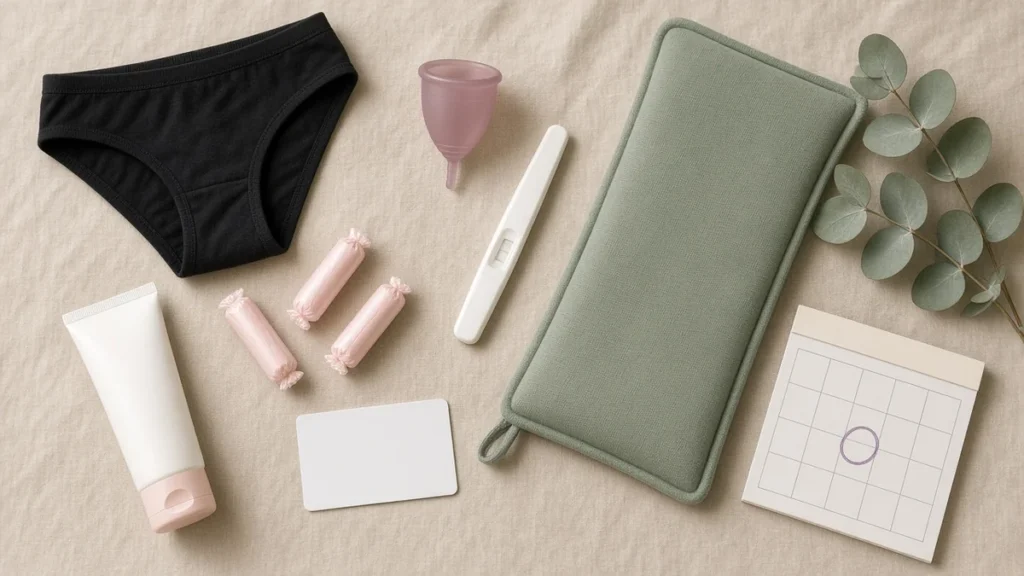
FSA eligible items for women go well beyond tampons. If your plan year ends December 31, whatever is left in your health FSA usually disappears after that, unless your employer offers a grace period or a carryover. Here’s what you can actually buy, which items the IRS names outright, which ones depend on your plan, and how to spend what’s left without a denied claim.
This isn’t tax advice. It’s a plain-English guide built from IRS Publications 502 and 969, the CARES Act and the IRS’s 2026 limits, checked on October 27, 2026. Your plan document and your FSA administrator have the final word, so use this as your list of what to ask.
- Quick answer
- What counts as an FSA eligible item?
- FSA eligible items for women: the checklist
- Is period underwear FSA eligible? What the law actually says
- Pregnancy, fertility and postpartum
- Cramps, bladder leaks and winter mood
- Menopause and midlife: what usually needs a letter
- Beauty and skin care: a short list
- The Dec 31 deadline: grace period, carryover or neither
- How to use your FSA before Dec 31, step by step
- FSA-friendly picks we’ve already reviewed
- FSA vs HSA for these purchases
- Mistakes that get FSA claims denied
- When to see a doctor (and when a visit helps your claim)
- Frequently asked questions
- What are considered FSA items?
- Is period underwear FSA eligible?
- Which period underwear are FSA-eligible for?
- Are tampons no longer FSA-eligible?
- What hygiene items are FSA-eligible for?
- What is surprisingly eligible for FSA?
- How to use FSA money before end of year?
- What are the FSA-eligible items for 2026?
- Which is better, a HSA or FSA?
- Are prenatal vitamins FSA eligible?
- Can I buy FSA eligible items on Amazon?
- Sources
Quick answer
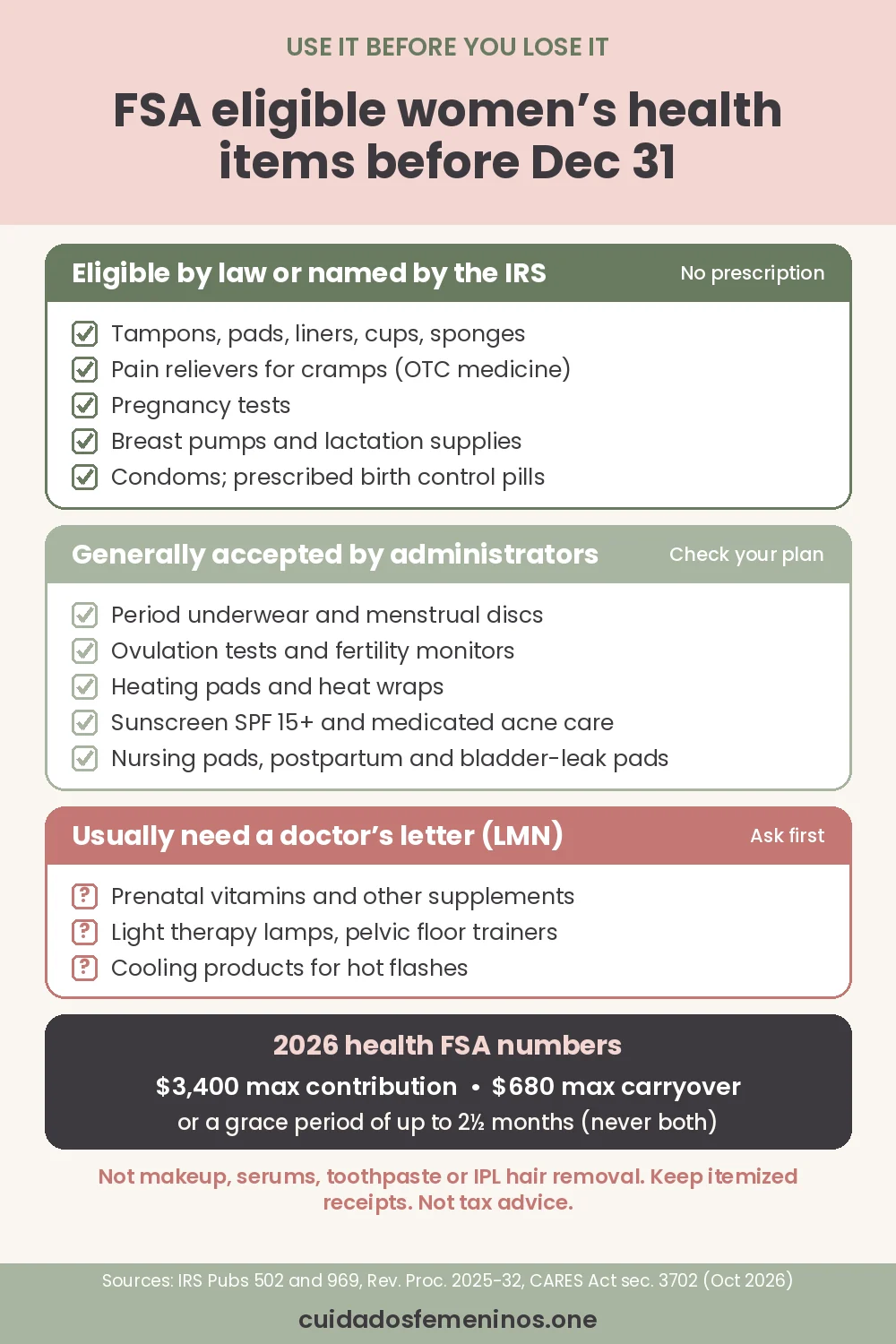
- By law, menstrual care products and over-the-counter medicines count. Since 2020, the CARES Act treats tampons, pads, liners, cups, sponges and similar products as medical care, and you don’t need a prescription for medicines like ibuprofen.
- The IRS names a few items outright: pregnancy test kits, breast pumps and supplies that assist lactation, birth control pills prescribed by a doctor, and condoms.
- Many favorites are administrator calls. Period underwear, ovulation tests, heating pads, sunscreen and nursing pads are generally accepted by FSA administrators, but the IRS doesn’t list them by name.
- Some things need a letter from your clinician. Under IRS rules, vitamins, including prenatals, qualify only when a practitioner recommends them for a diagnosed condition. Light therapy lamps and pelvic floor trainers usually need a letter of medical necessity too.
- The 2026 numbers: you could contribute up to $3,400, and if your plan has a carryover, up to $680 can roll into 2027. A plan can offer a grace period of up to 2½ months instead, never both, and plenty offer neither.
Affiliate disclosure: As an Amazon Associate, I earn from qualifying purchases. I may also earn from some brand partner links. If you buy through a product link on this page, the price is the same for you. Read the full disclosure.
What counts as an FSA eligible item?
The IRS starts from one idea. Medical expenses are the costs of diagnosing, curing, mitigating, treating or preventing disease, or of affecting a part or function of the body. Publication 969 says a health FSA covers the expenses that would generally qualify for the medical deduction, and adds two things the deduction itself doesn’t allow: over-the-counter medicine, whether or not it’s prescribed, and menstrual care products.
What doesn’t count matters just as much. Publication 502 rules out items you’d use for everyday living unless they’re mainly for treating an illness, and its example is toothpaste. It also says nutritional supplements and vitamins don’t qualify unless a medical practitioner recommends them as treatment for a specific condition a physician diagnosed. Anything bought mainly for looks fails the same test.
There’s one 2026 update most lists haven’t caught yet. On September 23, 2026, the IRS added a question about wearables like rings, watches and patches to its FAQ. A device that tracks general wellness, fitness or sleep isn’t a medical expense just because it measures your health. It can qualify if you buy and use it mainly to diagnose, treat or prevent a specific disease. In the IRS’s words, “a generalized desire to monitor or improve health is not sufficient.”
That gives you three buckets, and the checklist below uses them: eligible by law or named by the IRS, generally accepted by administrators (plan practice, not an IRS list), and needs a letter of medical necessity (a short note from your clinician tying the item to a diagnosis).
FSA eligible items for women: the checklist
| Item | Status | Why | Examples we’ve reviewed |
|---|---|---|---|
| Tampons, pads, liners, cups, sponges | Eligible by law | CARES Act section 3702 calls these menstrual care products and treats them as medical care | Always ZZZ Overnight (disposable overnight) |
| Menstrual discs | Generally accepted by administrators | Treated as a “similar product” to cups | Flex Disc |
| Period underwear | Generally accepted by administrators | Most plans read it as a similar menstrual product; the IRS doesn’t name it | Bambody period underwear, Thinx for All Everyday Comfort Brief |
| Pain relievers for cramps (ibuprofen, naproxen) | Eligible by law | The CARES Act dropped the prescription requirement for over-the-counter medicines | Any brand |
| Heating pads and heat wraps | Generally accepted by administrators | Used for pain relief; not named in Publication 502 | Sunbeam XL heating pad, ThermaCare Menstrual Heatwraps |
| Pregnancy tests | Named by the IRS | Publication 502 has its own “Pregnancy Test Kit” entry | Any brand |
| Ovulation tests and fertility monitors | Generally accepted by administrators | Treated as diagnostic or fertility items; not named in Publication 502 | Easy@Home ovulation strips (50-pack), Clearblue Digital ovulation test, Inito Fertility Monitor, Mira Fertility Max Kit |
| Breast pumps and supplies | Named by the IRS | Covers supplies that assist lactation, but not excess bottles for food storage | Any brand |
| Nursing pads, milk storage bags | Generally accepted by administrators | Usually filed as lactation supplies; ask your plan | Any brand |
| Condoms, prescribed birth control pills | Named by the IRS | Both have their own entries in Publication 502; over-the-counter birth control pills count as OTC medicine | Any brand |
| Prenatal vitamins | Depends on your plan | IRS rule: only when recommended for a diagnosed condition; many plans accept them in pregnancy | Any brand |
| Postpartum items (peri bottles, postpartum pads, perineal cooling pads) | Generally accepted by administrators | The law’s definition includes “other genital-tract secretions”; the rest is plan practice | Any brand |
| Bladder-leak pads | Generally accepted by administrators | Usually treated as incontinence supplies | Poise Ultra Thin pads |
| Pelvic floor trainers | Usually needs a letter of medical necessity | Approved when a clinician ties it to leaks or postpartum recovery | Perifit |
| Light therapy lamps | Usually needs a letter of medical necessity | For diagnosed seasonal affective disorder, not general mood | Verilux HappyLight Luxe, Carex Day-Light Classic Plus |
| Sunscreen, broad spectrum SPF 15+ | Generally accepted by administrators | Publication 502 doesn’t mention sunscreen; makeup with SPF usually isn’t accepted | Any brand |
| Medicated acne treatments | Generally accepted by administrators | Products with drug ingredients like benzoyl peroxide or adapalene are handled as OTC medicine | Any brand |
| Cooling products for hot flashes | Usually needs a letter, often denied | Fans, sheets and pajamas are dual-use items | Any brand |
| Thermometers, blood pressure monitors | Generally accepted by administrators | Publication 502 includes diagnostic devices | Any brand |
| Makeup, anti-aging serums, IPL hair removal | Not eligible | Cosmetic; IPL might only qualify with a letter for a diagnosed condition | Any brand |
Before a big order, look up your own plan’s eligibility list. Most administrators publish one, and it’s the list your claim will be checked against.
Is period underwear FSA eligible? What the law actually says
The law doesn’t mention period underwear by name. Here’s the actual definition in CARES Act section 3702: a menstrual care product is “a tampon, pad, liner, cup, sponge, or similar product used by individuals with respect to menstruation or other genital-tract secretions.” It applies to FSAs, HSAs and HRAs for expenses after December 31, 2019.
Absorbent period underwear does the same job as a pad, which is why administrators generally accept it as a “similar product.” Because it’s a judgment call and not an IRS line item, a few things make the claim go smoothly:
- Buy from a store that marks FSA-eligible items, or keep an itemized receipt that clearly says “period underwear.”
- Stick to what you’ll actually use. A plan can question a claim that looks like a wardrobe refresh.
- If you’re unsure, check your administrator’s eligibility list before you buy a large set.
If your flow is heavy, our guide to period underwear for heavy flow explains what the lab tests found and when to pair underwear with a disc or pad.
Pregnancy, fertility and postpartum
Pregnancy tests are the easy one: Publication 502 lists pregnancy test kits as a medical expense. If you’re wondering about timing, here’s how soon you can take a pregnancy test.
Ovulation tests and fertility monitors aren’t named by the IRS, but administrators generally accept them. Here’s how to read ovulation test strips, and our comparison of Inito vs Mira if you’re weighing a hormone monitor. Fertility treatment itself is named: Publication 502 includes procedures such as IVF, including temporary storage of eggs or sperm, to overcome an inability to have children. If you’re choosing a health plan right now, see whether insurance covers IVF and set your 2027 FSA election with that in mind.
Breast pumps are named too. Publication 502 says you can include “breast pumps and supplies that assist lactation,” but not excess bottles for food storage. Flanges, valves and tubing fit that wording. Nursing pads and storage bags are usually accepted, but that’s plan practice.
Prenatal vitamins are the gray area. The IRS says vitamins count only when a practitioner recommends them to treat a specific diagnosed condition. Some administrators reimburse prenatals during pregnancy with just a receipt, and others ask for a letter, so check before you buy a six-month supply.
Postpartum supplies like peri bottles and perineal cooling pads are generally accepted by administrators. Postpartum pads are on firmer ground: the CARES Act definition covers products used for menstruation “or other genital-tract secretions,” which fits bleeding after birth.
Keep in mind that a health FSA comes through a job. If you’re pregnant without coverage, our guide for anyone pregnant with no health insurance walks through Medicaid, CHIP and Marketplace options.
Cramps, bladder leaks and winter mood
Heating pads and heat wraps are generally accepted by administrators as pain relief, even though the IRS doesn’t list them. Our guide to the best heating pad for period cramps covers how long and how hot to use one.
Pelvic floor trainers usually need a letter of medical necessity, since plans see them as dual-use. A clinician who documents stress incontinence or postpartum weakness makes approval far more likely. Before you spend, read whether pelvic floor trainers work better than plain Kegels.
Light therapy lamps follow the same pattern. With a diagnosis of seasonal affective disorder and a letter, many plans reimburse them. Without one, expect a denial. Here’s how to choose a light therapy lamp for seasonal depression that actually reaches 10,000 lux at your distance.
Menopause and midlife: what usually needs a letter
Prescription treatment, including hormone therapy, is eligible as a prescribed medicine. Over-the-counter remedies with a drug ingredient count as OTC medicine. Plans differ on vaginal moisturizers and lubricants, so check your administrator’s list or ask about a letter if your clinician diagnosed vaginal dryness.
Cooling products are where claims often stall. Fans, cooling towels, pajamas and sheets have ordinary uses, so administrators usually want a letter tying them to diagnosed hot flashes, and many still say no. We’d plan on paying for cooling sheets for night sweats out of pocket.
Beauty and skin care: a short list
Most beauty products aren’t eligible, and that includes makeup, anti-aging serums and ordinary moisturizers. The exceptions are narrow, and both rely on administrator practice, not an IRS list:
- Sunscreen: administrators generally accept broad spectrum sunscreen with SPF 15 or higher. Publication 502 doesn’t mention sunscreen at all, and tinted products or makeup with SPF usually get turned down.
- Medicated acne products: treatments with a drug ingredient such as benzoyl peroxide, salicylic acid or adapalene are generally accepted as OTC medicine. A “glow” or “clarifying” product without one isn’t.
At-home IPL hair removal is cosmetic, so it isn’t eligible unless a clinician documents a medical condition it treats. If you’re curious anyway, here’s whether at-home IPL works.
The Dec 31 deadline: grace period, carryover or neither
Publication 969 calls FSAs “use-it-or-lose-it” plans. Your employer can soften that in one of two ways, but not both:
| Your plan has | What it means for 2026 money | Watch out for |
|---|---|---|
| A grace period | You can buy eligible items for up to 2½ months after the plan year ends (to March 15 for a calendar-year plan) and pay with leftover 2026 money | Your plan may set a shorter window |
| A carryover | Up to $680 of unused 2026 money moves into 2027; anything above that is lost | Your plan can set a lower cap |
| Neither | Anything not spent on expenses from the 2026 plan year is forfeited | This is common, so don’t assume you have a cushion |
| A run-out period (separate from both) | A set amount of time after the plan year to submit claims for things bought by the deadline | It isn’t extra time to buy |
One detail matters if you’re switching to an HSA-eligible plan in 2027. Publication 969 says grace period coverage from a general-purpose health FSA only leaves you HSA-eligible if your FSA balance is zero at the end of the plan year. So if your plan has a grace period, spending the account down to zero by December 31 can protect your 2027 HSA contributions.
For next year’s election, it helps to know that your whole annual election is available from day one. Publication 969 says you must be able to get the full amount at any time during the coverage period, regardless of how much you’ve contributed so far.
How to use your FSA before Dec 31, step by step
- Log in to your FSA portal and write down your exact balance and plan year end date.
- Find out whether you have a grace period, a carryover or neither, and how long the run-out period is.
- Book anything you’ve put off: a checkup copay, dental work, an eye exam or new glasses.
- Refill prescriptions, then stock up on items you’ll truly use, like period care, pain relievers, tests and first-aid supplies.
- For anything marked “needs a letter,” ask your clinician for a letter of medical necessity before you buy.
- Pay with your FSA card where it’s accepted. If it’s declined, pay another way and file the receipt.
- Keep itemized receipts showing the date, the store, the product name and the price.
- File every claim before the run-out period ends, and don’t claim the same expense twice from an FSA and an HSA.
FSA-friendly picks we’ve already reviewed
These are products we’ve covered in depth elsewhere on the site. Check each listing for an FSA or HSA eligible label and confirm with your plan, because sellers and plans don’t always agree.
- Period care: Bambody period underwear and Thinx for All Everyday Comfort Brief for everyday wear, Always ZZZ Overnight for nights, and the Flex Disc if you prefer a disc.
- Cramps: the Sunbeam XL heating pad for the couch and ThermaCare Menstrual Heatwraps for a day out.
- Trying to conceive: Easy@Home ovulation strips (50-pack) for daily testing, the Clearblue Digital ovulation test if you want a yes or no answer, or a hormone monitor like the Inito Fertility Monitor or the Mira Fertility Max Kit.
- With a letter of medical necessity: Perifit for pelvic floor training, Poise Ultra Thin pads while you train, and the Verilux HappyLight Luxe or Carex Day-Light Classic Plus for diagnosed seasonal depression.
FSA vs HSA for these purchases
| Health FSA | HSA | |
|---|---|---|
| Who can have one | Employees whose employer offers it | People with an HSA-eligible health plan and no disqualifying coverage |
| Plan required | None in particular | A qualifying high-deductible plan (2026 minimum deductible $1,700 self-only, $3,400 family) or, from January 1, 2026, a bronze or catastrophic plan available through an Exchange |
| 2026 contribution limit | $3,400 through salary reduction | $4,400 self-only, $8,750 family |
| Does the money expire? | Usually at the end of the plan year, unless there’s a grace period or carryover | No; it stays in your account |
| If you change jobs | The account belongs to the employer’s plan | The account is yours |
| Eligible items | Medical expenses plus OTC medicine and menstrual products | The same, with HSA rules on whose expenses count |
You generally can’t contribute to an HSA while you’re also covered by a general-purpose health FSA. A limited-purpose FSA, usually for dental and vision, is the exception Publication 969 allows.
Mistakes that get FSA claims denied
- Sending a receipt that only shows the store name and total, with no product names.
- Assuming an administrator-accepted item, like period underwear or sunscreen, is accepted by your plan without checking.
- Buying a dual-use item, like a light therapy lamp or a cooling fan, without the letter your plan requires.
- Treating a run-out period as extra shopping time.
- Ignoring a request for a receipt after a card swipe. Many plans suspend the card until you send it or repay the amount.
When to see a doctor (and when a visit helps your claim)
If you’re buying period products in bulk because your periods are very heavy, that’s worth a conversation with a clinician. The CDC lists these signs of heavy menstrual bleeding that should be checked:
- Bleeding that lasts longer than 7 days.
- Soaking a tampon or pad every hour or more often on the heaviest days.
- Passing clots bigger than a grape.
- Flooding that limits work, school, exercise or social plans, or being told you’re low in iron.
Also see a doctor for bladder leaks that don’t improve with pelvic floor exercises, low mood that lasts for weeks, or hot flashes that disrupt your sleep. A visit has a practical upside too. Your copay is an eligible FSA expense, and it’s your chance to ask for the letter of medical necessity that makes a trainer, a lamp or vitamins reimbursable.
Frequently asked questions
What are considered FSA items?
FSA items are costs mainly for diagnosing, treating or preventing a disease or affecting a body function, plus over-the-counter medicines and menstrual care products. That covers pregnancy tests, breast pumps, condoms, period products and pain relievers. Things for general health or looks, like toothpaste, makeup or most vitamins, don’t count.
Is period underwear FSA eligible?
Usually, yes. The CARES Act covers tampons, pads, liners, cups, sponges and similar products used for menstruation, and most FSA administrators treat absorbent period underwear as one of those similar products. The IRS doesn’t name it, though, so keep an itemized receipt that says “period underwear” and check your plan’s list.
Which period underwear are FSA-eligible for?
There’s no official brand list. Administrators look at what the product does, so absorbent underwear sold for periods is usually accepted, whether it’s Thinx, Bambody or a store brand. Regular underwear isn’t. Buying from a store that flags FSA items, or keeping a receipt naming the product, makes the claim easy.
Are tampons no longer FSA-eligible?
Tampons are still FSA eligible. The CARES Act made menstrual care products a medical expense for FSAs and HSAs for expenses after December 31, 2019, and that rule hasn’t been repealed. Pads, liners, cups and sponges are covered by the same law, and you don’t need a prescription for any of them.
What hygiene items are FSA-eligible for?
Only hygiene items with a medical purpose. Menstrual products are eligible by law, and administrators generally accept items like bladder-leak pads and first-aid supplies. Everyday personal care isn’t: the IRS gives toothpaste as an example of a nondeductible personal item. Soap, deodorant and feminine washes usually don’t qualify.
What is surprisingly eligible for FSA?
Condoms, which the IRS added by notice in 2024, and breast pump supplies that assist lactation. Administrators also generally accept sunscreen, heating pads, ovulation tests and period underwear. With a clinician’s letter, some plans reimburse light therapy lamps or pelvic floor trainers. Always check your own plan’s list first.
How to use FSA money before end of year?
Check your balance and your plan’s deadline first, then ask whether you have a grace period or a carryover. Book any checkups you’ve postponed, refill prescriptions and buy period care, tests or first-aid supplies you’ll really use. Save every itemized receipt and file claims before the run-out period ends.
What are the FSA-eligible items for 2026?
The rules didn’t change much for 2026. Eligible items are still medical costs, plus over-the-counter medicines and menstrual products. What changed is the money: you can contribute up to $3,400, and a plan with a carryover can roll up to $680 into 2027. The IRS also clarified wearables in September.
Which is better, a HSA or FSA?
An HSA usually wins if you can get one, because the money is yours and never expires. You need an HSA-eligible plan, though, like a qualifying high-deductible plan or, from 2026, an Exchange bronze or catastrophic plan. An FSA works with most employer plans and gives you the full year’s election up front.
Are prenatal vitamins FSA eligible?
Sometimes. IRS rules say vitamins and supplements qualify only when a medical practitioner recommends them to treat a specific diagnosed condition. Many administrators accept prenatal vitamins with a receipt anyway, while others ask for a letter of medical necessity. Check your plan before stocking up, and keep the receipt either way.
Can I buy FSA eligible items on Amazon?
Yes, if you pay with your FSA card where it’s accepted or pay another way and submit an itemized receipt. Not every product sold as a health item is eligible, so check the listing and your plan. The receipt needs the date, the product name and the price for the claim to go through.
This article is general information, was last updated on October 27, 2026, and isn’t tax, legal or medical advice. FSA plans set their own rules within IRS limits, so confirm deadlines and eligible items with your plan administrator before you buy.
Sources
- IRS Publication 502: Medical and dental expenses (pregnancy test kit, breast pumps and supplies, birth control pills, condoms, fertility enhancement, nutritional supplements, personal use items)
- IRS Publication 969: Health savings accounts and other tax-favored health plans (health FSAs, grace period and carryover, HSA eligibility)
- IRS Revenue Procedure 2025-32: 2026 inflation adjustments, section 4.15 (health FSA limit $3,400, carryover $680)
- IRS Revenue Procedure 2025-19: 2026 HSA contribution limits and HDHP minimum deductibles
- CARES Act, Public Law 116-136, section 3702: over-the-counter medicines and menstrual care products
- IRS: Frequently asked questions about medical expenses related to nutrition, wellness and general health (updated September 23, 2026)
- IRS Notice 2026-05: Expanded availability of HSAs under the One, Big, Beautiful Bill Act
- IRS news release IR-2025-119: New HSA benefits, including bronze and catastrophic plans
- CDC: Signs and symptoms of bleeding disorders in women (heavy periods)
Keep reading
- Period underwear for heavy flow What the lab tests found.
- Heating pad for period cramps How long, how hot and which kind.
- Inito vs Mira Which fertility monitor is worth it.
- Does insurance cover IVF? Pick a 2027 plan that does.
- Pregnant with no health insurance? Medicaid, CHIP and open enrollment.
- More women’s health guides
If you want to read more articles like FSA Eligible Items for Women: What to Buy Before Dec 31 (2026), check out the Women's Health category.