
Joint Bank Account for Couples: Yours, Mine and Ours (2026)
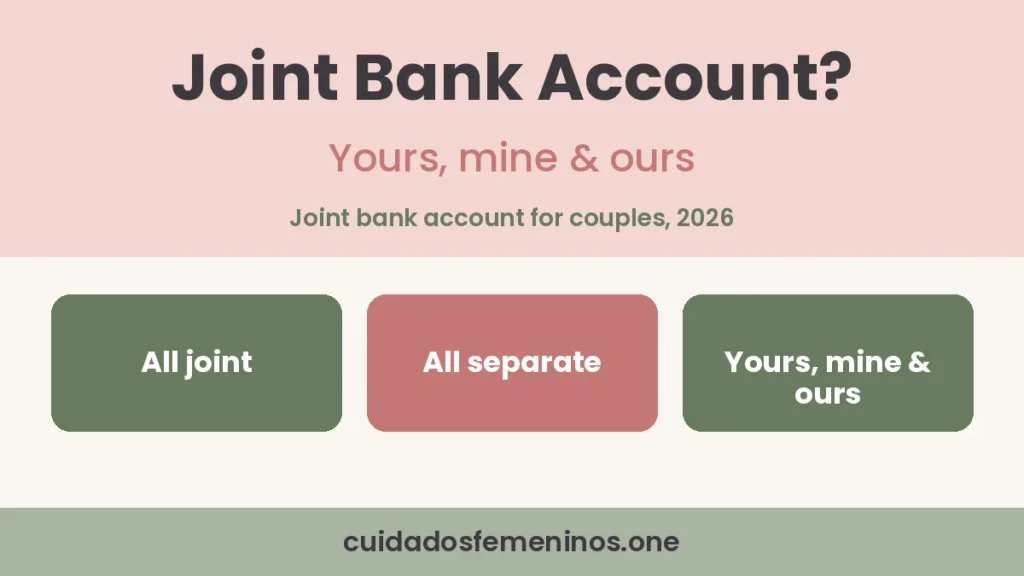
Is a joint bank account for couples a good idea? For most couples, a mix works best: one joint account for shared bills and savings, and an account each in your own name. Fully joint and fully separate can both work too. What matters is agreeing how much each of you puts in, and keeping some money only you control.
Below you'll find the three main setups, a fair way to split bills when one of you earns less, what to change during maternity leave, and what a joint account does and doesn't protect if you're not married. Every number here was checked against the Census Bureau, the FDIC and the CFPB on October 29, 2026.
- Quick answer
- Should couples have a joint bank account?
- The 3 ways couples handle money
- How to split bills fairly when one of you earns more
- What a joint account means for you if you earn less
- If the relationship ends
- Financial abuse: the warning signs
- Joint bank accounts for unmarried couples
- What is the 7 7 7 rule for married couples?
- Is a joint account FDIC insured?
- What you need to open a joint account
- Before you open one: a checklist for the two of you
- When to get legal or financial help
- Frequently asked questions
- Should couples have a joint bank account?
- Should husband and wife have a joint account?
- Do married couples need a joint account?
- What percentage of married couples have a joint bank account?
- What is the 7 7 7 rule for married couples?
- Which bank is best for a joint account for couples?
- What's a good joint bank account for couples?
- Can unmarried couples open a joint bank account?
- What happens to a joint account if we break up?
- Is a joint account FDIC insured differently?
- Sources
Quick answer
- Most married couples share at least one account: 77% in 2023, down from 85% in 1996, per the Census Bureau. Only 40% keep everything joint.
- Either owner can usually take it all. In most joint accounts, one owner can withdraw the whole balance and even close the account without the other's OK, according to the CFPB.
- Split by income, not 50/50, when your pay is very different. Each of you pays the same percentage of what you earn.
- Keep money in your own name, especially if you earn less, plan to take leave or aren't married.
- Insurance: the FDIC covers each co-owner up to $250,000 in joint accounts at one bank, on top of their individual accounts.
Should couples have a joint bank account?
There's no right answer, and the trend is moving toward a mix. The Census Bureau's SIPP tables show the share of married couples with no joint account at all rose from 15% in 1996 to 23% in 2023. Couples who keep both joint and separate accounts now make up about half of all couples with a joint account. The Census Bureau points to people marrying later, with their finances already set up, as one likely reason.
Women tend to care more about the details. In Achieve's 2026 survey of US adults, 58% of women said it's very important that a partner is financially transparent, compared with 29% of men. And in a UK survey Barclays published in October 2026, 64% of women said partners should keep some money separate even when living together or married.
The 3 ways couples handle money
| Setup | What it looks like | Works well when | Watch out for |
|---|---|---|---|
| All joint | Both paychecks go into shared checking and savings | You have similar habits and want one simple picture | Either of you can empty it; overdrafts and fees hit you both |
| All separate | Each keeps their own accounts and you settle up for shared bills | You're newer to living together or value privacy | Constant settling up; slower access for a survivor if one of you dies |
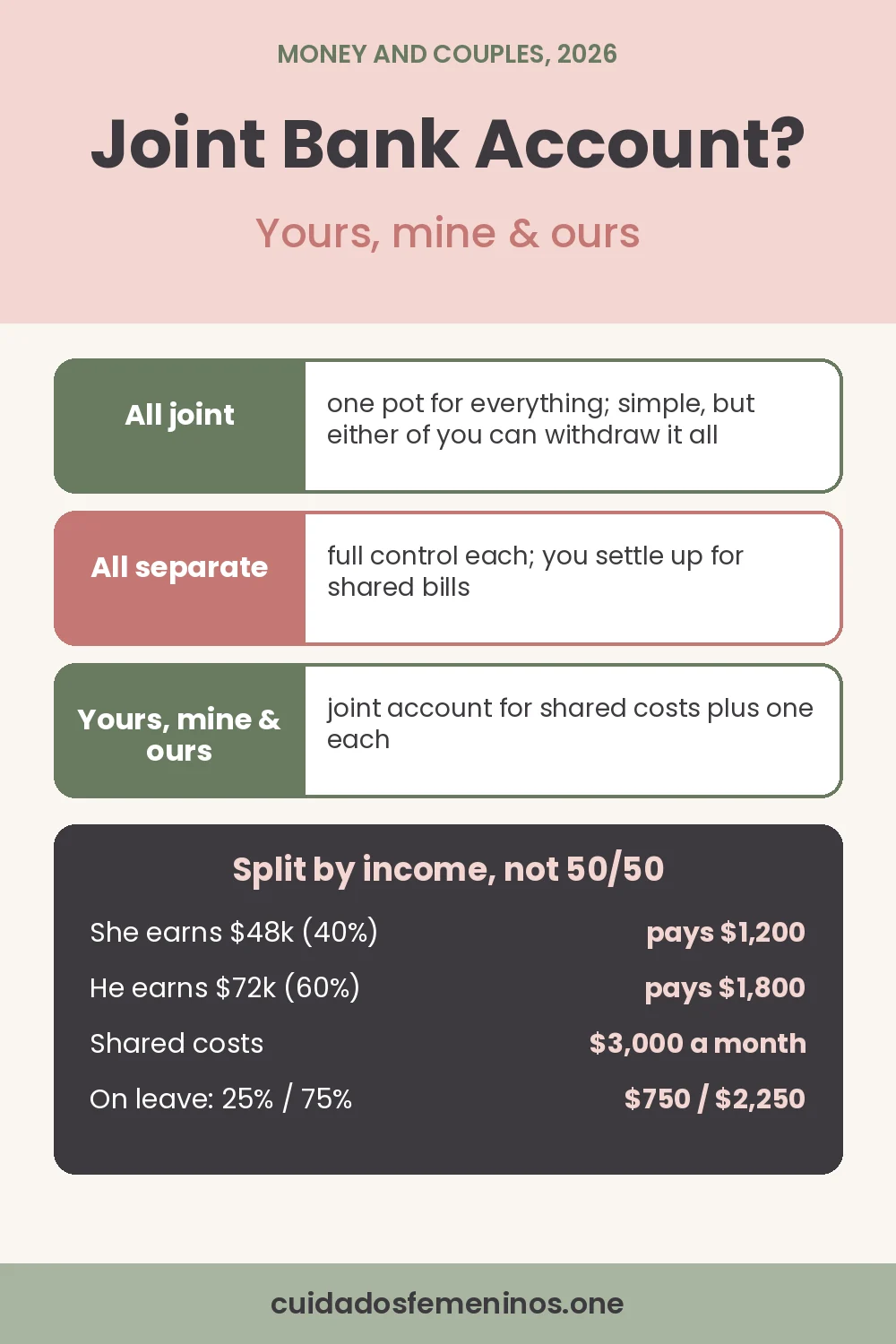
| Yours, mine and ours | A joint account for shared costs, funded from two personal accounts | Incomes differ, or one of you may step back from work | You need clear contribution rules, and the joint money is still open to both |
All joint
One pot is easy. Both paychecks land in the same place, every bill comes out of it, and you always know where you stand. Savings goals move faster because nothing is split. The trade-off is that there's no money that's only yours, every purchase is visible, and if things go wrong, the other person can legally take everything.
All separate
Each of you keeps full control, and you settle shared costs with transfers, a payment app or by taking turns on bills. It's clean and private, and it can make sense if one of you brings large student loans or supports family. It does take ongoing coordination, and it's easy for one person to end up covering more without anyone noticing.
Yours, mine and ours
This is the hybrid most couples land on. You each get paid into your own account, then move an agreed amount into a joint account for rent, groceries, utilities and shared savings. What's left stays yours. You get teamwork on the household side and privacy on the personal side. You just need to agree on the amounts and revisit them when life changes.
How to split bills fairly when one of you earns more
A 50/50 split feels fair only when your incomes are close. When they aren't, the lower earner can end up with nothing left for herself. A proportional split fixes that: each of you puts in the same percentage of your income.
Here's how the math works. Say she earns $48,000 a year and he earns $72,000. Together that's $120,000, so she earns 40% of it and he earns 60%. If shared costs come to $3,000 a month, she puts in $1,200 and he puts in $1,800.
| Her | Him | Together | |
|---|---|---|---|
| Yearly income | $48,000 | $72,000 | $120,000 |
| Monthly income (before tax) | $4,000 | $6,000 | $10,000 |
| Share of household income | 40% | 60% | 100% |
| Monthly transfer for $3,000 of shared costs | $1,200 | $1,800 | $3,000 |
| Left from gross pay for personal spending, savings and taxes | $2,800 | $4,200 | $7,000 |
You can run the same numbers on take-home pay instead of salary, which is often fairer if one of you has much higher taxes or retirement contributions. Whatever you pick, write it down and review it once a year or whenever either income changes.
Example: what changes on maternity leave
Say she takes three months of leave and her income drops to about $2,000 a month from partial paid leave, while his stays at $6,000. Household income is now $8,000 a month, so her share falls to 25% and his rises to 75%.
| During leave | Her | Him | Together |
|---|---|---|---|
| Monthly income | $2,000 | $6,000 | $8,000 |
| Share of household income | 25% | 75% | 100% |
| Monthly transfer for $3,000 of shared costs | $750 | $2,250 | $3,000 |
Without that adjustment, she'd still owe $1,200 a month, more than half of her reduced income. Agree on the new split before the baby comes, not in the middle of night feeds. If you can, keep something going into her retirement account during leave, even a small amount, so she doesn't fall behind. If you're still sorting out coverage, our guide for anyone pregnant with no health insurance walks through Medicaid and Marketplace options.
What a joint account means for you if you earn less
A joint account is shared money, legally and practically. That's the point, but it also means the person who deposits less has the same access as the person who deposits more, and the reverse. A few things protect the lower earner:
- An account in your own name, with a small cushion you don't have to explain. Even a few hundred dollars makes a difference in an emergency.
- Your own credit, such as a credit card only in your name that you pay in full. It keeps your credit history alive if most bills run through joint accounts.
- Records of big deposits, like an inheritance or money you had before the relationship, so it's clear where they came from.
- Access to every login and statement. You should be able to see the joint accounts without asking.
If the relationship ends
In most joint accounts either owner can withdraw the whole balance and close the account without the other's agreement, the CFPB says, unless the account agreement or state law says otherwise. Removing someone from a joint account usually needs their consent, according to the CFPB. So if you see trouble coming:
- Download recent statements and note who deposited what.
- Talk with your partner about splitting the balance, and put the agreement in writing.
- Ask the bank what it takes to freeze the account or remove an owner.
- Change passwords on any accounts that are only yours, and move direct deposits there.
- Talk to a family law attorney early if the split may be contested, especially if you're married.
Financial abuse: the warning signs
Money can be used to control someone. Warning signs include a partner who insists on all the passwords but hides their own spending, who makes you ask permission for basic purchases, who stops you from working, or who pressures you to take out loans or credit cards. The CFPB calls debt forced on someone this way coerced debt and has been working on rules to help survivors fix their credit reports.
If any of this sounds familiar, you can call the National Domestic Violence Hotline at 1-800-799-7233, text START to 88788, or chat at thehotline.org. It's free, confidential and open 24/7. If you're in danger, call 911.
Joint bank accounts for unmarried couples
You don't need to be married to open a joint account. Any two adults can usually do it. What you don't get is the legal framework of marriage. If a married couple divorces, a court divides the property. If an unmarried couple splits, there's no divorce process, and the account agreement mostly decides who can take what. Census data show only 16% of unmarried couples living together had a joint account in 2023.
Two details matter even more when you're not married:
- Survivorship. Most joint accounts carry a right of survivorship, so the balance generally goes to the surviving owner if one of you dies, according to the CFPB. That can be what you want, or it can override what you'd planned for family. Ask the bank how your account is titled.
- Payable on death (POD). For money in your own name, you can name a POD beneficiary. That person can't touch the account while you're alive and receives it after you die. The FDIC insures POD accounts as trust accounts, at $250,000 per owner for each beneficiary, up to $1,250,000 per owner at one bank since an April 2024 rule change.
Keep an emergency fund in your own name too. It covers a deposit and a move if things end suddenly.
What is the 7 7 7 rule for married couples?
It's a relationship tip, not a money rule: a date every 7 days, a night away every 7 weeks and a longer trip every 7 months. It spread on social media, and experts quoted by HuffPost point out it isn't based on research. Its only link to banking is that weekly dates and regular trips cost money, so if you like the idea, a small "us" line in your joint budget makes it easier to keep up.
Is a joint account FDIC insured?
Yes, if the bank is FDIC insured. Under FDIC rules, each co-owner's shares of all joint accounts at one bank are added together and insured up to $250,000, separately from accounts in their own name. Two co-owners can have up to $500,000 of joint deposits fully covered at one bank. To qualify, all owners must be living people, have equal withdrawal rights and have signed the account card, according to the FDIC. If you add a beneficiary to a joint account, it's insured as a trust account instead. Credit unions have similar coverage through the NCUA.
What you need to open a joint account
Banks usually ask each person for a government-issued photo ID, a Social Security number or ITIN, a date of birth and an address. Some let you both apply online; others need you both at a branch, or let one of you open the account and add the other later. You don't need to be married or related. Before you sign, check:
- The monthly fee and how to waive it.
- Overdraft fees, and whether you can turn overdraft off.
- Whether both of you get alerts for every withdrawal.
- How to remove an owner, and whether it needs both signatures.
- How the account is titled: joint with right of survivorship, or something else.
Before you open one: a checklist for the two of you
- Share your debts, credit scores and existing accounts.
- Pick a setup: all joint, all separate, or yours, mine and ours.
- Agree on contributions, using the proportional table above if your incomes differ.
- Set a dollar amount either of you can spend from the joint account without checking in first.
- Automate the transfers so nobody has to remember.
- Keep an emergency fund in each of your names.
- Review it every 6 to 12 months, and right away after a job change, a move or a new baby.
The best time for this talk is before a stressful season, not during one. Our guide to holiday stress has a simple 30-minute money talk you can borrow. If you're planning a family, it's also worth checking whether your insurance covers IVF and what's left in your FSA, since FSA eligible items for women include more than most people think.
If one of you stays home with the kids, add one more item to the list: coverage on both parents. Here's how to size life insurance for a stay-at-home mom, starting with what childcare would cost.
When to get legal or financial help
Talk to a family law attorney if you're separating and can't agree on how to split shared money, if large sums or a home are involved, or if you're not married and want a written cohabitation agreement. A nonprofit credit counselor or a fee-only financial planner can help you set up a budget and contribution split. If a partner is controlling your money or you feel unsafe, call the National Domestic Violence Hotline at 1-800-799-7233.
Frequently asked questions
Should couples have a joint bank account?
It depends on how you both handle money. Many couples do well with a hybrid: one joint account for shared bills and savings, plus an account each in their own name. Fully joint or fully separate can work too, as long as you agree on the rules and understand that either owner can usually withdraw everything.
Should husband and wife have a joint account?
Most do, but it isn't required. In 2023, 77% of married couples with bank accounts held at least one joint account, according to the Census Bureau, while 23% had none. What matters more is agreeing how shared bills get paid and each of you keeping some money in your own name.
Do married couples need a joint account?
No. No federal law requires married couples to share an account, and plenty keep everything separate or use a hybrid. What you do need is a clear plan for shared bills. Keep in mind that state property laws, not account titles alone, can decide who owns what in a divorce.
What percentage of married couples have a joint bank account?
About 77% of married couples who own bank accounts held at least one joint account in 2023, down from 85% in 1996, according to Census SIPP data. Only 40% held all their accounts jointly, down from 53%. Among unmarried couples living together, just 16% had a joint account.
What is the 7 7 7 rule for married couples?
It's an informal relationship tip that went viral on social media: a date every 7 days, a night away every 7 weeks and a longer trip every 7 months. It isn't based on research and has nothing to do with bank accounts. Couples adapt the timing to their budget and kids.
Which bank is best for a joint account for couples?
There's no single best bank. Compare a few on what matters to you both: FDIC or NCUA insurance, no monthly fee or an easy way to waive it, overdraft rules, how each owner gets alerts, whether you can add or remove an owner online, and whether you can link accounts you each hold separately.
What's a good joint bank account for couples?
A good one is insured, cheap to keep and easy to see from both phones. Look for no monthly fee, low or no overdraft fees, instant alerts for both owners and automatic transfers. If you want a savings goal too, a joint high-yield savings account next to joint checking works well.
Can unmarried couples open a joint bank account?
Yes. Any two adults can usually open a joint account together, no marriage or relationship required. Just know that without marriage, there's no divorce process to divide the money. Either owner can generally withdraw it all, and most joint accounts pass to the surviving owner if one of you dies.
What happens to a joint account if we break up?
In most joint accounts either owner can take out all the money and even close the account, the CFPB says. Agree on a split in writing, move each share to individual accounts and close the joint one. Removing one owner usually needs both signatures. If you can't agree, talk to a lawyer.
Is a joint account FDIC insured differently?
Yes. Each co-owner's shares of all joint accounts at one bank are insured up to $250,000, separately from accounts in their own name. So two co-owners get up to $500,000 of joint coverage. If you name a POD beneficiary, the FDIC treats it as a trust account with different limits.
This article is general information, was last updated on October 29, 2026, and isn't financial or legal advice. Account rules vary by bank and state law, so read your account agreement and talk to a lawyer or financial counselor about your situation.
Sources
- U.S. Census Bureau: Almost a quarter of married couples didn't have joint accounts in 2023, up from 15% in 1996 (America Counts story, September 2025, SIPP data)
- U.S. Census Bureau: Joint bank account ownership within couples, 1996 to 2023 (SIPP tables, September 2025)
- FDIC: Your insured deposits (joint accounts, trust accounts and the April 1, 2024 rule change)
- FDIC: Changes in deposit insurance coverage, April 1, 2024 (trust accounts and POD)
- Electronic Code of Federal Regulations: 12 CFR 330.9, joint ownership accounts
- CFPB: A joint checking account owner took all the money out and closed the account without my agreement. Can they do that?
- CFPB: What happens if I have a joint bank account with someone who died?
- CFPB: Can I remove my spouse from our joint checking account?
- CFPB: Rulemaking to help mitigate the financial consequences of domestic violence and elder abuse (December 9, 2024; coerced debt)
- National Domestic Violence Hotline: 1-800-799-7233, text START to 88788
- Achieve: Financial independence is shaping how women approach relationships (2026 Dating and Debt Survey, US, March 17, 2026)
- Barclays: Coffees over cocktails, money moves up the dating agenda (UK survey, October 26, 2026)
- HuffPost: Should you use the 777 rule in your relationship? (experts on the informal rule)
Keep reading
- Pregnant with no health insurance? · Medicaid, CHIP and open enrollment.
- Does insurance cover IVF? · What to check before open enrollment.
- FSA eligible items for women · Use your balance before Dec 31.
- Holiday stress · The 30-minute money talk before December.
- Cord blood banking costs · The real price over 20 years.
- More rights and money guides
If you want to read more articles like Joint Bank Account for Couples: Yours, Mine and Ours (2026), check out the Rights & Money category.