
Magnesium Glycinate in Pregnancy: Is It Safe, How Much (the 350 mg Rule) and Does It Help Leg Cramps?
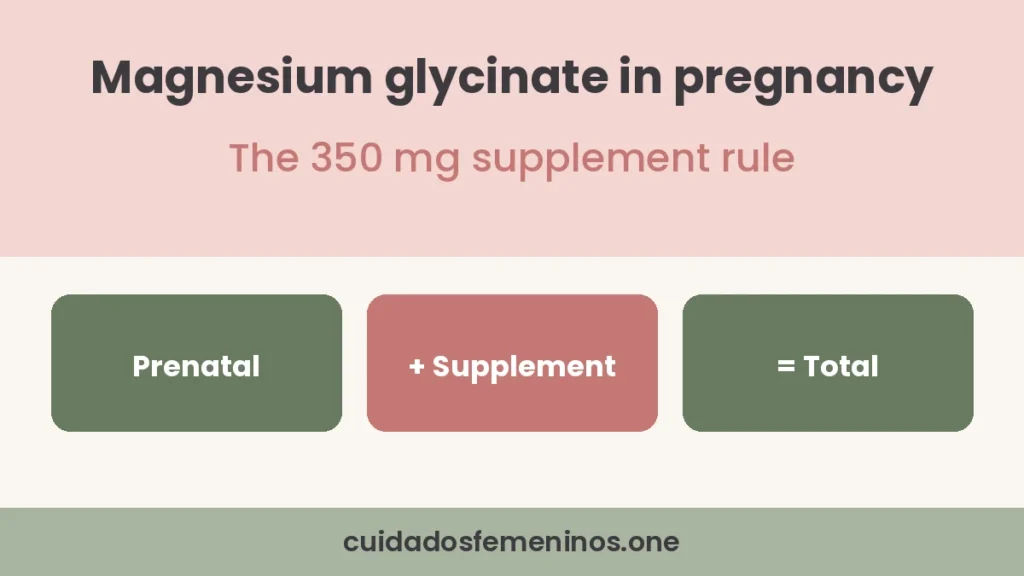
Is magnesium glycinate in pregnancy safe? At normal doses, and with your provider's OK, it is generally considered safe. The number to know is 350 mg: that is the daily limit for magnesium from supplements and medicines, and it includes what is already in your prenatal. Magnesium from food doesn't count toward it.
If you bought a bottle for night leg cramps, constipation or bad sleep, here is how to check your dose, what the leg cramp studies really found and when to call your doctor instead.
- Quick answer
- How much magnesium do you need in pregnancy?
- Elemental magnesium vs the compound on the label
- Check your prenatal label, step by step
- Does magnesium help pregnancy leg cramps?
- Sleep and constipation: what is known
- Magnesium forms compared
- Timing: when to take it
- Oral supplements vs hospital IV magnesium
- Who should ask a clinician first
- When to call your doctor or midwife
- Frequently asked questions
- Is magnesium glycinate safe in the first trimester?
- How much magnesium glycinate can I take while pregnant?
- Can magnesium cause contractions or miscarriage?
- Can I take magnesium glycinate with my prenatal?
- What is the best time of day to take magnesium in pregnancy?
- Does magnesium help pregnancy insomnia?
- Is glycinate or citrate better for constipation in pregnancy?
- Are magnesium sprays safe in pregnancy?
- Can I take magnesium and iron together?
- Is magnesium oxide bad in pregnancy?
- Sources
Quick answer
- Generally considered safe at normal doses when your OB or midwife agrees.
- Supplement limit: 350 mg a day of elemental magnesium, counting your prenatal. Food doesn't count.
- For leg cramps, one trial looked promising, but the overall evidence is low certainty.
- Read the elemental milligrams on the Supplement Facts panel, not the big number on the front of the bottle.
How much magnesium do you need in pregnancy?
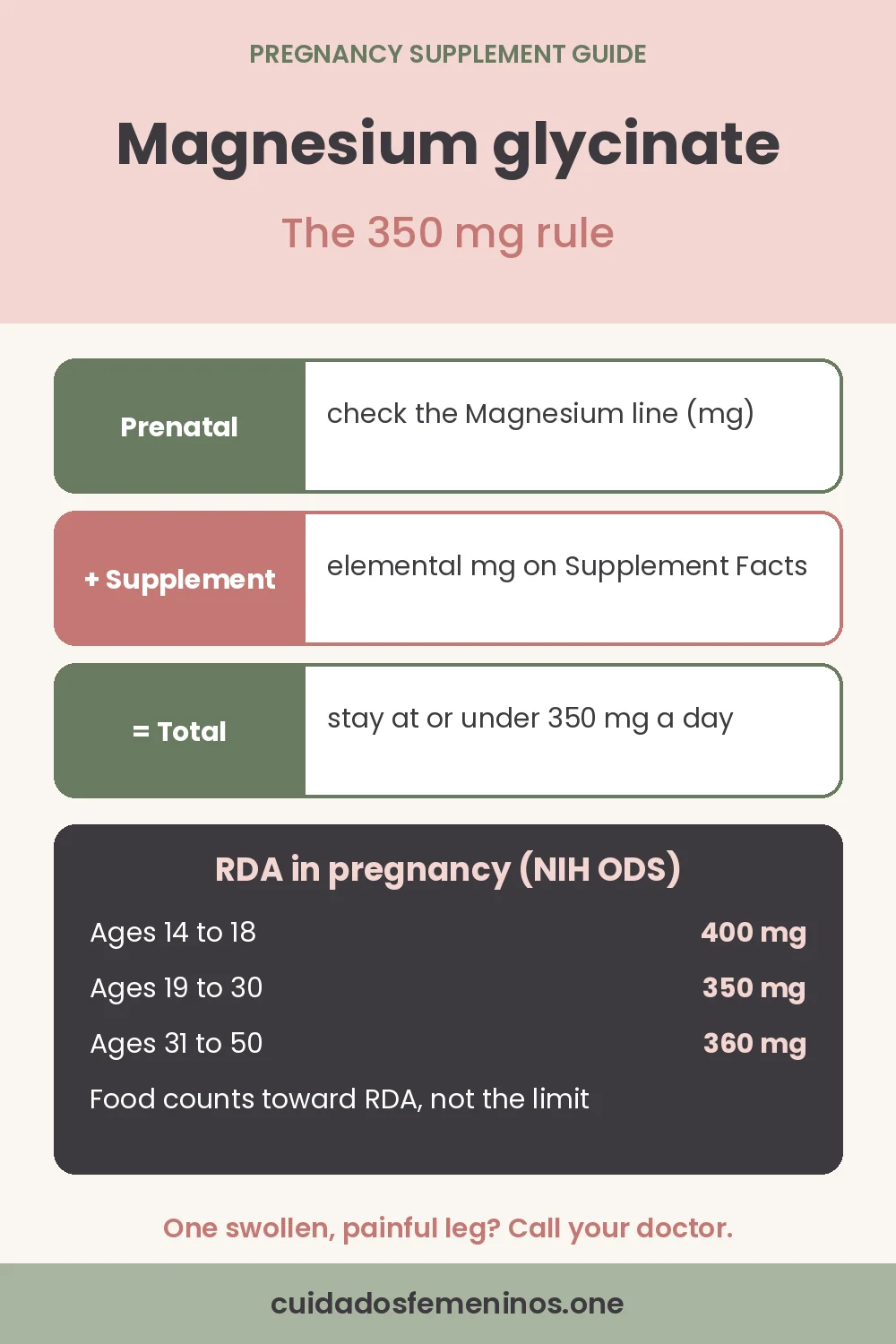
Your need goes up a little in pregnancy. These are the Recommended Dietary Allowances (RDAs) from the NIH Office of Dietary Supplements, and they count food, drinks and supplements together:
| Your age | RDA in pregnancy (all sources) | Limit for supplements and medicines |
|---|---|---|
| 14 to 18 | 400 mg a day | 350 mg a day |
| 19 to 30 | 350 mg a day | 350 mg a day |
| 31 to 50 | 360 mg a day | 350 mg a day |
The RDA and the limit look almost the same, which confuses a lot of people. They measure different things. The RDA is your total from every source. The 350 mg upper limit only covers magnesium from supplements and medicines, because magnesium in food doesn't cause problems in healthy people: the kidneys clear the extra.
Many women do fall short. According to the NIH pregnancy fact sheet, national survey data from 2001 to 2014 showed that 53.3% of pregnant women got less magnesium from food than the average requirement, and 47.5% were still below it after counting supplements. Pumpkin seeds, chia, almonds, spinach, black beans and whole grains are some of the richest food sources.
Elemental magnesium vs the compound on the label
The front of a bottle may say "magnesium glycinate 500 mg," but that can be the weight of the whole compound, not the magnesium in it. By molecular weight, pure magnesium bisglycinate is only about 14% magnesium. The rest is glycine, the amino acid it is bound to. Products can also blend in other forms, so you can't work out the magnesium from the front label alone.
The Supplement Facts panel is the number to trust. Under FDA labeling rules (21 CFR 101.36), the amount listed must be the weight of the mineral itself, "the weight of calcium rather than that of calcium carbonate," in the rule's own example. The NIH says the same for magnesium. Look for a line like "Magnesium (as magnesium bisglycinate)" followed by milligrams. That figure is what you add up.
Check your prenatal label, step by step
- Find the Supplement Facts panel on your prenatal.
- Look for the Magnesium line and write down the milligrams.
- Check the serving size. Some prenatals are two, three or more pills a day, and the amount is per serving.
- Do the same with your magnesium glycinate bottle.
- Add the two numbers, plus any antacid or laxative with magnesium you use often. Keep the total at or under 350 mg.
Don't assume your prenatal has much. A 2021 review of 188 US prenatal supplements, summarized by the NIH, found that 66% contained magnesium, with a median of 50 mg per serving. Gummies often skip minerals. If you are also checking the rest of your prenatal, see whether your prenatal has iodine, how much DHA you need in pregnancy and why choline in pregnancy is so often missing.
Example: your prenatal has 50 mg and your glycinate capsule lists 120 mg of magnesium per serving of two capsules. That is 170 mg a day, well under the limit. Taking that serving twice a day would put you at 290 mg.
Does magnesium help pregnancy leg cramps?
Maybe, for some women. The evidence is thin. The most cited trial, from Thailand (Supakatisant and Phupong, Maternal & Child Nutrition, 2015), enrolled 86 healthy women at 14 to 34 weeks who had leg cramps at least twice a week. Eighty finished the four weeks. Women took 300 mg a day of magnesium bisglycinate chelate or a placebo.
- Cramps dropped by at least half in 86.0% of the magnesium group vs 60.5% on placebo.
- Cramp intensity dropped by at least half in 69.8% vs 48.8%.
- Side effects such as nausea and diarrhea were similar in both groups.
Notice how many women improved on placebo too. And the bigger picture is less clear. The 2020 Cochrane review of leg cramp treatments in pregnancy looked at eight small trials with 576 women. For magnesium, results were inconsistent: some measures improved, others showed little or no difference. The trials measured cramps in different ways, so they couldn't be pooled, and the certainty of the evidence was low or very low. The authors concluded it is unclear whether any of the treatments work.
That doesn't mean magnesium is useless. It means it is a reasonable thing to try with your provider's OK, not a sure fix. Simple steps are worth doing either way:
- Stretch your calves before bed: stand facing a wall, step one foot back, keep the heel down and hold.
- When a cramp hits, flex your foot so your toes point up toward your knee.
- Drink fluids through the day and move around if you sit or stand for long periods.
A cramp vs a blood clot. A cramp is sudden, hard and passes in minutes. Pregnancy raises the risk of blood clots about fivefold, according to the CDC. Call your doctor right away if one leg is swollen, painful or tender, or the skin is warm, red or discolored. Get emergency care for trouble breathing, chest pain that is worse when you breathe in, coughing up blood or a racing heartbeat.
If you came here for period cramps rather than pregnancy, see our guide to magnesium for period cramps.
Sleep and constipation: what is known
Magnesium is involved in muscle and nerve function, so many women take it at night hoping to sleep better. That makes sense in theory, but none of the pregnancy trials we reviewed tested sleep as the main result. If it helps you, fine. If you are still not sleeping, tell your provider.
For constipation, the form matters. Magnesium salts that are not absorbed pull water into the gut, which is why magnesium is the active ingredient in some laxatives. The NIH lists carbonate, chloride, gluconate and oxide as the forms most often linked to diarrhea. Citrate is a common laxative choice. Glycinate isn't on that list, which is one reason many women pick it when they want magnesium without a trip to the bathroom.
Iron pills are a common cause of constipation in pregnancy. If yours are the problem, our guides to low ferritin with normal hemoglobin and iron infusion in pregnancy explain the other options.
Magnesium forms compared
| Form | Often chosen for | Gut effects | Notes in pregnancy |
|---|---|---|---|
| Glycinate or bisglycinate | Cramps, general use | Not on the NIH list of forms most linked to diarrhea | About 14% magnesium by weight; check the elemental mg |
| Citrate | Constipation | More likely to loosen stools | Better absorbed than oxide in small studies |
| Oxide | Low cost, laxative | Among the forms most linked to diarrhea | Absorbed less well than citrate and similar forms |
| L-threonate | Marketed for the brain | Little data | Not studied in pregnancy |
| Sprays and oils | Sore muscles | Not swallowed | Skin absorption is poorly studied; hard to dose |
No form has been shown to be best for every pregnant woman. The elemental dose and how your stomach handles it matter more than the marketing.
Affiliate disclosure: As an Amazon Associate, I earn from qualifying purchases. I may also earn from some brand partner links. If you buy through a product link on this page, the price is the same for you. Read the full disclosure.
If you are comparing products, look for a label that lists the elemental magnesium per serving and a third-party testing seal (USP, NSF or ConsumerLab, which the NIH mentions). You can browse magnesium bisglycinate supplements on Amazon or prenatal vitamins with magnesium on Amazon. On iHerb, you can search magnesium bisglycinate on iHerb and use code RKB5150 at checkout. Whatever you choose, add it to your prenatal number before you buy.
Timing: when to take it
There is no proven best time. Evening works well for many women because cramps and poor sleep happen at night. If it upsets your stomach, take it with a snack.
If you take a separate iron or calcium supplement, take them at different times of day. The NIH notes that calcium can interfere with iron absorption, and some experts advise separate times for those two. Doing the same with magnesium is a simple precaution, even though it has not been studied much.
Antibiotics are the bigger timing issue. Magnesium binds tetracyclines such as doxycycline and quinolones such as ciprofloxacin and levofloxacin. The NIH says to take these antibiotics at least 2 hours before or 4 to 6 hours after a magnesium supplement.
Oral supplements vs hospital IV magnesium
Hospital magnesium is a completely different thing. Magnesium sulfate given through an IV is used in preeclampsia to prevent seizures and in some preterm labors to help protect the baby's brain. It is given at much higher doses, with monitoring, and a pill can't stand in for it.
Oral magnesium has not been shown to prevent preeclampsia in pregnant women in general. The 2014 Cochrane review of magnesium supplementation in pregnancy (10 trials, 9,090 women) found no clear difference in preeclampsia, and concluded there is not enough high-quality evidence that oral magnesium is beneficial in pregnancy. The NIH notes that a later meta-analysis saw lower preeclampsia rates only in trials of high-risk pregnancies, and that results overall are mixed.
Who should ask a clinician first
- Kidney disease or reduced kidney function, because the kidneys clear extra magnesium.
- Heart rhythm problems.
- Blood pressure medicines or diuretics.
- Antibiotics such as doxycycline, ciprofloxacin or levofloxacin, because of the timing rules above.
- Regular use of antacids or laxatives that contain magnesium.
When to call your doctor or midwife
- You are not sure your total supplemental magnesium is under 350 mg.
- Cramps are severe, frequent or keep waking you most nights.
- You get diarrhea, nausea or stomach pain that doesn't settle.
- One leg is swollen, painful, warm or red. Call right away.
- You have trouble breathing, chest pain or are coughing up blood. Get emergency care.
Frequently asked questions
Is magnesium glycinate safe in the first trimester?
At normal doses it is generally considered safe when your provider agrees, and the 350 mg supplement limit applies in every trimester. Studies of magnesium for leg cramps mostly enrolled women from about 14 weeks on, so there is less direct data for early pregnancy. Ask before you start.
How much magnesium glycinate can I take while pregnant?
Keep supplemental magnesium at or under 350 mg a day, counting the elemental magnesium in your prenatal plus any separate product. Food does not count toward that limit. Your total need from food and supplements is 350 to 400 mg a day, depending on your age.
Can magnesium cause contractions or miscarriage?
There is no good evidence that normal oral doses do either. In the 2014 Cochrane review of oral magnesium in pregnancy, stillbirth risk was not higher, though the trials were small and mixed. Very high doses can cause diarrhea, so stay under 350 mg and report cramping pain or bleeding.
Can I take magnesium glycinate with my prenatal?
Yes, if the two together stay at or under 350 mg of elemental magnesium. Many prenatals have little or none: in a 2021 review of 188 US prenatals, 66% had magnesium, with a median of 50 mg per serving. Add both Supplement Facts numbers before you buy.
What is the best time of day to take magnesium in pregnancy?
There is no proven best time. Many women take it in the evening because cramps and poor sleep happen at night. If you also take a separate iron or calcium pill, taking them at different times of day is a simple precaution, and it helps you remember each one.
Does magnesium help pregnancy insomnia?
It might for some women, but it has not been well tested for sleep in pregnancy. No trial in the sources we checked measured sleep as its main result. If you are not sleeping, tell your provider, because snoring, restless legs, anxiety or reflux can all need different care.
Is glycinate or citrate better for constipation in pregnancy?
Citrate is more likely to loosen stools, because magnesium salts pull water into the gut. Glycinate is not on the NIH list of forms most linked to diarrhea, so many women find it easier to take. Ask your provider before you use any magnesium as a laxative.
Are magnesium sprays safe in pregnancy?
There is little research on how much magnesium the skin absorbs from sprays or oils, so they are hard to dose and should not replace an oral supplement your provider recommends. If you want to try one for sore calves, check the label for added scents or ingredients and ask your provider.
Can I take magnesium and iron together?
You usually can, but many clinicians suggest spacing minerals a few hours apart. The NIH notes that calcium can reduce iron absorption, and some experts advise separate times for calcium and iron. Spacing magnesium the same way is an easy precaution, though it has not been studied much.
Is magnesium oxide bad in pregnancy?
It is not dangerous at normal doses, but it is absorbed less well than citrate and similar forms, and the NIH lists oxide among the forms most often linked to diarrhea. If you pick oxide, check the elemental milligrams on the label and keep your total supplemental intake under 350 mg.
This article is general information, updated November 4, 2026. It is not medical advice. Talk to your OB, midwife or pharmacist before you start, stop or change any supplement in pregnancy.
Sources
- NIH Office of Dietary Supplements: Magnesium, fact sheet for health professionals (updated January 6, 2026)
- NIH Office of Dietary Supplements: Dietary Supplements and Life Stages: Pregnancy, fact sheet for health professionals
- Supakatisant C, Phupong V. Oral magnesium for relief in pregnancy-induced leg cramps: a randomised controlled trial. Maternal & Child Nutrition, 2015
- Luo L et al. Interventions for leg cramps in pregnancy. Cochrane Database of Systematic Reviews, 2020 (CD010655)
- Makrides M et al. Magnesium supplementation in pregnancy. Cochrane Database of Systematic Reviews, 2014 (CD000937)
- eCFR: 21 CFR 101.36, nutrition labeling of dietary supplements
- U.S. FDA: Dietary Supplement Labeling Guide
- PubChem: magnesium glycinate (bisglycinate), CID 84645, molecular formula and weight
- CDC: Understanding your risk for blood clots with pregnancy
Keep reading
- Does your prenatal have iodine? How to read the label.
- How much DHA in pregnancy Doses and what to look for.
- Choline in pregnancy Why most prenatals fall short.
- Iron infusion in pregnancy When pills are not enough.
 When to Take an Ovulation Test: The Right Cycle Day and Time of Day
 How Soon Can You Take a Pregnancy Test? A Day-by-Day Guide to Testing Early
 Faint Line on a Pregnancy Test: Is It Positive? How to Tell, and What to Do Next
If you want to read more articles like Magnesium Glycinate in Pregnancy: Is It Safe, How Much (the 350 mg Rule) and Does It Help Leg Cramps?, check out the Fertility, Pregnancy & Baby category.