
Choline in Pregnancy: What the New IQ Study Found, How Much You Need (450 vs 900 mg) and Whether Eggs Are Enough
Choline in pregnancy went from a footnote to front-page news on October 19, 2026, when a randomized trial in the American Journal of Obstetrics & Gynecology found that children whose mothers took a choline supplement from week 16 scored about eight points higher on an IQ test at age 4. That's a striking result, and it comes with real caveats. Here is exactly what the study found, how much choline you need (450 mg is the official target, while the researchers now suggest 900 mg), whether eggs are enough, and how to choose a supplement without overdoing it.
We read the trial abstract and the university's announcement, checked every number against the NIH Office of Dietary Supplements and ACOG, and pulled choline amounts from current supplement labels on October 24, 2026. Where the evidence is thin, we say so.
- Quick answer
- What the new choline IQ study found
- How much choline do you need during pregnancy? 450 vs 900 mg
- Why don't doctors recommend choline?
- Why your prenatal vitamin probably isn't enough
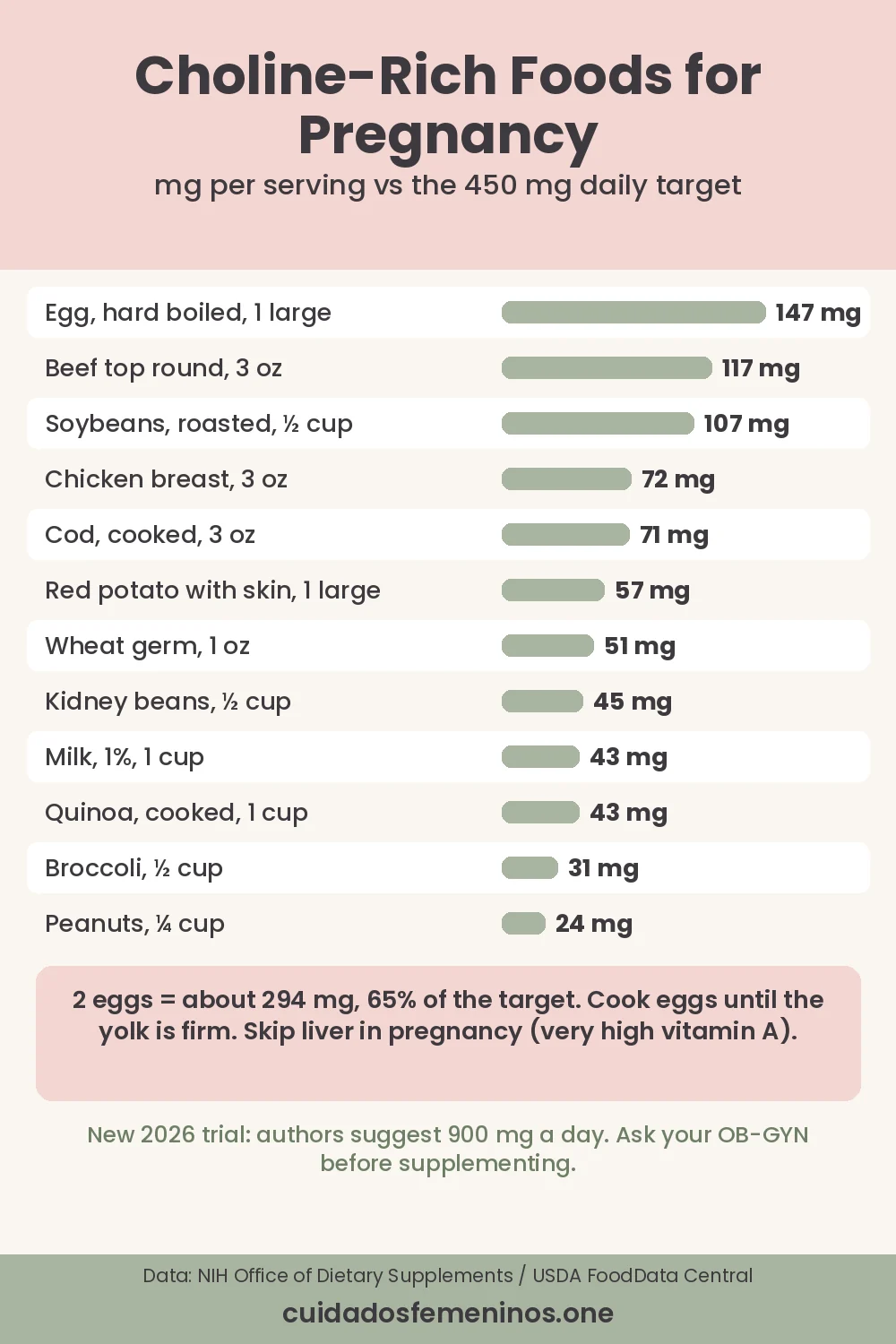
- Choline-rich foods: how much is in what you eat
- Is 2 eggs enough choline for pregnancy?
- Choline bitartrate vs phosphatidylcholine: which form?
- Best choline supplements for pregnancy (and prenatals with choline)
- Which trimester is best for choline?
- Is there a connection between choline and autism?
- Side effects, the upper limit and who should be careful
- When to talk to your doctor or midwife
- Frequently asked questions
- How much choline is recommended during pregnancy?
- Is 2 eggs enough choline for pregnancy?
- Is there a connection between choline and autism?
- Do I really need choline during pregnancy?
- Which trimester is best for choline?
- Why don't doctors recommend choline?
- What is the best choline supplement for pregnancy?
- What are the side effects of taking choline while pregnant?
- Does choline increase IQ?
- What are the contraindications for choline?
- Sources
Quick answer
- Daily target: 450 mg of choline in pregnancy and 550 mg while breastfeeding (NIH, ACOG). The upper limit is 3,500 mg a day from food and supplements combined.
- Most women fall short: about 90% to 95% of pregnant women eat less than 450 mg, and the average US woman gets about 278 mg.
- Your prenatal probably won't fix it: popular prenatals list 0 to 110 mg; only a few reach 400 to 450 mg, and they take 4 to 8 capsules.
- The new study: 9,000 mg of phosphatidylcholine a day from week 16 raised children's IQ at age 4 by an average of 7.78 points and cut parent-rated social withdrawal. Attention didn't change.
- The caveats: a third of families dropped out, behavior was rated by parents, and the autism finding is exploratory.
- Eggs: two large eggs give about 294 mg, or 65% of the daily target. Cook them until the yolk is firm.
- Next step: add up your prenatal and your diet, then ask your OB-GYN or midwife whether a choline supplement makes sense for you.
What the new choline IQ study found
The trial ran at University of Colorado prenatal clinics and affiliated community hospitals. Researchers randomly assigned 206 pregnant women to take either 9,000 mg of phosphatidylcholine (the form of choline that occurs naturally in eggs and meat) or a placebo every day from 16 weeks of pregnancy until delivery. All women were encouraged to take a standard prenatal vitamin and eat choline-containing foods. Parents rated their children's behavior from 18 months to 4 years, and the children took a standard IQ test (the WPPSI-IV) at ages 3 and 4.
| Outcome | Choline group | Placebo group | How solid is it? |
|---|---|---|---|
| Full-scale IQ at age 4 | 7.78 points higher on average (95% CI 1.88 to 13.7) | Reference | Secondary outcome, statistically significant |
| IQ above 120 (top 10%) | 10 of 54 children | 2 of 49 children | Statistically significant, small numbers |
| Elevated social withdrawal (parent-rated) | 4% | 24% | Primary outcome, significant |
| Attention problems | No significant difference | No significant difference | Primary outcome, not met |
| Autism-range scores plus language delays | 1 of 71 | 10 of 71 | Exploratory only; very wide confidence interval (1.31 to 76.1) |
| Safety | No significant supplement-related problems reported | Mothers and children |
Senior author Dr. Robert Freedman called it the largest randomized trial of prenatal choline supplementation so far. The team's explanation is that choline reaching the baby activates a receptor made by the CHRNA7 gene, which helps developing nerve cells build the connections they need before birth.
What the study can't tell you yet
- A third of families dropped out. 206 women enrolled, but 142 children were assessed by parents and only about 100 had IQ scores in the analysis. If dropouts differed between the groups, the results could shift.
- Behavior was parent-rated. Parents filled out a checklist rather than blinded clinicians doing an assessment, though the trial itself was placebo-controlled.
- IQ was a secondary outcome. The two main questions were social withdrawal and attention, and only one of them improved.
- The autism signal rests on 11 children. It's interesting, but it's a hypothesis to test, not a reason to expect a supplement to prevent autism.
- One research group, one region. It hasn't been repeated by an independent team yet, and we don't know whether the IQ gap lasts past age 4.
How it fits with earlier research
It isn't the first hint. The same Colorado group earlier found that prenatal phosphatidylcholine improved newborn brain-wave measures and reduced attention and social withdrawal problems at 40 months. At Cornell, a carefully controlled feeding study gave women in their third trimester either 480 or 930 mg of choline a day; babies in the higher group had faster information-processing speed through their first year. None of these studies is large, but they point the same way.
How much choline do you need during pregnancy? 450 vs 900 mg
The official answer is 450 mg a day. That's the Adequate Intake set by the National Academies, and it's what ACOG and the NIH use. The new trial's authors think more helps: they now suggest 900 mg of choline, or 7,200 mg of phosphatidylcholine, a day, a little less than the dose they tested. That's their recommendation as researchers, not an official guideline.
| What | Amount per day | Source |
|---|---|---|
| Adequate Intake, pregnancy (19 and older) | 450 mg | NIH ODS, ACOG |
| Adequate Intake, breastfeeding | 550 mg | NIH ODS |
| Adequate Intake, women 19+ not pregnant | 425 mg | NIH ODS |
| What the average US woman eats | About 278 mg | NHANES, via NIH ODS |
| Trial authors' suggested dose | 900 mg choline or 7,200 mg phosphatidylcholine | CU Anschutz, October 2026 |
| Dose tested in the trial | 9,000 mg phosphatidylcholine (roughly 1,100 to 1,200 mg of choline) | AJOG trial; choline content is our estimate |
| Upper limit, food plus supplements | 3,500 mg (3,000 mg if 18 or younger) | NIH ODS |
Why the difference between milligrams of phosphatidylcholine and milligrams of choline? Choline makes up only about 13% of a phosphatidylcholine molecule by weight. So 9,000 mg of phosphatidylcholine delivers roughly 1,100 to 1,200 mg of actual choline. Supplement labels list one or the other, and mixing them up is the most common dosing mistake.
Why don't doctors recommend choline?
Many do, as part of a healthy diet: ACOG lists choline, at 450 mg a day, among the key nutrients of pregnancy and names eggs, milk, beef liver, peanuts and soy as sources. What's missing is formal guidance on supplements, and especially on doses above 450 mg, because only a handful of randomized trials exist. Choline is also left out of most prenatal vitamins, so it often doesn't come up at prenatal visits unless you raise it. Bringing this study to your next appointment is a reasonable way to start that conversation.
Why your prenatal vitamin probably isn't enough
The NIH notes that prenatal supplements typically contain little if any choline. Part of the reason is size: choline is bulky. To get 450 mg of choline from choline bitartrate you need about 1,100 mg of powder, before any of the other vitamins. That's why the prenatals that do reach the target ask for 4 to 8 capsules a day.
| Prenatal (label checked Oct 24, 2026) | Choline per daily serving | Capsules per day | Share of 450 mg |
|---|---|---|---|
| Ritual Essential Prenatal | 55 mg (choline bitartrate) | 2 | 12% |
| Thorne Basic Prenatal | 110 mg (choline citrate) | 3 | 24% |
| Needed Prenatal Multivitamin (8-capsule version) | 400 mg | 8 (start with 2 and build up) | 89% |
| Kirkman Labs Prenatal with Choline | 450 mg (choline bitartrate) | 4 | 100% |
Even with a choline-rich prenatal, check the rest of the label. Some high-choline formulas, such as Needed's, leave iron out on purpose (the brand sells it as a separate supplement), and iron needs rise from 18 to 27 mg a day in pregnancy. If you've been told your iron is low, our guide to low ferritin with normal hemoglobin explains which blood tests to ask for.
Choline-rich foods: how much is in what you eat
Eggs, meat, fish, dairy and soy carry most of the choline in a typical diet. Here are amounts per serving from the NIH Office of Dietary Supplements, which draws on USDA FoodData Central, with a pregnancy note where it matters.
| Food and serving | Choline (mg) | Share of 450 mg | Pregnancy note |
|---|---|---|---|
| Beef liver, pan fried, 3 oz | 356 | 79% | Not recommended: the NHS advises avoiding liver in pregnancy because of its high vitamin A |
| Egg, hard boiled, 1 large | 147 | 33% | Cook until the yolk and white are firm (FDA) |
| Beef top round, braised, 3 oz | 117 | 26% | Cook thoroughly |
| Soybeans, roasted, ½ cup | 107 | 24% | Best plant source |
| Chicken breast, roasted, 3 oz | 72 | 16% | |
| Ground beef, 93% lean, 3 oz | 72 | 16% | Cook to 160°F |
| Cod, cooked, 3 oz | 71 | 16% | Low-mercury fish |
| Red potato, baked with skin, 1 large | 57 | 13% | |
| Wheat germ, toasted, 1 oz | 51 | 11% | |
| Kidney beans, canned, ½ cup | 45 | 10% | |
| Quinoa, cooked, 1 cup | 43 | 10% | |
| Milk, 1%, 1 cup | 43 | 10% | Pasteurized only |
| Yogurt, vanilla nonfat, 1 cup | 38 | 8% | |
| Brussels sprouts, boiled, ½ cup | 32 | 7% | |
| Broccoli, boiled, ½ cup | 31 | 7% | |
| Shiitake mushrooms, cooked, ½ cup | 27 | 6% | |
| Peanuts, dry roasted, ¼ cup | 24 | 5% |
Is 2 eggs enough choline for pregnancy?
Two large eggs give about 294 mg of choline, roughly 65% of the 450 mg target, so they're the easiest single step you can take. They won't get you all the way on their own, but a normal day of food usually closes the gap:
| Example day | Choline (mg) |
|---|---|
| 2 hard-boiled eggs at breakfast | 294 |
| 3 oz roasted chicken breast at lunch | 72 |
| ½ cup canned kidney beans | 45 |
| 1 cup 1% milk | 43 |
| ½ cup broccoli | 31 |
| Total | 485 mg (above the 450 mg target) |
Reaching the 900 mg the trial's authors suggest from food alone would take about six eggs a day, which is why Dr. Freedman says supplements are needed to hit that level. Whatever you eat, the FDA advises pregnant women to cook eggs until both the yolk and white are firm, and to skip raw batter, homemade dressings and eggnog made with raw eggs.
If you eat little or no meat or eggs
Vegetarian and especially vegan diets make 450 mg hard to reach. Roasted soybeans, soy milk, beans, quinoa, wheat germ, broccoli and Brussels sprouts all help, but you would need large portions every day. This is the group most likely to benefit from a choline supplement, so ask about it early, ideally while you're still trying to conceive.
Choline bitartrate vs phosphatidylcholine: which form?
There are three common forms in supplements, and the NIH notes that no study has directly compared how well each is absorbed. What we do know:
| Form | Choline by weight | Pros | Cons |
|---|---|---|---|
| Choline bitartrate | About 40% | Small, inexpensive tablets; 500 mg of choline fits in one; the most common form in prenatals | In a 2021 trial in non-pregnant adults it raised TMAO (see side effects); eggs and phosphatidylcholine did not |
| Phosphatidylcholine (PC) | About 13% | The form used in the Colorado trial; did not raise TMAO in the 2021 trial | A 420 mg softgel gives only about 55 mg of choline; 7,200 mg means about 17 softgels a day; usually made from soy |
| Lecithin | Lower still (500 mg of PC per 3.6 g of lecithin in one popular brand) | Cheap and food-like | Delivers very little choline per pill |
| Choline citrate | Varies | Used in some prenatals, such as Thorne | Usually small amounts per serving |
In practice, most women who supplement use choline bitartrate because the pill count is manageable. If you want to follow the trial more closely with phosphatidylcholine, be ready for a lot of softgels, and talk to your provider about the total dose first.
Best choline supplements for pregnancy (and prenatals with choline)
Affiliate disclosure: As an Amazon Associate, I earn from qualifying purchases. I may also earn from some brand partner links. If you buy through a product link on this page, the price is the same for you. Read the full disclosure.
These are products we checked on October 24, 2026, with the choline amount on the current label. We don't list prices because they change daily. None of them is "the" answer; the right one depends on how much choline your prenatal and your diet already give you.
| Product | Form | Choline per serving | Pills | Best for | Check it |
|---|---|---|---|---|---|
| Nature's Way Choline 500 mg | Choline bitartrate | 500 mg | 1 tablet | A simple top-up when your prenatal has little or no choline | iHerb |
| NOW Choline & Inositol | Choline bitartrate + inositol | 250 mg (plus 250 mg inositol) | 1 capsule | A smaller step up; split doses | iHerb · Amazon |
| Source Naturals Phosphatidyl Choline 420 mg | Phosphatidylcholine (soy) | 420 mg PC, about 55 mg choline | 1 softgel | The same form as the trial, at a much lower dose | iHerb |
| Kirkman Labs Prenatal with Choline | Prenatal multi, choline bitartrate | 450 mg | 4 capsules | Meeting the full 450 mg target inside your prenatal | iHerb |
| Needed Prenatal Multivitamin | Prenatal multi | 400 mg (full 8-capsule dose) | 8 capsules | A high-nutrient prenatal; iron sold separately | Amazon |
| Thorne Basic Prenatal | Prenatal multi, choline citrate | 110 mg | 3 capsules | A prenatal with iron; add choline on top | iHerb |
| Ritual Essential Prenatal | Prenatal multi, choline bitartrate | 55 mg | 2 capsules | Small pills; pair with a separate choline product | Amazon |
A simple way to decide: write down the choline in your prenatal, estimate your food (two eggs is about 300 mg), and see how far you are from 450 mg. A single 250 or 500 mg choline tablet closes the usual gap. If you and your provider decide to aim for the trial authors' 900 mg, you'll know exactly how much to add, and you'll still be far below the 3,500 mg upper limit.
Which trimester is best for choline?
All of them, but the evidence is strongest from the second trimester on. ACOG notes choline may help prevent some birth defects that form in the first weeks, and demand rises as the baby's brain grows quickly in the second and third trimesters. The Colorado trial started at week 16; the Cornell study added choline in the third trimester. If you're planning a pregnancy, starting with a prenatal that includes some choline before you conceive means you're covered from day one. After birth, keep it up while breastfeeding, when the target rises to 550 mg.
Is there a connection between choline and autism?
The honest answer is maybe, and it isn't proven. In the 2026 trial, 1 of 71 children in the choline group and 10 of 71 in the placebo group had autism-range scores on a parent checklist along with language delays typical of autism. The authors call this an exploratory analysis: it wasn't one of the trial's main questions, it's based on 11 children, and the confidence interval is extremely wide. Nothing here shows that choline prevents autism. It's a lead for larger, independently run trials.
Side effects, the upper limit and who should be careful
At the amounts in food and typical supplements, choline is well tolerated, and the Colorado trial reported no significant supplement-related safety problems at a high dose. Problems show up at very high intakes. According to the NIH, too much choline can cause:
- A fishy body odor
- Vomiting, nausea or diarrhea
- Excessive sweating and salivation
- Low blood pressure, which can make you dizzy
- Liver toxicity at extreme intakes
The upper limit of 3,500 mg a day (3,000 mg if you're 18 or younger) counts food and all supplements together. There's also an open question about TMAO, a compound gut bacteria make from choline that's been linked to heart disease in adults. In a 2021 trial in non-pregnant adults, choline bitartrate raised TMAO while eggs and phosphatidylcholine didn't. What that means in pregnancy isn't known.
Talk to your provider before taking choline if you
- Have trimethylaminuria (fish odor syndrome)
- Have low blood pressure or faint easily
- Have kidney or liver disease
- Are allergic to soy (most phosphatidylcholine and lecithin is made from soy)
- Already take several products that contain choline, such as a prenatal plus a separate choline supplement plus a protein shake
The NIH lists no clinically relevant drug interactions for choline, but bring every bottle to your appointment anyway.
When to talk to your doctor or midwife
- You're planning a pregnancy or just got a positive test (see how soon you can test) and want to choose a prenatal.
- You eat few eggs, meat or dairy, or you're vegetarian or vegan.
- You're thinking about a higher dose, such as the 900 mg the trial authors suggest.
- You notice a fishy body odor, dizziness, vomiting or diarrhea after starting a supplement.
- You have severe nausea or vomiting and can't keep food or vitamins down. Call your provider the same day if you can't keep fluids down.
No insurance yet? You can still get prenatal care at community health centers while coverage comes through; our guide for pregnant women without health insurance shows where to start.
Questions to bring to your next prenatal visit
- How much choline is in my prenatal, and is it enough with what I eat?
- Should I add a choline supplement, and at what dose?
- Is choline bitartrate fine for me, or would you prefer another form?
- Does anything in my health history make extra choline a bad idea?
- Should I keep taking it while breastfeeding?
Frequently asked questions
How much choline is recommended during pregnancy?
The official target is 450 mg a day, the Adequate Intake set by the National Academies and repeated by ACOG and the NIH. It rises to 550 mg while breastfeeding. The safe upper limit is 3,500 mg a day for adults. The authors of the October 2026 trial now suggest about 900 mg, but that isn't an official guideline yet.
Is 2 eggs enough choline for pregnancy?
Not quite. Two large hard-boiled eggs give about 294 mg of choline, roughly 65% of the 450 mg daily target. Add a serving of chicken, a glass of milk and some beans or broccoli and most women get there. Reaching the 900 mg the new study's authors suggest would take about six eggs a day.
Is there a connection between choline and autism?
There's a signal, not proof. In the 2026 Colorado trial, 1 of 71 children in the choline group versus 10 of 71 in the placebo group had autism-range checklist scores plus language delays. The authors label this exploratory: it involved only 11 children, was parent-rated, and wasn't the trial's main question. It needs confirming.
Do I really need choline during pregnancy?
Yes. Choline is an essential nutrient your body can't make in large enough amounts, and pregnancy raises the need because the baby's brain and spinal cord draw on it. The NIH estimates 90% to 95% of pregnant women eat less than the 450 mg target, and most prenatal vitamins contain little or none.
Which trimester is best for choline?
All of them. Choline matters from conception, and demand climbs as the baby's brain grows in the second and third trimesters. The Colorado trial started at week 16, and a Cornell feeding study added choline in the third trimester. Keep going while breastfeeding, when the target rises to 550 mg a day.
Why don't doctors recommend choline?
Many do, as part of diet. ACOG lists 450 mg of choline among key pregnancy nutrients. What's missing is formal guidance on supplements or on higher doses like 900 mg, because only a few randomized trials exist. It also isn't in most prenatal vitamins, so it rarely comes up unless you ask about it.
What is the best choline supplement for pregnancy?
The best one is the one that fills your personal gap without stacking too much. Choline bitartrate tablets are small and inexpensive; phosphatidylcholine is the form used in the new trial but needs many softgels. Add up your prenatal and your diet first, then choose a dose with your OB-GYN or midwife.
What are the side effects of taking choline while pregnant?
At normal supplement doses most women notice nothing. Very high intakes can cause a fishy body odor, nausea or vomiting, sweating, extra saliva, diarrhea and low blood pressure. Stay under the 3,500 mg daily upper limit from food and supplements combined, and stop and call your provider if you feel dizzy or faint.
Does choline increase IQ?
One randomized trial suggests it might. Children of mothers who took 9,000 mg of phosphatidylcholine daily from week 16 scored about 7.8 points higher on a full-scale IQ test at age 4 than the placebo group. IQ was a secondary outcome and a third of families dropped out, so larger studies still need to confirm it.
What are the contraindications for choline?
There are no known drug interactions, according to the NIH. Be careful, and ask your doctor first, if you have trimethylaminuria (fish odor syndrome), low blood pressure, kidney or liver disease, or a soy allergy, since most phosphatidylcholine and lecithin supplements come from soy. Count every product you take toward the upper limit.
This article is for general information, was last updated on October 24, 2026, and is not medical advice. Choline research is moving fast. Talk to your OB-GYN or midwife before you start, stop or change any supplement during pregnancy.
Sources
- Hunter SK, Hoffman MC, Law AJ, et al. Prenatal maternal phosphatidylcholine and children's behavior and cognition through 4 years of age: randomized clinical trial. American Journal of Obstetrics & Gynecology, online October 19, 2026
- University of Colorado Anschutz: Prenatal supplement linked to improved child cognition and social behavior (October 20, 2026)
- ClinicalTrials.gov: NCT03028857, prenatal phosphatidylcholine trial registration
- NIH Office of Dietary Supplements: Choline fact sheet for health professionals (intakes, food table, upper limits)
- NIH Office of Dietary Supplements: Dietary supplements and life stages, pregnancy
- ACOG: Healthy eating during pregnancy (choline, 450 mg a day)
- Caudill MA, et al. Maternal choline supplementation during the third trimester improves infant information processing speed. FASEB Journal, 2018
- Wilcox J, et al. Dietary choline supplements, but not eggs, raise fasting TMAO levels: a randomized clinical trial. American Journal of Medicine, 2021
- FDA: Dairy and eggs, food safety for moms-to-be
- NHS: Foods to avoid in pregnancy (liver and vitamin A)
- USDA FoodData Central (choline content of foods)
Keep reading
- Pregnant with no health insurance? Your 2027 options for low-cost prenatal care.
- Low ferritin but normal hemoglobin Iron needs before and during pregnancy.
- How soon can you take a pregnancy test? A day-by-day guide.
- Inito vs Mira Which fertility monitor is worth it while you try.
- Cord blood banking cost comparison 2026 What the banks really charge.
- Does insurance cover IVF? How to pick a 2027 plan that does.
If you want to read more articles like Choline in Pregnancy: What the New IQ Study Found, How Much You Need (450 vs 900 mg) and Whether Eggs Are Enough, check out the Fertility, Pregnancy & Baby category.