
Does Insurance Cover Egg Freezing in 2027? State Rules, Employer Benefits and How to Pay
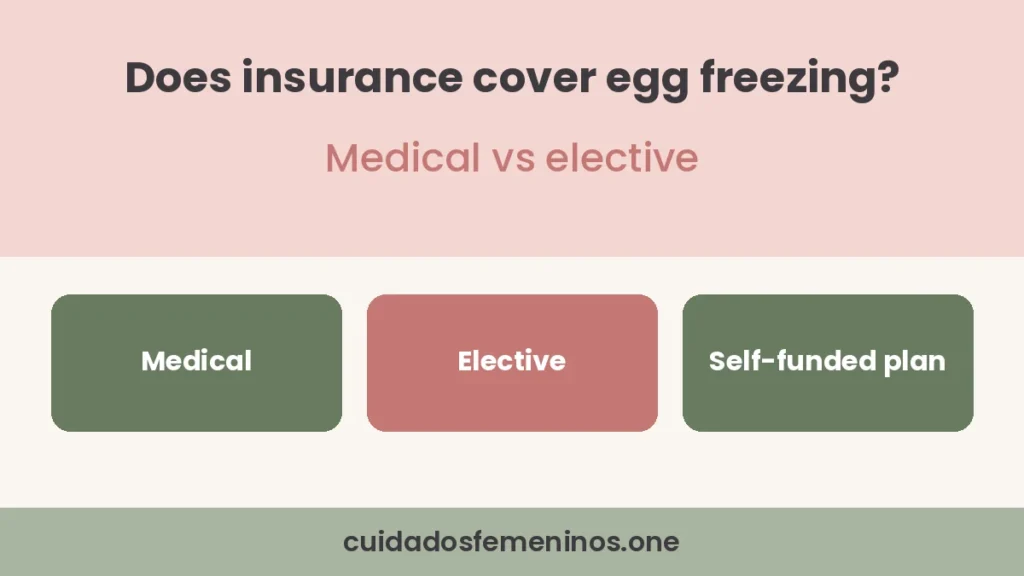
Does insurance cover egg freezing? If you're freezing eggs before cancer treatment or another treatment that can harm your fertility, there's a good chance it does, if you live in one of the states that require it and your plan is fully insured. If you're freezing eggs to have more time, regular health plans usually don't cover it, and your best shot is an employer fertility benefit. Here's how to tell which group you're in, what changes in 2027 and how to pay if you're on your own.
Open enrollment is when this matters most. It's the one time a year you can switch to a plan or add a benefit that covers it. For HealthCare.gov plans, the deadline for coverage that starts January 1 is December 15. Employer deadlines are often earlier.
- Quick answer: medical vs elective egg freezing
- Which states require insurance to cover egg freezing?
- Why your state law may not apply to you
- What's new for 2027: the proposed federal fertility benefit rule
- How much does egg freezing cost?
- How to pay for egg freezing if insurance won't
- 12 questions to ask HR or your insurer before December 15
- When to see a fertility specialist
- Frequently asked questions
- Does insurance cover egg freezing for non-medical reasons?
- Does Blue Cross Blue Shield cover egg freezing?
- How much does egg freezing cost without insurance?
- Can I use my FSA or HSA for egg freezing?
- Do state laws cover egg storage?
- Will the 2027 federal rule make my employer cover egg freezing?
- Why doesn't my state law apply to my plan?
- Are there grants for egg freezing?
- What happens to my frozen eggs if I change jobs?
- Should I freeze eggs before or after open enrollment?
- Sources
Quick answer: medical vs elective egg freezing
Insurers and state laws treat these two very differently, so start here.
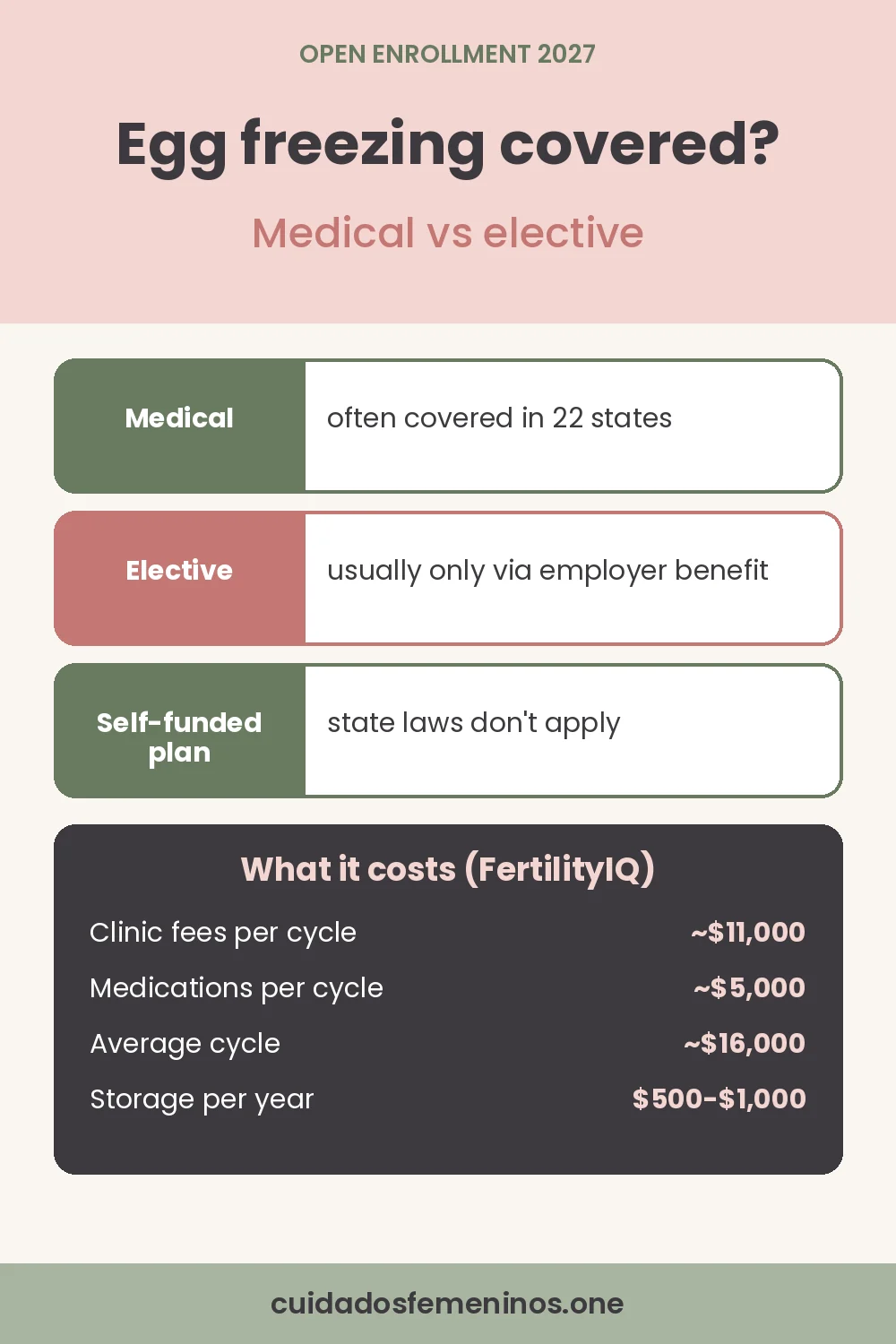
| Medical egg freezing (fertility preservation) | Elective egg freezing | |
|---|---|---|
| Why it's done | Before chemotherapy, radiation, surgery or other treatment that can cause infertility | To delay pregnancy for personal, career or relationship reasons |
| State laws | 22 states require fully insured plans to cover it, by RESOLVE's count | No state law we found requires plans to cover it |
| Where coverage comes from | Your medical plan, if your state requires it | An employer fertility benefit, if you have one |
| Storage | Often limited to 1 to 3 years, or excluded | Depends on the benefit |
| Using the eggs later | Usually a separate question, covered only if your plan covers IVF | Depends on the benefit |
Doctors call the medical kind fertility preservation for iatrogenic infertility, which just means infertility caused by a medical treatment. If that's you, ask your oncologist or surgeon for a referral to a fertility specialist before treatment starts. Time matters more than paperwork here.
Which states require insurance to cover egg freezing?
No federal law requires private health insurance to cover egg freezing. Some states do, mostly for medical freezing. KFF tracks which states require fertility coverage, and RESOLVE summarizes each law. These are the details we confirmed in RESOLVE's state pages, last checked October 27, 2026:
| State | Medical egg freezing (fertility preservation) | IVF and other notes |
|---|---|---|
| California | A basic health care service when a covered treatment may cause infertility; all plans except Medi-Cal and self-funded plans | Large group plans (more than 100 employees) must cover IVF from 2026: up to 3 egg retrievals, unlimited transfers |
| New York | Required in all commercial markets: individual, small and large group | Large group plans (100 or more employees) cover up to 3 IVF cycles |
| Illinois | Required for individual and group policies | Covers IVF in plans that include pregnancy benefits |
| Colorado | Required for large group plans (more than 100 employees) from 2023 | Large group plans also cover infertility treatment, including IVF |
| Delaware | Required in individual, group and blanket policies; includes egg, embryo and ovarian tissue freezing | Covers IVF |
| Georgia | Required for policies issued or renewed after January 1, 2026 | Plans can exclude storage beyond 1 year |
| Texas | Required before cancer treatment that can cause infertility | Doesn't include storage; insurers only have to offer IVF coverage to employers |
| Kentucky, Louisiana, Montana, Oklahoma, Nevada, Utah | Required, with different limits | Kentucky can exclude storage after 1 year; Louisiana after 3 years |
| Connecticut, Maryland, Massachusetts, New Hampshire, New Jersey, Rhode Island, Maine, Hawaii | Also have fertility preservation rules | Check RESOLVE for limits; Hawaii and Maryland exclude storage |
Florida added fertility preservation, including up to 3 years of storage, only for its state employee plan from 2026. If your state isn't listed, that doesn't always mean you have no protection. Laws change every year, so check KFF's state map or your state insurance department.
Why your state law may not apply to you
This is the part that surprises most people. State insurance laws only apply to fully insured plans, where an insurance company carries the risk. Self-funded plans, where your employer pays claims and an insurer just runs the paperwork, fall under the federal ERISA law instead. State mandates don't reach them.
That's most people with job-based coverage. KFF's 2025 employer survey found 67% of covered workers were in self-funded plans, including 80% at firms with 200 or more workers. So you can live in New York and still have no egg freezing coverage, because your employer chose not to add it.
How to tell which kind you have:
- Look in your Summary Plan Description. It usually says "self-funded," "self-insured" or "fully insured."
- Check your card. If it names your employer's plan and says an insurer only "administers" it, it's probably self-funded.
- Ask HR in writing: "Is our medical plan fully insured or self-funded?"
- Big employers with workers in many states are more likely to be self-funded.
If your plan is self-funded, the question isn't your state law. It's what your employer decided to include. We go deeper on this in our guide to whether insurance covers IVF, since the same trap applies.
What's new for 2027: the proposed federal fertility benefit rule
On May 13, 2026, the Departments of Labor, Health and Human Services and the Treasury published a proposed rule in the Federal Register (91 FR 27140, document 2026-09479). Comments closed July 13, 2026. It's still a proposal, not a final rule, and it doesn't require anyone to cover anything.
What it would do: let employers offer fertility coverage as a separate "excepted benefit," for plan years starting on or after January 1, 2027. Excepted benefits are exempt from many federal rules that apply to regular health coverage, which should make it easier for employers to offer a fertility benefit to more workers. Under the proposal, the benefit would have to:
- Cover substantially all infertility diagnosis, mitigation or treatment, given by licensed professionals.
- Have a lifetime limit of no more than $120,000 per participant, together with their beneficiaries, adjusted for medical inflation after 2027.
- Be a separate policy, or not an integral part of the main plan. The employer must also offer regular major medical coverage, but you wouldn't have to enroll in it.
- Come with a plain-language notice when you first can enroll, every year after that and on request.
What it means for you: if your employer adds a stand-alone fertility benefit for 2027, read whether it includes egg freezing, storage and medications. The Labor Department fact sheet has a short summary. The final rule, if there is one, could look different.
How much does egg freezing cost?
The CDC tracks fertility treatment outcomes but not prices, so the best numbers come from patient and clinic data. FertilityIQ puts the average cycle at about $16,000: roughly $11,000 in clinic fees and $5,000 in medications. Freeze, which compared prices at more than 500 clinics, found an average of $14,364 per cycle as of January 2025.
| Cost | Typical range | Source |
|---|---|---|
| Clinic cycle (monitoring, retrieval, lab work) | About $11,000 on average; $3,000 to $16,500 at individual clinics | FertilityIQ; Freeze, January 2025 |
| Medications per cycle | About $5,000 on average; most pay $3,000 to $6,000 | FertilityIQ; Freeze |
| Storage per year | $500 to $1,000; Freeze average $697 | FertilityIQ; Freeze |
| Using the eggs later (thaw, fertilization, transfer) | A separate IVF cost, paid when you use them | FertilityIQ |
Two things make the real total bigger than one cycle. FertilityIQ found the average patient does a second cycle, and more than 20% do a third. And storage keeps going every year until you use or discard the eggs. Moving eggs to an off-site storage facility can cut that fee, sometimes by half.
Ask every clinic for a written, itemized quote that separates the cycle, medications, anesthesia and storage, and ask how many years of storage are included.
How to pay for egg freezing if insurance won't
| Option | What it can cover | What to watch |
|---|---|---|
| Employer fertility benefit | A cycle, medications, storage or a dollar allowance | Read whether elective freezing is included and the lifetime limit |
| FSA or HSA | Medical expenses under IRS rules, including IVF and temporary storage of eggs | Elective freezing isn't addressed directly; you may need a letter of medical necessity |
| Clinic payment plans or packages | Cycle fees, sometimes medications | Get the interest rate and refund terms in writing |
| Personal loan or credit | Any out-of-pocket cost | Rates depend on your credit; compare the total you'll repay |
| Grants | Part of a cycle, medications or storage | Most are for cancer patients; elective cases rarely qualify |
IRS Publication 502 lists procedures such as IVF, including temporary storage of eggs or sperm, as deductible medical expenses for overcoming an inability to have children. That's why many FSA and HSA administrators accept fertility preservation claims. For elective freezing, ask your administrator before you pay. Our list of FSA eligible items for women explains how to spend what's left before your deadline.
For grants, Livestrong Fertility and The Chick Mission focus on people facing cancer treatment, and BabyQuest Foundation gives fertility treatment grants. The Alliance for Fertility Preservation keeps a broader list. If you're splitting the cost with a partner, our guide to a joint bank account for couples shows how to divide a big bill by income.
12 questions to ask HR or your insurer before December 15
- Is our plan fully insured or self-funded?
- Does it cover elective egg freezing, medical fertility preservation, or neither?
- If it's covered, what's the dollar limit and how many cycles are allowed?
- Are medications, monitoring, retrieval, freezing and storage included? For how many years?
- Do I need an infertility diagnosis or a letter of medical necessity?
- Are there age, marital status or other limits?
- Which clinics and labs are in network?
- How does prior authorization work, and how long does it take?
- Will we offer a separate fertility benefit for 2027?
- Can I use FSA or HSA money, and what paperwork do I need?
- Is there a fertility stipend outside the medical plan?
- What's the deadline to change coverage for next year?
Ask for the answers in writing. A screenshot of the benefits portal or an email from HR is far more useful than a phone call if a claim is denied later.
When to see a fertility specialist
- You're about to start chemotherapy, radiation or surgery that could affect your ovaries. Ask for a referral right away.
- You're 35 or older and thinking about freezing eggs.
- You have endometriosis, a family history of early menopause or have had ovarian surgery.
- You've been trying to get pregnant for 12 months, or 6 months if you're 35 or older.
A specialist can test your ovarian reserve and tell you how many eggs you might expect per cycle, which affects both the cost and whether freezing makes sense for you. If you're already pregnant and uninsured, start with our guide for when you're pregnant with no health insurance.
Frequently asked questions
Does insurance cover egg freezing for non-medical reasons?
Usually not. State laws that mention egg freezing almost all cover it only before treatments that can harm fertility, like chemotherapy. Freezing eggs to delay pregnancy is generally left to the plan or employer. Some employer fertility benefits do include elective freezing, so check your benefits portal and ask HR before open enrollment closes.
Does Blue Cross Blue Shield cover egg freezing?
It depends on the exact plan, the state and whether your employer is self-funded. A fully insured Blue Cross plan in a state with a fertility preservation law has to follow that law for medical freezing. Elective freezing is usually covered only if your employer added it. Search your plan documents for "fertility preservation."
How much does egg freezing cost without insurance?
FertilityIQ puts the average cycle at about $16,000, around $11,000 in clinic fees plus about $5,000 in medications. Freeze found an average of $14,364 per cycle across US clinics as of January 2025. Storage adds $500 to $1,000 a year, and many women do more than one cycle.
Can I use my FSA or HSA for egg freezing?
Often, yes. IRS Publication 502 counts procedures to overcome an inability to have children, including IVF and temporary storage of eggs or sperm, as medical expenses. The IRS doesn't address purely elective freezing directly, so administrators may ask for a letter of medical necessity. Confirm with your plan before you pay.
Do state laws cover egg storage?
Some do, for a limited time. Georgia and Kentucky plans can exclude storage after one year, Florida's state employee plan and Louisiana limit it to three years, and Texas doesn't require storage at all, according to RESOLVE. Ask your plan exactly how many years of storage it pays for, and get it in writing.
Will the 2027 federal rule make my employer cover egg freezing?
No. The May 2026 proposal would only let employers offer a separate fertility benefit, up to $120,000 per person, as an excepted benefit for plan years starting on or after January 1, 2027. It doesn't require any employer to offer it, and it's still a proposed rule, not a final one.
Why doesn't my state law apply to my plan?
Your plan may be self-funded. State insurance mandates only apply to fully insured plans. Self-funded employer plans fall under the federal ERISA law, and KFF found 67% of covered workers were in self-funded plans in 2025. Ask HR in writing whether your plan is fully insured or self-funded.
Are there grants for egg freezing?
Yes, but most are for cancer patients. Livestrong Fertility and The Chick Mission help people facing cancer treatment, and BabyQuest Foundation gives grants for fertility treatment. Elective freezing rarely qualifies. The Alliance for Fertility Preservation keeps a list of programs. Read each one's rules and deadlines before you apply.
What happens to my frozen eggs if I change jobs?
Your eggs stay where they are. The storage contract is usually between you and the clinic or storage facility, so you keep paying the annual fees even if your new employer's plan doesn't cover them. Ask the new plan whether it covers storage or later IVF with eggs frozen before you joined.
Should I freeze eggs before or after open enrollment?
If a better benefit starts January 1, it can be worth waiting so the cycle falls under the new plan. Check the start date, prior authorization rules and any waiting period first. If you're facing cancer treatment, don't wait for paperwork: ask your oncologist for a fertility referral right away.
This article is general information, updated November 2, 2026. It is not medical, legal or insurance advice. State laws and plan rules change, so confirm coverage in writing with your insurer or HR and talk to a fertility specialist about your own situation.
Sources
- Federal Register: Excepted Fertility Benefits, proposed rule, 91 FR 27140, document 2026-09479 (May 13, 2026; comments closed July 13, 2026)
- U.S. Department of Labor: fact sheet on the proposed excepted fertility benefits rule
- KFF State Health Facts: state infertility coverage requirements
- KFF: 2025 Employer Health Benefits Survey (self-funded plans)
- RESOLVE: insurance coverage by state (fertility preservation and IVF laws)
- FertilityIQ: the costs of egg freezing (patient-reported averages)
- Freeze: egg freezing cost guide, clinic price data as of January 2025
- IRS Publication 502: Medical and Dental Expenses (fertility enhancement)
- Livestrong Fertility: program for cancer patients and survivors
- The Chick Mission: fertility preservation grants for cancer patients
- BabyQuest Foundation: fertility treatment grants
- Alliance for Fertility Preservation: state laws and patient resources
- HealthCare.gov: open enrollment dates and deadlines
Keep reading
- Does insurance cover IVF? States, employer benefits and 2027 changes.
- FSA eligible items for women What you can still buy before the deadline.
- Pregnant with no health insurance Medicaid, CHIP and what to do this week.
- Joint bank account for couples Splitting big costs by income.
 Magnesium Glycinate in Pregnancy: Is It Safe, How Much (the 350 mg Rule) and Does It Help Leg Cramps?
 When to Take an Ovulation Test: The Right Cycle Day and Time of Day
 How Soon Can You Take a Pregnancy Test? A Day-by-Day Guide to Testing Early
If you want to read more articles like Does Insurance Cover Egg Freezing in 2027? State Rules, Employer Benefits and How to Pay, check out the Fertility, Pregnancy & Baby category.